
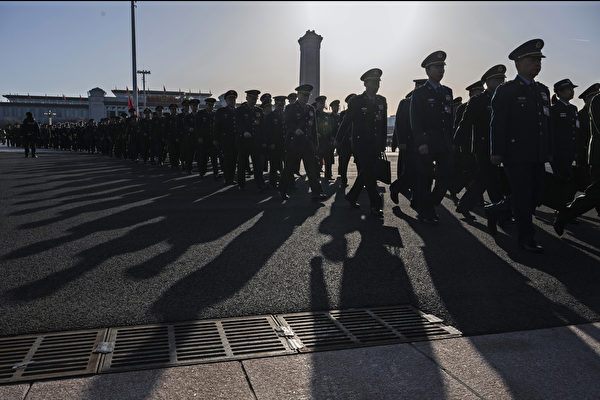
On January 24, 2026, Vice Chairman of the Chinese Communist Party’s Central Military Commission Zhang Youxia and Chief of Staff of the Joint Staff Department Liu Zhenli were officially announced to have fallen from power by the authorities. Analysts have pointed out that behind this sudden and significant political event, there may be deep-seated political maneuvering suggesting unprecedented uncertainty in Beijing’s political landscape.
The Chinese Ministry of National Defense announced on January 24 that Central Political Bureau Member and Vice Chairman of the Central Military Commission, Zhang Youxia, and Central Military Commission Member and Chief of Staff of the Joint Staff Department, Liu Zhenli, were suspected of serious violations of discipline and law, and have been placed under investigation by the central authorities.
An editorial in the People’s Liberation Army Daily, relayed by Xinhua News Agency, stated that Zhang Youxia and Liu Zhenli violated the principle of the Chairman’s responsibility system of the Military Commission, affecting the Party’s absolute leadership over the military, damaging the authority of the Military Commission, undermining the political ideological foundation of all military officers and soldiers, disrupting the political ecology and combat readiness construction of the military, and causing immense harm to the foundation of the Chinese Communist Party’s governance.
This announcement confirmed the rumors circulating on the internet and overseas media in the preceding days.
Previously, both Zhang Youxia and Liu Zhenli were absent from the commencement ceremony of the provincial-level and ministerial-level key leadership training session held on January 20, and they also did not attend the closing ceremony on January 23, leading to speculation about their rumored investigation.
Regarding the developments in the Chinese military, Shen Mingshi, a researcher at the Taiwan Institute for National Defense and Security Studies, analyzed that there has not been visible public support from the top ranks of the Chinese military for the highest leadership, nor any noticeable unusual troop movements, indicating that the situation still requires observation.
He specifically mentioned the movements in the Central Theater Command and the 82nd Group Army. Shen Mingshi assessed that some senior personnel in the Central Theater Command have complex backgrounds, and the 82nd Group Army is deployed around Beijing, suggesting that their command and obedience relationships could become significant variables in crucial moments.
Shen Mingshi pointed out that from a purely military power comparison perspective, the different security and field units are not completely equal, but whether a confrontation will occur depends on the political orders and the functioning of the military obedience system.
Overseas writer and independent commentator Chen Pukong stated in his online show that this notification presented three abnormal characteristics:
Firstly, it was rapid. In the past, when high-ranking officials in the Chinese Communist Party or the military got into trouble, it was often after a long period of disappearance, changes in duties, or indirect signals before being formally announced. However, the quick announcement of Zhang Youxia and Liu Zhenli being investigated in a short amount of time is a rare occurrence.
Secondly, it was direct. The notification did not use the language of “former position,” nor did it proceed by demotion or adjusting their status beforehand. Instead, it directly named their current positions and announced the investigation, breaking with the usual gradual disclosure.
Thirdly, it was a first-time occurrence. Whether before or after Xi Jinping’s leadership, the Chinese Communist Party rarely directly announced the current Political Bureau Member and Vice Chairman of the Central Military Commission being placed under investigation through a decision by the Party Central Committee.
Chen Pukong noted that the subject of the notification was not the Central Commission for Discipline Inspection or the Military Discipline Inspection Commission, but it was a decision made in the name of the “Party Central Committee,” which itself was abnormal in its procedural language. He believed that this unconventional approach revealed the tense state of operation of the high-level power structure in the Chinese Communist Party, showing that the infighting within the military ranks has become openly intense and urgent.
Economic researcher Su Xiaohe emphasized the severity of the situation in his online show. He also pointed out that the short time interval between the appearance of rumors and the official notification, differing from the customary rhythm of investigations into high-ranking military officials, indicated that the decision-makers may be facing a more urgent situation in their judgment.
He further analyzed that the speed of this notification, only a few days after the apparent disappearance of Zhang and Liu, far surpassed the handling process of previous cases such as that of He Weidong. The political arena is currently quiet, with no large-scale “stance wave” appearing after the notification, indicating that the eerie silence proves that various factions are still observing, and the truth is much more complex than the official statement.
Su Xiaohe pointed out that Zhang Youxia, as the most senior military general with deep ties to Xi Jinping dating back several decades, has had a longstanding “Yan’an faction” connection with the current top leader. While the Zhang family historically had a close relationship with the Xi family, in the face of political power, these deep personal relationships have apparently been completely severed.
He said that this unconventional move reflects that “Old Xi and Old Zhang are completely at odds,” and the two sides have entered a “fight to the death” confrontation. In his view, this rapid characterization of events is a politically aggressive move, with the Xi administration aiming to establish a predetermined fact through public opinion using this official announcement.
Su Xiaohe described this event as one of the rare military and political upheavals since the Lin Biao incident in 1971, believing that its potential impact is not limited to personnel matters but could also have spill-over effects on political and economic expectations. In an environment of high uncertainty, certain factions within the Party may try to influence future developments through strong bargaining tactics, and the outcome is still subject to further observation.
Chen Pukong concluded that this official announcement is not just an anti-corruption or disciplinary investigation but also an external manifestation of a drastic reorganization in the Chinese Communist Party’s power structure. The subsequent course of events will depend on whether there will be resistance within the military, whether the Party can maintain surface stability, and whether the top leadership can effectively control the chain reactions resulting from this decision.