
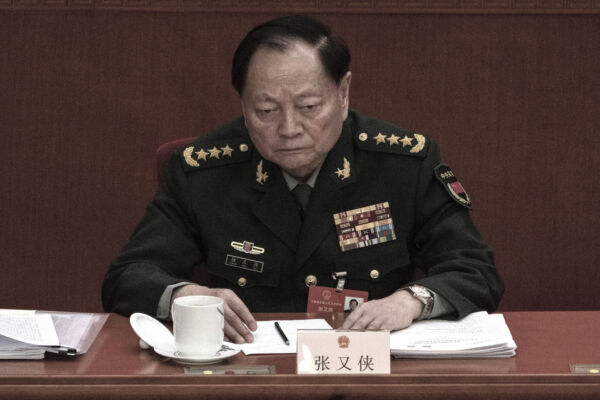
On January 24, the Ministry of National Defense of the Chinese Communist Party (CCP) suddenly announced that Zhang Youxia, Vice Chairman of the Central Military Commission, and Liu Zhenli, Chief of Staff of the Joint Staff Department of the Central Military Commission, were suspected of serious violations of discipline and law. After research by the Party Central Committee, it was decided to investigate Zhang Youxia and Liu Zhenli.
The news of Zhang Youxia being taken away for investigation began circulating online on the 20th, and his official announcement marks one of the quickest falls among the disgraced generals in the past.
At the time of his arrest, the popular overseas drama “The End of Winnie” was airing, depicting a coup in the South China Sea where General Zhang, unable to tolerate anymore, gathers troops to capture the dictator “Winnie” sitting on the dragon throne, a term used colloquially for the CCP leader.
The coincidence of events suggests that Zhang Youxia’s arrest may not have been a result of careful planning but rather a rash decision.
Analysis points out that the emphasis in Zhang Youxia’s case lies not in the “suspected serious violations of discipline and law” but in the fact that it was decided “after research by the Party Central Committee.” This statement typically appears only in three instances: involving high-ranking officials, relating to systemic political security, or requiring approval from the highest levels. This implies that the investigation followed a political conclusion rather than standard procedure.
Zhang Youxia, 75 years old, is comparable to Mao Lin in terms of his military position, background, and relationship with Xi.
Overseas opinion indicates that the impact of this event can be compared to the “Lin Biao Incident” and the “Wang Lijun Embassy Escape,” two rare “accidental events” in history that led to significant changes in China’s political landscape.
Victor Shih, a China studies expert at the University of California, San Diego, expressed shock at the news, emphasizing that corruption alone cannot explain everything, questioning the implications of Zhang’s removal on the military.
Zhang and Liu’s faction of Vietnam War veterans is likely to face purging, raising concerns as they represent some of the last military officers with combat experience. The removal of such a deeply rooted faction will have ripple effects on various military circles and groupings.
Since taking office in 2012, Xi Jinping has been engaged in a near civil war with the military, having purged over a hundred senior military leaders, including four vice-chairmen of the military commission, leaving only Zhang Shengmin in the current Central Military Commission.
The extent of this military purge is unprecedented, surpassing even the Cultural Revolution and the Soviet Great Purge. Therefore, Xi is often compared to the last Ming emperor, Chongzhen.
Chongzhen was known for being ruthless and authoritative, changing 14 generals in 17 years, ultimately leading to the fall of the Ming Dynasty and his own demise.
This seemingly autocratic power structure, lacking trust in the bureaucratic system and society, appears fragile and vulnerable, as social backlash and disappointment in governance could ensue.
As the situation escalates, China’s political landscape may head into uncharted territory, descending into turmoil and uncertainty.
Gordon Chang, a prominent China expert, warns of the turmoil in China, urging other regions to remain vigilant.
Henry Gao, a professor at Singapore Management University, discusses the logic of dictatorial rule and the consequences of absolute power, stressing the need to eradicate potential threats within the regime to maintain control.
The events surrounding Zhang Youxia highlight the clash between different logics within the military, posing risks to military decision-making, operational efficiency, and strategic judgment.
Ordinary people are impacted as well due to the deterioration of the military’s overall judgment, leading to emotionalized diplomacy and reduced policy effectiveness.
The consequences of these shifts will filter down to various aspects of society, influencing areas such as currency valuation, employment, military recruitment, social control measures, and even external conflict risks. Ignoring the political landscape will not shield individuals from its effects.
The removal of Zhang Youxia raises concerns about free expression and independent thinking within the military, as divergent opinions could be perceived as threats in a system that demands absolute loyalty and conformity.