
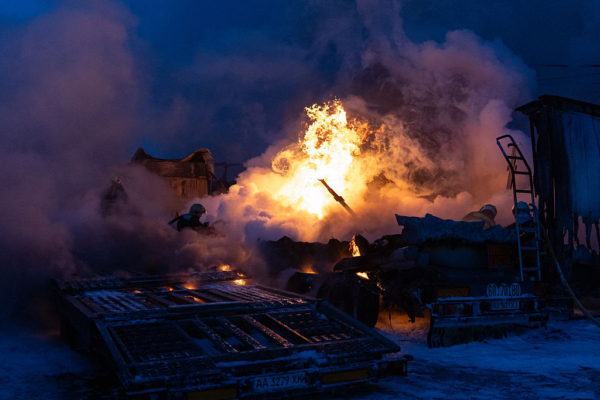
On Saturday, January 24, Vitali Klitschko, the mayor of the Ukrainian capital Kiev, stated that Russian forces launched early morning attacks on Kiev and the northeastern city of Kharkiv, resulting in multiple injuries and causing nearly 6,000 buildings in Kiev to lose heating.
Previous attacks had already disrupted the city’s centralized heating system, and emergency responders had just managed to restore heating. This latest large-scale attack by Russia on the energy system left Kiev echoing with explosions throughout the night, with temperatures hovering around -10°C in the harsh winter, leading to another breakdown in heating services.
In fact, since the Russian invasion of Ukraine, Russia has been targeting Ukraine’s energy, internet, and transportation infrastructure. This winter, Russian forces continued to heavily bombard energy facilities, leading to people across Ukraine having only a few hours of electricity supply each day, with some facing the dilemma of being without heating or water.
Regarding casualties, Mayor Klitschko reported one fatality and four injuries in Kiev, with three individuals receiving hospital treatment, while in Ukraine’s second-largest city of Kharkiv, 19 people were injured, including one child.
This is the second major nighttime attack Kiev has faced since the new year. Deputy Prime Minister Oleksiy Kuleba stated that the attacks left over 800,000 people in Kiev and 400,000 people in the northern Chernihiv region without power.
Overhead in Kiev, flashes of orange lightning periodically illuminated the sky as air defense forces fired at incoming missiles and drones, with huge explosions echoing between the city’s tall buildings. The Ukrainian Air Force reported that Russian forces deployed 375 drones and 21 missiles in this attack, including 2 rare “Zircon” hypersonic ballistic missiles.
Kiev’s military administrative chief Tymur Tkachenko reported that at least 4 areas were targeted in the attack, with a medical facility also being damaged.
Located 30 kilometers from the Russian border, Kharkiv frequently faces drone attacks due to its proximity to the eastern front. Mayor Ihor Terekhov stated that 25 drones attacked multiple areas within the city, damaging facilities including a displaced persons’ shelter, a maternity hospital, and a medical facility.
(Information sourced from Reuters reports)