
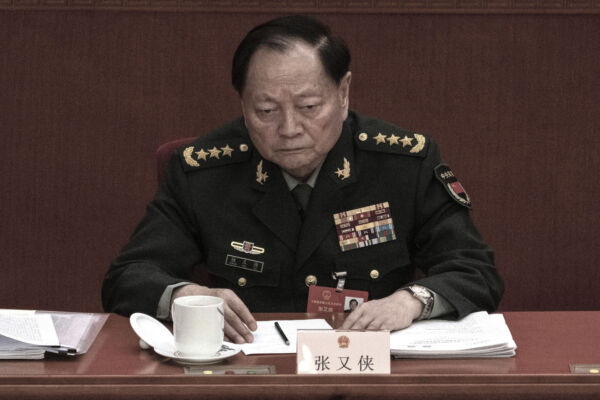
January 24, 2026 Epoch Times News: Chinese Communist Party Central Military Commission Vice Chairman Zhang Youxia was absent from the opening ceremony of the “Provincial and Ministerial Level Leading Cadres” seminar held at the Central Party School recently, sparking continuous rumors online about his arrest, but it cannot be confirmed at the moment. This situation mirrors the opaque state of affairs seen in recent years with the CCP’s anti-corruption campaign. Two Taiwan experts pointed out that this incident confirms the drawbacks of the CCP’s leadership and its dark system.
Zhang Youxia, who was absent from the opening ceremony of the CCP’s provincial and ministerial level officials’ “special seminar” on January 20, continued to be absent from the closing ceremony of the seminar on January 23. During this time, overseas rumors claimed that Zhang Youxia and 17 other senior generals had been arrested, likened to a “major military upheaval!” Some overseas netizens believe in the possibility of these rumors, while others express skepticism. As usual, the CCP has not provided any response.
Taiwan think tank consultant Wu Se expressed in an article on the Taiwan Central Broadcasting Corporation’s website on the 23rd that the absence of Zhang Youxia and Military Commission member Liu Zhenli at the meeting was indeed unusual. Over the past year, there have been unusually frequent personnel changes in the military, leading to high levels of speculation from the outside world.
Wu Se pointed out that the power structure of the CCP’s party, government, and military is becoming increasingly uncertain. Under the logic of the CCP’s “party leading the military,” the anti-corruption actions against military leaders lack transparent procedures and independent oversight mechanisms. Even for the highest-ranking generals, it has become common for them to suddenly “disappear” without any public explanation. Under a system of high centralization, information control, and politicized anti-corruption efforts, deciphering the operation of CCP military power has become increasingly difficult.
The article stated that the spreading rumors of Zhang Youxia’s arrest also reflect the contradictions in the CCP’s internal rule. While the authorities attempt to suppress any information detrimental to regime stability through strict control of public opinion, the extreme singularity and lack of credibility in official information actually lead to various unusual situations being scrutinized, speculated upon, and even magnified. Such situations are likely to occur more frequently as the CCP’s 21st National Congress approaches in 2027.
Assistant Professor Hong Yaonan from Tamkang University’s Department of Diplomacy and International Relations analyzed in an article on the Newtalk News website on the 23rd: “Is Zhang Youxia in trouble?”
Hong Yaonan believes that the seeds of this struggle within the military were sown as early as 2023. On July 26 of that year, the Central Military Commission’s Equipment Development Department issued a notice to collect clues of irregularities in military equipment procurement since 2017, and the starting point of the corruption investigation was precisely when Zhang Youxia handed over the department to Li Shangfu. The time cut-off of “not pursuing predecessors” was interpreted as Xi Jinping’s “protecting Zhang, stabilizing military morale.”
The article argues that this granted Zhang Youxia a period of respite and space for counterattacks, leveraging his deep connections cultivated over many years in the military. Subsequently, heavyweight generals like Miao Hua and He Weidong fell one after another. However, in August 2025, the Rocket Army Logistics Department issued as many as 180 penalty notices on the “military procurement network,” with violations tracing back to as early as 2016—Zhang Youxia’s final year in charge of the equipment department. This indicates that the originally set “protection time limit” for Zhang had been breached.
Hong Yaonan stated that Zhang Youxia seems to have the power to counterattack in the short term, challenging Miao Hua and He Weidong, showing that his influence in the military still exists, but he is also challenging Xi’s authority and may not be able to avoid being “purged.”
However, Hong Yaonan believes that the deeper crisis within the CCP lies in the system itself. Xi Jinping has no successor and tolerates no challenges. He wants power to be concentrated but distrusts all potential successors deeply. Mao Zedong designated successors only to later denounce them—an echo in Xi’s political shadow. Yet Xi’s choice is to replay the tragedy of institutional blockade: no term limits, no succession plan, no accountability. In such a system, mistakes cannot be corrected but only covered up; loyalty becomes the only currency, and suspicion becomes the norm of governance.
He concluded by saying that the real question should not be “Will Zhang Youxia get into trouble,” but rather, in such a system, who can avoid trouble? Observational indicators at the upcoming several high-level CCP meetings, not just Ma Xingrui but also Zhang Youxia, will shed light on this.
At the CCP’s Fourth Plenary Session of the 20th Central Committee in October last year, the authorities openly dealt with a large number of leaders, including former Vice Chairman of the Military Commission He Weidong and Military Commission member Miao Hua. They were considered close to Xi Jinping but were denounced by the CCP’s military media as corrupt and disloyal.
Subsequently, on November 12 of the same year, the CCP’s official newspaper People’s Daily published an article about Zhang Youxia, mentioning “Xi Jinping” or “Chairman Xi” at least 20 times throughout the article. Zhang Youxia praised “Chairman Xi’s creative proposal to comprehensively strengthen military governance,” emphasizing the need to resolutely prevent being “two-faced” and practicing false loyalty.
Current affairs commentator Li Linyi at the time told Epoch Times that this might be Zhang Youxia’s superficial effort under internal power struggles, intentionally dispelling rumors. Recently, there have been widespread rumors about his rise and dominance within the military.
Li Linyi pointed out that the CCP system itself creates “two-faced individuals,” such as He Weidong earlier this year praising Xi’s ideology at the Military Discipline Commission’s expanded meeting, similar to Lin Biao’s loyalty to Mao Zedong before being reported to flee the grimm. Zhang Youxia’s current political stance may not hold weight at crucial moments, as he may either be abandoned by Xi or turn against him.