
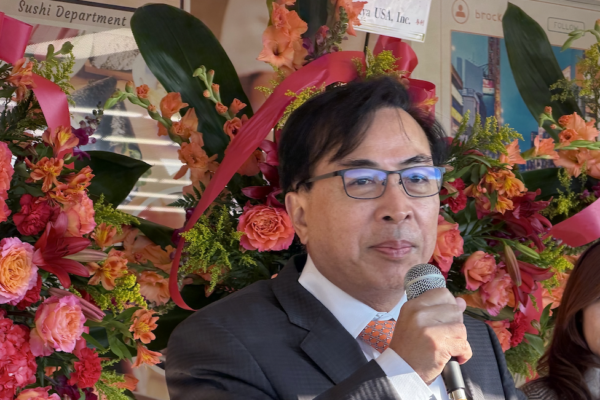
Silicon Valley entrepreneur Hu Limin has successfully ventured into the physical supermarket industry in the competitive Bay Area market. He believes that the key to running a supermarket is not about chasing competitors, but rather about clear positioning, delivering top-notch product quality, and sharing the fruits of entrepreneurship.
Hu Limin told Dajiyuan that initially, he only wanted to build a stable “retirement income type business”, but after practical operation, the team has discovered a highly competitive “Secret Sauce”. It has a healthy profit structure and a replicable and expandable business model. Therefore, the next strategy is to re-finance, comprehensively deploy in the Bay Area market, first gain scale and advantages, and then further expand outward.
Facing major Asian supermarkets such as H-Mart, 99 Ranch, Mitsuwa, and other Korean and Japanese supermarkets that have successively entered the Bay Area, Hu Limin emphasized that he has never focused on “how to defeat the opponent”, but rather focused on finding his own path.
“By dominating the entire Bay Area market, there will be enough volume and customer base, making it difficult for others to compete.”
In terms of actual layout, the third store has been confirmed to be located in Pleasant Hill, with a size of about 40,000 square feet, investing millions of dollars in renovation, and is expected to open in the second half of this year, after summer. In addition, a smaller branch will also be opened in San Jose, and multiple locations are still under negotiation.
Hu Limin believes that the core competitiveness of physical retail ultimately returns to the product itself. He emphasized the importance of selling only the freshest fish as a golden rule in the operation: if it cannot be sold early, it is directly scrapped. With a stable customer base now, the products are almost sold out every day, requiring multiple replenishments, creating a positive cycle.
“If the fish isn’t fresh, customers will only come once; the harder it is to sell, the more discounts you offer, leading to a vicious cycle.” Hu Limin pointed out that as long as high quality, freshness, and reasonable prices are maintained, consumers will naturally increase.
This operating model also brings spillover effects to the business district.
He cited the example of Fremont, where after the store opened, the nearby businesses’ revenue grew simultaneously, with some store owners saying, “With the increase in foot traffic, the entire commercial area has come alive.”
Using Foster City as another example, he mentioned that before entering, the area had few visitors and many stores closed, forming a vicious cycle. After the new supermarket opened, it quickly attracted traffic back, revitalizing surrounding restaurants and other retail stores simultaneously.
“In a place with no people, all stores cannot survive; but when we come in, it’s like injecting a new vitality, and the entire business area comes alive.” He said that the Foster City government and Chamber of Commerce did thorough research beforehand and actively provided support, with mainstream media assisting in promotion, becoming a successful case of public-private cooperation.
Hu Limin said this is a typical Win-Win-Win model: company revenue grows, city taxes increase, the government can give back to citizens, and suppliers and partners can also expand their market share.
As the brand stands firmly, more and more suppliers consider Osaka Supermarket as their most important partner. “If you want quality products, you must have a quality supply chain.” Hu Limin said that only by establishing long-term trust with the best suppliers can the freshest and best ingredients have stable supply.
Now, with each new store opened, a whole group of suppliers and partners often “follow along,” forming a replicable and expandable ecosystem.
Regarding AI and technology application, Hu Limin admitted that he has also made mistakes in the past. He early on introduced robots, electronic ordering, and systems into the supermarket, but found limited effectiveness. He cited a study from MIT, saying that 95% of AI enterprise applications ultimately fail, because implementing AI involves not only technology but a comprehensive change in people, culture, and processes.
“AI will definitely change the business, but not today, and not tomorrow. It’s a process of ten years.” He said that many physical industries are not yet ready at this stage, and overly complex systems may reduce efficiency. However, he is optimistic that the next wave of AI will gradually penetrate the core of enterprises, bringing new entrepreneurial opportunities.
Hu Limin said that his true understanding of the “entrepreneurial spirit” did not come from high-tech companies, but from years of involvement in the non-profit organization “Friends of Chinese Special Children”. In the non-profit organization, despite no high salaries, it can attract volunteers to invest a lot of time. This has made him deeply understand the importance of mission, cohesion, and leadership.
He has brought such ideas into business operations, emphasizing “giving ownership to employees,” so that everyone can participate in the results and truly stimulate motivation. Therefore, he plans to view supermarkets as a startup-type enterprise in the future, allowing senior executives to share equity and share results.
“Earning money is not the goal; making a business successful and allowing more people to grow together is the greatest reward.” Hu Limin concluded.
In addition, Hu Limin also touched on the potential and responsibility of the Chinese community in American society. He pointed out that the Chinese community itself has many advantages, with most people being hardworking, intelligent, and possessing good economic capabilities. If they can further strengthen cooperation with each other, they will be able to have a greater positive impact on American society.
Now, he is actively involved in community affairs, supporting Chinese participation in politics, and speaking out for their own rights; Hu Limin emphasized that only by working together can the Chinese community walk more steadily and further.