
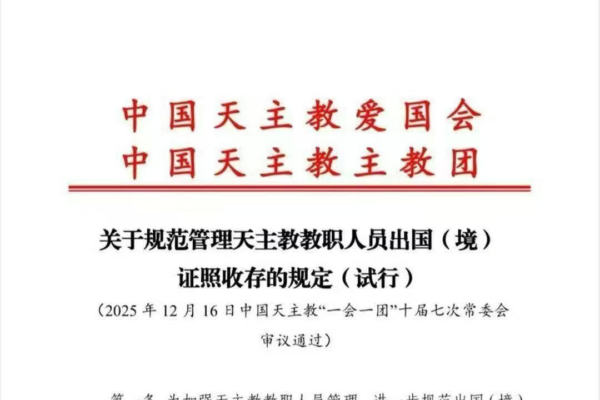
On December 16, 2025, the Chinese Patriotic Catholic Association and the Chinese Bishops’ Conference jointly passed an internal management regulation requiring unified storage and strict approval of the exit permits for Catholic clergy across mainland China. Some Christian believers have indicated that they have also heard that the Three-Self Patriotic Movement church is discussing a similar model, but specific details are not yet known.
The document titled “Regulations on the Standardized Management of Catholic Clergy’s Exit Permits (Trial)” indicates that Catholic clergy under the control of the Chinese Communist Party have been formally incorporated into a “quasi-cadre-style management” system similar to that of CCP officials at the institutional level.
According to the content of the document, including bishops, priests, deacons, and nuns, all Catholic clergy must submit their regular passports, Hong Kong and Macau travel permits, and Mainland residents’ travel permits for Taiwan to the Catholic “two conventions” or diocese for centralized storage. Clergy members are not allowed to hold the permits themselves. Whether for official or personal reasons, if they need to go abroad, they must apply in advance and obtain approval from the relevant authorities before they can receive the documents for visa processing. Upon returning to China, they must return the permits within seven days, fill out a reporting record form and follow-up form to confirm their return.
This entire process is almost identical to the outbound management of government officials, CCP cadres, and executives of state-owned enterprises by the CCP: centralized storage of passports, outbound approval, and registration upon return, where the entire itinerary can be traced and monitored.
For a long time, the Chinese Communist Party has used control of exit documents to prevent and control personnel outflows, restrict external contacts, and see it as an important governance tool. Now, this model has been fully transplanted into the Catholic system, indicating that clergy members are no longer viewed simply as religious figures but rather integrated into a management system with clear political attributes.
The restrictions on clergy members’ “private travels” outlined in this internal document are particularly stringent. It stipulates that if clergy members need to go abroad for personal reasons, they must submit a written application at least thirty days in advance, detailing travel arrangements, reasons for travel, duration of stay, and a list of individuals, and must sign a commitment letter. Only after approval by the competent authorities can they proceed. The document also specifies that they are not allowed to change their travel plans or overstay during their trips. The terms indicate that the concept of “private” has become highly bureaucratized, further limiting individual space.
The document also outlines penalties for clergy members who fail to submit permits as required, change itineraries without approval, overstay, or refuse to return the documents. Depending on the severity of the situation, they may receive admonitions, temporary suspension of document processing, or even face “serious consequences” in accordance with the regulations of the national religious affairs department and the church.
A clergy member named Wang from Saint Anthony’s Church in Shenzhen, a Catholic church, told the Epoch Times that as a universal religion, Catholicism’s church structure and clergy training have long been based on cross-border exchanges. He expressed, “Participating in overseas conferences, priests studying theology, nuns engaging in international group activities were all normal within the Catholic system. However, now needing to surrender passports makes people feel controlled.”
While the document is issued under the name of “China’s Catholic Association and Bishops’ Conference,” and not an official Chinese legal document, its language, approval mechanism, and responsibility allocation closely resemble administrative documents of the CCP political system. Terms such as “approval by competent authorities,” “layered responsibility,” “commitment letter,” and “report form” which are typical terms in the CCP governance system, indicate that the Chinese Patriotic Catholic Association and the Bishops’ Conference are deeply embedded in the CCP’s religious management system in practice.
It is worth noting that the document is labeled as a “trial”. In the context of CCP governance, “trial” often implies paving the way for long-term implementation. Once the relevant measures run smoothly, it is not excluded that they may be solidified into a regular system in the future or even replicated in other religious systems.
A Christian in Hangzhou, Zhejiang, told reporters that he has also heard that the Three-Self Patriotic Movement church is internally discussing a similar centralized management system for exit permits. However, specific details have not been publicly disclosed. He expressed, “Now, various religious systems are being managed under a single model, starting with Catholicism. Whether it will extend to Christianity is something that many people are aware of and concerned about. I heard about it from a coworker.”