
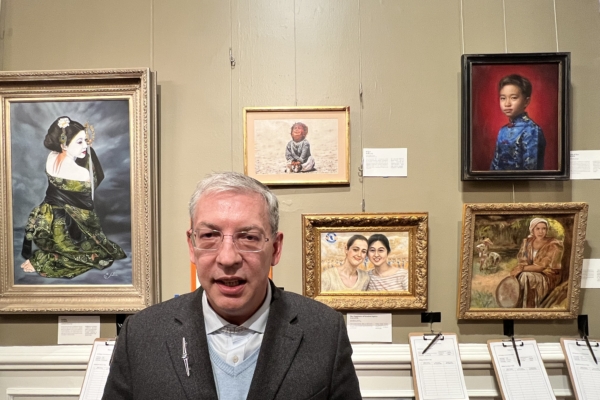
On the evening of January 20, the finalist exhibition of the 7th NTD World Figure Realistic Oil Painting Competition in 2025 opened at the Salmagundi Club in Manhattan, New York. René Cheng, a painter from Mexico, participated in the competition with a piece titled “Why?”
According to Cheng, participating in the competition was not just a challenge to his realistic painting technique, but also a creative journey from “pursuing beauty” to “awakening awareness.”
Cheng described “Why?” as depicting a three or four-year-old, dark-skinned boy crying in a desolate and impoverished environment due to fear, hunger, and thirst. He explained that this imagery symbolizes the neglected groups in society and the continued existence of injustice and suffering.
Through this artwork, he aims to provoke viewers with a direct and heavy question: why does such a reality persist? He emphasized that this is not to create despair but to make people realize the significance of every choice.
Reflecting on his creative process, Cheng shared that in his early years, he focused more on the form and visual “beauty.” Growing up in the vibrant culture of Mexico, with its colorful architecture, festivals, traditional attire, and folk art, greatly influenced his style. “Vibrant colors are usually my artistic statement,” he said.
However, as life experiences accumulated, he gradually realized that art should not only celebrate the beauty and brightness of life but also have the responsibility to present the flaws and hardships of reality, giving voice to the marginalized and voiceless.
“I believe some people live in awareness, while others do not,” Cheng said, highlighting that humans are always making choices between light and darkness. He stressed that art is not just a decorative presence but a force that triggers introspection and moral reflection, reminding people to take responsibility for themselves and society.
In his view, the role of art is to guide people back to universal values transcending cultures and eras, such as love, peace, kindness, courage, and empathy. “We all crave dignity and understanding, regardless of where we come from,” he said.
Cheng also discussed the influence of the market and commercialization on contemporary art. He gave examples of how some creators repeatedly replicate the same images of a popular theme because it sells well, and galleries even request the same piece to be painted in different colors. He argued that this approach veers art into a craftsmanship rather than true artistic expression.
He believed that genuine art must be original, unique, and carry the creator’s life experience and emotional energy; that is where the value of the work lies.
He expressed gratitude to the NTD World Figure Realistic Oil Painting Competition for providing artists with a path different from market-driven approaches, one that values spiritual depth and moral substance over repetition and duplication. He agreed with the competition’s advocacy for “purity, goodness, and beauty” and believed that such a purpose offers a platform for contemporary art to return to its inner essence and values.
In his eyes, realism is a rare and often underestimated skill that not only requires keen observation and discipline but also embodies the artist’s passion, love, and soulful dedication.