
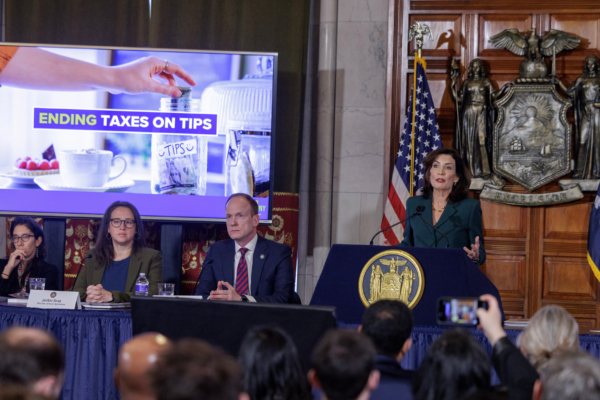
New York Governor Hochu announced the 2027 fiscal year (2026-2027) administrative budget on January 20, with a total size of approximately $260 billion, surpassing the previous fiscal year’s $252 billion to reach a new high. The state government emphasized that due to the growth in tax revenue driven by Wall Street bonuses and stock market performance exceeding expectations, there are no plans to increase individual income tax rates. Instead, new funds will be prioritized for investment in childcare, education, healthcare, and to prepare for possible reductions in federal funding.
Blake Washington, the Executive Director of the New York State Budget Office, stated that New York State’s relatively progressive tax system, coupled with sustained consumer spending and positive expectations for Wall Street bonuses, enables the state to support increased expenditures without the need for tax hikes.
In terms of tax arrangements, the new budget does not raise corporate business tax or general income tax rates but introduces several adjustment measures, including: (1) extending the 7.25% corporate tax rate for three years until 2029; (2) exempting tips from state income tax, effective for the 2026 tax year.
Childcare is a significant focus of the new budget. Hochu plans to allocate approximately $500 million to support pre-K education for 3 to 4-year-old children statewide. The total investment in childcare and early education across the state amounts to $4.5 billion, with a target to achieve universal pre-K education for 4-year-olds by 2028. Additionally, funding support will be provided for the New York City’s “2-Care” program, offering free childcare for 2-year-old children.
However, concerns have been raised about the long-term stability of funding for the expansion of childcare. The advocacy group “Invest in Our NY” pointed out that without a “stable and predictable” long-term funding source, achieving universal childcare and improving childcare staff salaries may still face challenges. Furthermore, as the rollout of the free childcare program for 2-year-olds progresses annually, expenditure levels are expected to rise rapidly, adding pressure to future budgets.
On the healthcare expenditure front, spending on New York State’s Medicaid program is set to increase significantly by 11.4%. The state government explained that part of the increase is to offset federal cuts. The governor stated that federal funding in this budget is reduced by approximately $10.3 billion (about -11.4%) compared to the previous year, which includes the expiration of pandemic-related aids and structural impacts on medical expenses. She attributed this to the policy shift in Washington and mentioned that the state government has taken legal actions to block further cuts but still needs to bear some costs.
The 2027 new fiscal year budget must be negotiated with the state legislature by April 1st, as in past years, the New York State budget has faced challenges as policy provisions attached to it led to disagreements with the state legislature. If the deadline is not met, the state government may resort to short-term funding measures to maintain government operations.
Following the announcement of Governor Hochu’s new fiscal year administrative budget on Tuesday, New York City Mayor Mamdani promptly issued a response statement, acknowledging the state’s fiscal prudence and investment in early childhood education services. However, due to significant fiscal deficit resulting from the previous city administration’s financial mismanagement, Mamdani advocates for fair taxation on the wealthy and large corporations to protect the standards of working-class families and public services.