
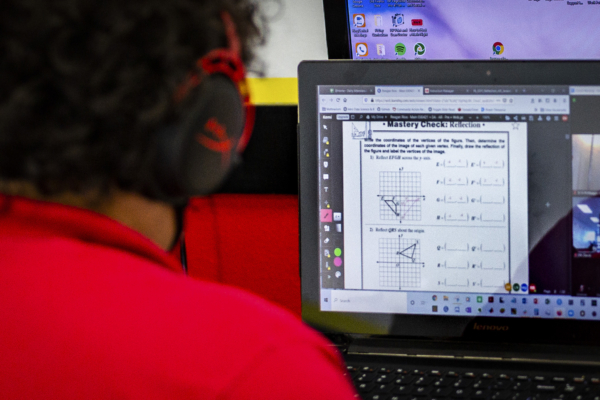
Many K-12 education policy experts predict that the coming year will be a pivotal moment for public schools to reevaluate their expensive and ineffective educational technology vendor contracts, possibly reducing the screen-centric learning approach.
Virginia Gentles, Director of Parental Rights at the Defense of Freedom Institute, said that while states and school districts made significant strides in 2025 to eliminate distractions caused by students using phones in classrooms, the nearly $190 billion in federal pandemic relief funds have been depleted, and there is still a long way to go to make up for learning losses during the COVID-19 pandemic.
“We’re not done yet,” she told a reporter from Dajiyuan, “We are just beginning to address the issue of children’s attention being commodified.”
Gentles suggested that the next major focus should be on laptops or other internet-enabled tools, noting that 90% of K-12 districts either distribute devices to each student or allow students to bring their own.
She pointed out that the one-to-one device policy quickly became widespread during the pandemic as schools were closed for extended periods and was supported by federal funding for continued distance learning, yet since the policy’s implementation, test scores in various states have continued to decline.
Additionally, Gentles indicated that older students could use social media and sports betting applications on laptops similarly to phones, while young children who have grown up with devices since birth struggle with even writing English letters on paper.
“Now is the time to abandon this idea. 2026 is the year to reassess it,” she said.
Gentles anticipates testifying before congressional committees and participating in public roundtable discussions at policy research centers on this issue in the new year. Once public attention increases, legislation will follow, much like the restriction on phones.
She does not advocate for a complete ban on students using laptops but believes there should be more emphasis on returning to more paper-and-pencil work in the classroom, increasing cooperative learning, and reducing screen time for students.
Gentles gave a “C” grade to most public schools’ one-to-one device policy, citing risks such as increased costs, cheating, plagiarism, addiction, corruption, and commodification. “The problem is not technology itself,” she said, “but the ubiquity of technology.”
Across various news headlines in the United States, the implementation and continuation of the one-to-one device policy have not been without issues. Many districts face challenges in device management, maintenance, and upgrade costs, exacerbated by the lack of ongoing federal funding support.
Bryce Fiedler, Director of the Carolina Academic Leadership Network, believes it is time to “end the Chromebook experiment.” He mentioned the dual issues of cost and educational quality, stating, “We cannot expect an 8-year-old to take care of a laptop properly. This creates 24/7 screen time on a learning level, something unprecedented in human history.”
Fiedler referenced a 2024 meta-analysis showing that students consistently scored higher on comprehension tests when reading printed materials compared to screen-based content, indicating that digital reading can result in lower information retention and understanding levels.
In Burke County School District in North Carolina, the school board passed a non-binding resolution before the school year began, requiring teachers to integrate digital instruction with face-to-face activities, like group discussions, after a daughter in elementary school revealed most of her instructional time was spent on screens.
As concerns grew among other parents, Jamie Wycoff, a school board member, made this suggestion. The initiative was well-received by teachers and students, leading to connections with educators in eight other states and introduction at the state education organization in Washington.
Joe Wilson, a school board member from Southern York County School District in Pennsylvania, mentioned that they are gradually phasing out the Chromebook program for grades K-4 this school year and adopting a more balanced approach to technology integration, ensuring digital learning no longer dominates instruction.
Currently, two students share one laptop, and devices cannot be taken home. Wilson stated that this change promoted collaboration and group teaching among students.
“Digital learning hasn’t met people’s original expectations,” he said, noting that the district had implemented a one-to-one device policy before the pandemic, with test scores either stagnating or declining in multiple grades.
States and districts hastily spent federal relief funds on laptops, software, and other digital learning tools during the pandemic, signing multi-year contracts with educational technology vendors. As many schools’ five-year contracts are set to expire between 2026 and 2027, it is now the time for K-12 leaders to pause and reconsider.
While many devices come with protective filters to block students from accessing specific websites, some vendors fail to adequately protect student privacy. A report by the Internet Safety Labs in August highlighted that schools were using double the number of off-the-shelf applications compared to authorized ones, potentially compromising privacy and increasing targeted advertising when students create accounts without school authorization.
Megan Kaul, a mother of two from Seattle and a member of the Mothers Against Media Addiction organization, revealed that she refuses to let her third-grade daughter use school-supplied devices due to privacy concerns. Her daughter completes some writing assignments in class on an open-access laptop and insists on using books or printed materials for reading tasks instead of screens.
“Reading through an app is pointless,” Kaul said, “especially when so many books and library resources are underutilized.”
She also expressed frustration upon hearing from older students that in science class, they only watch videos of experiments rather than performing hands-on activities themselves. “Using authentic materials for practical learning is always better,” she said. “We have exaggerated the concept of technology.”