
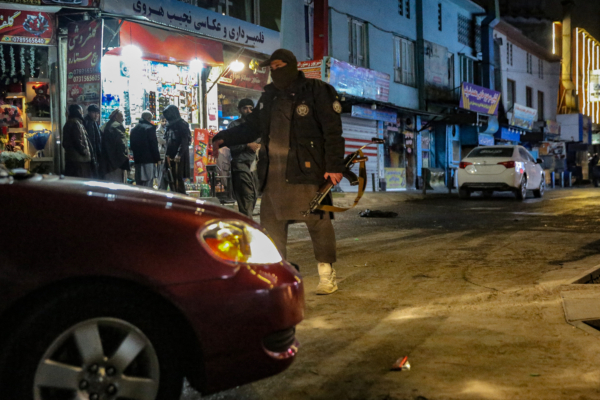
On January 19, a Chinese restaurant in the Afghan capital Kabul was attacked by a bomb, resulting in at least 7 deaths. The Islamic State of Iraq and Syria (ISIS) Afghanistan branch later claimed responsibility and mentioned the Chinese government’s Xinjiang policy in their statement. Experts warn that China’s involvement in Xinjiang and its “Belt and Road” initiative poses security threats to Chinese personnel and projects overseas, with security risks showing a trend of becoming long-term.
According to Reuters, the explosion occurred in the commercial district of Shahr-e-Naw in Kabul at around 3 to 3:30 pm local time on January 19. Kabul police spokesperson Khalid Zadran stated that the restaurant named “Lanzhou Beef Noodle,” run by a Chinese Hui Muslim couple and an Afghan partner, primarily served the local Chinese Muslim community living and doing business in the area.
Zadran mentioned that the explosion took place near the restaurant’s kitchen, resulting in the death of one Chinese citizen and 6 Afghan nationals. Stefano Panichi, the head of the humanitarian organization Emergency in Afghanistan, stated that hospitals received 20 wounded individuals, including 7 who were already deceased upon arrival, with 4 women and 1 child among the injured.
Videos circulating on social media showed the front structure of the restaurant severely damaged, with thick smoke rising at the scene and debris scattered on the street. The Shahr-e-Naw area houses multiple embassies, shopping centers, and commercial office buildings and has been considered relatively stable in terms of security in Kabul.
On January 20, Chinese Foreign Ministry spokesperson Guo Jiakun condemned and opposed all forms of terrorism, calling on the Afghan authorities to ascertain the truth and punish the perpetrators. ISIS’s Afghanistan branch, through its “Amaq News Agency,” claimed responsibility for the attack, stating that it was carried out by a suicide bomber and cited Chinese citizens as targets due to the “Chinese (Communist Party) government’s policies towards Uighurs.”
In an interview with Epoch Times, Taiwan’s Institute for National Defense and Security Research analyst Shen Mingshi analyzed that China’s persecution policy towards Uighurs in Xinjiang has played a significant role as a motivating factor for ISIS and its affiliates to mobilize and engage in violent actions.
Additionally, he believed that following China’s promotion of the “Belt and Road” initiative and the China-Pakistan Economic Corridor, a large number of projects and personnel entering the region have been perceived by some extremist organizations as “economic exploitation” and “foreign influence.”
Furthermore, Shen Ziyun, the Director of the Strategic and Resources Department at Taiwan’s Institute for National Defense and Security Research, stated that ISIS views China as a significant target primarily due to two factors: the Xinjiang issue, where ISIS accuses China of persecuting Muslims, and the expansion of the “Belt and Road” initiative in the Islamic world.
The Victims of Communism Memorial Foundation, based in Washington DC, released the “Xinjiang Police Files” in May 2022, revealing the widespread detention and strict control situation in Xinjiang. The US and several human rights organizations have accused the Chinese government of systematically persecuting Uighur people. The Chinese authorities have denied these allegations.
Associate Professor Feng Chongyi from the University of Technology Sydney believes that the explosion at the Afghan Chinese restaurant reflects more on sporadic violent acts of extremist groups in the backdrop of their decline. However, the timing and regional environment of the event still highlight the instability of the security situation in Afghanistan and the high level of uncertainty amidst the intertwining geopolitical forces in the Middle East and South Asia.
Shen Mingshi stated that this attack is not an isolated incident but rather a result of the long-term interaction and convergence of ISIS’s Afghanistan branch with various extremist organizations in Pakistan and Afghanistan.
He pointed out that organizations like the Pakistani Taliban, Jaish-e-Mohammed, and Lashkar-e-Jhangvi have been active for a long time in the border areas between Pakistan and Afghanistan, with recent attacks increasingly targeting Chinese personnel and projects.
Shen Mingshi believed that ISIS’s Afghanistan branch has planned attacks in Kabul multiple times and openly included Chinese citizens on their target list. Choosing a Chinese restaurant as a target signifies both a concentration of people and relatively weak security, as well as holding symbolic significance.
Suziyun expressed to Epoch Times that understanding this attack requires considering internal factional conflicts in the Islamic world and the strategic agendas of extremist organizations.
He pointed out that the Taliban, ISIS, and the Shi’ite factions represented by Iran belong to different camps and have long-standing opposition to each other, suggesting that ISIS’s actions in Afghanistan are more independently planned rather than directed by the Taliban or Iranian forces.
Since the withdrawal of US troops from Afghanistan in 2021 and the Taliban’s regained control, official contacts between China and the Taliban authorities have increased gradually. China was among the first countries to appoint a new ambassador under the Taliban-led Afghan government.
Chinese business people have flocked into Afghanistan, with China’s Xinjiang-based China National Petroleum Corporation signing a three-year, $540 million oil extraction deal with the Taliban government in January 2023. In April of the same year, Gochin, a Chinese company, expressed interest in investing around $10 billion to develop lithium mines in Afghanistan.
However, China’s investments in the region face severe security challenges, with attacks against Chinese personnel and projects occurring frequently in recent years, leading to a sharp deterioration in local security conditions.
Explosions and suicide attacks occur sporadically in Afghanistan, with the ISIS Khurasan branch (ISIS-K) claiming responsibility for most incidents. In 2022, Kabul witnessed another deadly attack on a hotel popular among Chinese tourists, also claimed by ISIS. The context of this attack is even more complex.
Furthermore, according to public records, in 2021, a bus carrying Chinese engineering personnel working on the Dusun Dam project near the Afghan border in Pakistan was bombed, resulting in 13 deaths, including 9 Chinese workers. In 2022, the Baloch Liberation Army carried out a suicide bombing at Karachi University, resulting in 4 deaths, including 3 Chinese teachers. In April 2024, there was another explosion targeting Chinese workers in Pakistan’s Shangla County.
The Baloch Liberation Army is an armed organization established by the Baloch people of Pakistan and Afghanistan, opposing and trying to thwart the joint China-Pakistan economic corridor under the “Belt and Road” initiative.
Experts believe that the security risks faced by overseas Chinese personnel and projects due to China’s increasing global presence are showing a trend of becoming long-term and structured.
Suziyun pointed out that amid the ongoing turmoil in the Middle East, security risks for Chinese personnel and projects overseas are expected to further increase, and the advancement of the “Belt and Road” initiative in high-risk regions will face greater uncertainties.
He particularly emphasized that if the Iranian regime suffers severe damage or collapses, it will not only severely weaken the armed groups it supports against the US but also have a significant negative impact on China’s energy security and geopolitical strategic layout in the Middle East.