
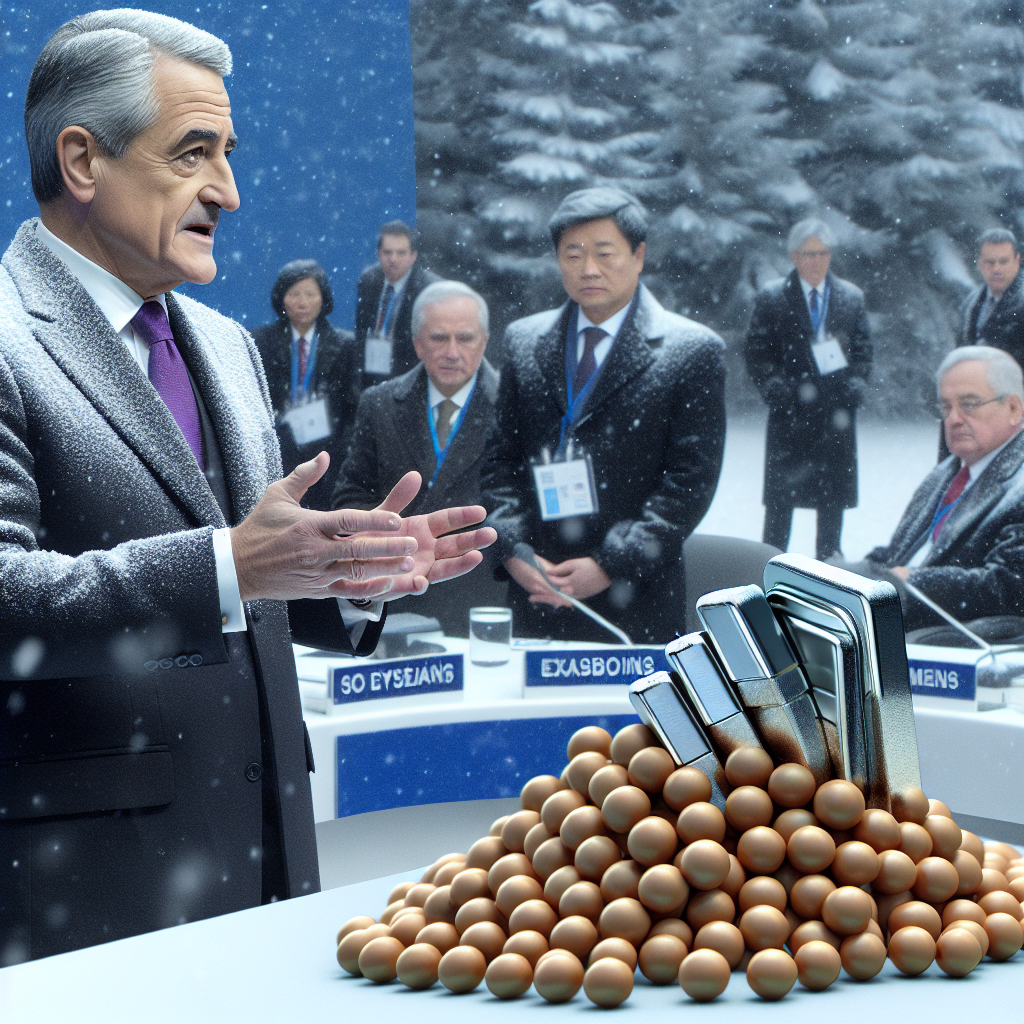
On Tuesday, January 20, the US Treasury Secretary Scott Bennett announced that during the Davos World Economic Forum, he had a meeting with Chinese Vice Premier He Lifeng. Bennett discussed topics related to China’s fulfillment of purchasing American soybeans and exporting magnets in the context of US-China trade.
Amid escalating tensions in US-China trade relations and tariff rates surging above 100% at one point, Bennett and He Lifeng have been key negotiators representing the US and China in trade talks. Their meeting in Geneva last May initiated a series of follow-up discussions, followed by talks in London, Stockholm, Madrid, and Kuala Lumpur.
On Tuesday at the main venue of the World Economic Forum in the Swiss Alps, Bennett, in an interview with Fox Business Channel, stated: “I met with my Chinese counterpart in Davos last night. They have fulfilled all commitments.”
Bennett mentioned that China has honored the agreement to purchase American soybeans, with both countries looking forward to procuring 25 million metric tons of American soybeans next year. However, the US suggested that China “buy a little more” as President Trump consistently raises this issue in meetings with Chinese leader Xi Jinping.
Last year, China temporarily suspended soybean purchases from the US due to the US-China trade war, which displeased President Trump. At the end of October last year, Trump and Xi Jinping reached a procurement consensus during a trade meeting in South Korea. Bennett later stated that China agreed to purchase 12 million metric tons of American soybeans by the end of February 2026, and an annual purchase of 25 million metric tons over the next three years.
Following the procurement agreements, American soybeans have started to be exported to China. Three traders revealed to Reuters on January 6 that COFCO Group, China’s state-owned food and grain corporation, purchased 10 shipments of American soybeans.
Additionally, Bennett mentioned that the supply of rare-earth magnets has been consistently meeting expectations, with a delivery rate of “over 90%, which I find quite satisfactory.”
The supply of rare-earth magnets was a key issue in the 2025 trade negotiations as Beijing weaponized magnet materials, impacting the global supply chain.
Meanwhile, the US has been strengthening supply chains for critical minerals such as rare earths in collaboration with other Western countries to reduce dependency on China. On January 12, Bennett convened a meeting of finance ministers in Washington to discuss ensuring the security and diversification of critical mineral supply chains, countering China’s dominant position in the rare-earth element supply chain. The ministerial meeting gathered key allies, including Australia, Canada, the EU, France, Germany, India, Italy, Japan, Mexico, South Korea, and the UK, whose combined demand for critical minerals accounts for 60% of the global total.
It is anticipated that Bennett will also meet with CEOs from around the world during the Davos Forum.