
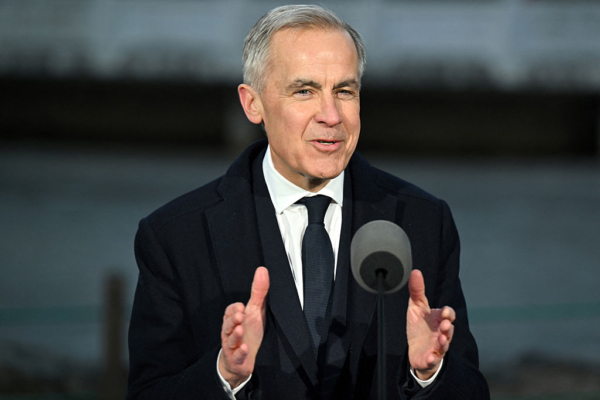
After Canadian Prime Minister Mark Carney reached a tariff agreement with the Chinese Communist Party (CCP) leaders, Representative Tseng Hou-jen of the Taipei Economic and Cultural Office in Canada expressed that not only is the CCP unable to solve Canada’s economic difficulties, but it is also an unreliable partner.
Last week, leaders of Canada and China reached a preliminary agreement, agreeing to reduce trade barriers and rebuild bilateral relations, marking a significant adjustment after years of worsening relations between the two countries.
According to the agreement signed by Canada and China, Canada will open a small market for electric vehicles to China at a low tariff rate, while China will lower import tariffs on Canadian canola seeds. The United States’ policy of equivalent tariffs has prompted Canada to urgently expand diversified export markets to reduce reliance on the US, as nearly 70% of Canada’s total exports flow to the US.
As reported by the “Japan Times,” Representative Tseng Hou-jen of the Taipei Economic and Cultural Office in Canada stated in an interview, “If (Carney’s) trip to China this time is sincerely seeking an economic remedy for Canada, I believe the answers cannot be found in China. But if this trip is an attempt to create some political leverage—whether domestically or internationally—then it’s a different story.”
This senior diplomat of the Republic of China, who previously served as Deputy Minister of Foreign Affairs, pointed out that a China-Canada trade agreement “is fundamentally unachievable, for a simple reason—Communist China is not a market economy,” citing various restrictions in its domestic market.
Tseng emphasized, “The expansion or contraction of the Chinese market is a political consideration; those coming to make purchases will only be state-owned enterprises, not consumers, which means the government could stop purchases at any time.”
Due to the lack of formal diplomatic relations between Taipei and Ottawa, Tseng Hou-jen’s position is equivalent to the Ambassador of the Republic of China (Taiwan) to Canada.
According to Canadian government data, in 2024, the Republic of China ranked as Canada’s fifteenth largest trading partner with a commodity trade volume of 6 billion Canadian dollars (equivalent to 4.3 billion US dollars), and bilateral service trade amounted to 1.9 billion Canadian dollars.
At the end of 2022, during the term of former Canadian Prime Minister Justin Trudeau, the Canadian government’s released the “Indo-Pacific Strategy,” which stated that the CCP is an “increasingly disruptive global force,” disregarding international rules and norms. Tseng noted that the document is a “very good roadmap.”
However, remarks from the Carney government’s cabinet suggest that the strategy is not set in stone, and the global political and economic landscape has drastically changed since the document was formulated. When asked whether Canada still agrees with the aforementioned description of the CCP, Foreign Minister Anita Anand responded last Wednesday (14th), “This is a new government, a new Prime Minister, a new foreign policy, and a new geopolitical environment.”
Of note, before Carney’s visit to China began on the 14th, two Liberal Party members, Helena Jaczek and Marie-France Lalonde, abruptly ended their trip to Taiwan.
Tseng Hou-jen pointed out that the early termination of the Liberal Party members’ visit to Taiwan to avoid Carney’s trip to China was “completely unnecessary.” He stated that it has been customary for years for Canadian lawmakers to visit Taiwan, which is the best way for Canadian legislators to understand the challenges Taiwan faces.
He also emphasized that Canada should “promptly” sign the trade cooperation framework agreement already drafted with Taiwan.