
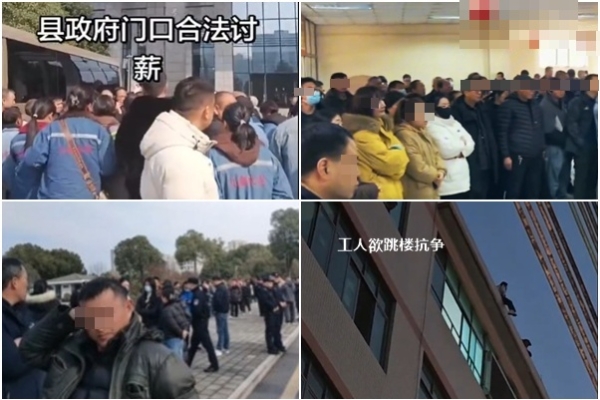
As China’s New Year approaches, labor disputes and collective rights actions have been on the rise in various parts of the country. Some workers have taken to the streets, surrounded construction sites, and even resorted to extreme measures to demand unpaid wages, sparking attention after related incidents spread on the internet, highlighting escalating labor disputes just before the Lunar New Year.
Entering January 2026, labor rights and wage disputes have erupted in numerous locations across China, involving areas such as construction, manufacturing, medical infrastructure, and public services, spanning Tianjin, Hubei, Guangdong, Inner Mongolia, Henan, Guizhou, Chongqing, Zhejiang, Shaanxi, and many other provinces and cities.
On January 6th, workers at Meike Meijia production base in Tianjin protested after the plant shut down and reports emerged of unpaid wages. Hundreds of workers gathered to demand the company settle months of unpaid salaries. A week later, workers from Tongshang Construction Company in Hubei clashed with company personnel during wage negotiations, with some workers reporting physical violence. On the same day, due to long-term wage arrears, a worker at Huizhou City Chinese Medicine Hospital construction site in Huizhou, Guangdong, protested by attempting to jump off a building.
Following these incidents, workers at the Baoan Hospital construction project in Baoan District, Shenzhen were owed wages and gathered outside the site’s entrance to demand payment. In Tongliao City, Inner Mongolia, over a hundred sanitation workers rallied at the local petition office due to long outstanding wages. Additionally, workers at the Jinxin Cement Factory in Kaifeng City, Henan, pursued their owed wages by protesting at the county government’s gates on January 15th.
Mr. Wang, a labor rights activist in Shenzhen, expressed to reporters that there have been several wage dispute incidents in Baoan District since January. He mentioned receiving numerous requests for assistance related to unpaid wages from the end of the year or the beginning of the year, some extending six months or more. Workers from Hubei also raised issues with labor authorities in Xixiang Street.
On January 15th, workers gathered to demand unpaid wages at the Bihaibay Project in Xixiang Street, Baoan District, Shenzhen. Videos circulated online showed workers holding banners and blocking the site’s entrance, insisting on receiving their withheld salaries. Wang mentioned that despite workers previously lodging complaints through labor services companies, project managers, or relevant departments, the issues remained unresolved, leading them to reluctantly resort to collective wage demands before the New Year.
Mr. Wang expressed concerns that the space for migrant worker rights advocacy in Shenzhen has been narrowing in recent years. “Many workers are worried about being laid off or blacklisted, hence they are reluctant to voice their grievances publicly, only taking action when they can no longer bear the situation,” he remarked.
In a video shared by netizens on January 18th, the China Construction Eighth Engineering Bureau project on Future Second Road in Wuhan, Hubei, was exposed for long-standing wage arrears. Workers reported that not only were wages unpaid, but their facial recognition information was removed by the company, preventing them from accessing the construction site, completely cutting off channels for wage claims, triggering public attention after circulating online.
Scholar Wang Kunming from Zhejiang told reporters that within the Chinese Communist Party system, central SOEs rely extensively on administrative resources to secure projects but lack corresponding accountability mechanisms. “It is quite common for central SOEs to delay payments to suppliers, causing a ripple effect down the supply chain where financial pressures eventually lead to wage arrears, resulting in a domino effect of companies facing such dilemmas, with no true ‘winners.'”
Wang pointed out that as the traditional Chinese New Year approaches, conflicts revolving around wage issues between workers and enterprises have noticeably increased. “The growing number of wage dispute incidents across the country indicates that many signs point to social risks becoming more pronounced, with economic issues transitioning into wider social conflicts, possibly evolving into political demands from the public.”
Simultaneously, multiple instances demonstrate the significant absence of oversight and responsibility from local Chinese Communist Party authorities regarding wage arrears. On one hand, local governments rely on infrastructure to drive economic growth and maintain fiscal stability, yet there is a chronic lack of supervision and protection of labor rights. In numerous regions, avenues like labor arbitration and petitions are virtually non-existent, making it difficult for workers to receive meaningful responses despite repeated complaints.
Analysts suggest that persistent wage arrears in China are not solely due to individual company misconduct but are closely tied to the current Chinese Communist Party system. Under this system, local governments heavily depend on central and state-owned enterprises, resulting in swift project approvals driven by administrative directives, but lacking effective accountability measures or risk constraints. Once economic growth slows or funding tightens, project costs are systematically shifted downward, leading to the immediate sacrifice of wages for grassroots laborers such as migrant workers.
Many incidents also indicate that when addressing wage arrears, Chinese authorities prioritize preventing wage claim actions from evolving into large-scale events rather than legally pursuing those responsible for the arrears. In certain regions, rights advocacy is viewed as a ‘stability risk,’ facing restrictions or even suppression, while arrears by enterprises are seldom publicly held accountable. This approach of prioritizing ‘stability maintenance’ over ‘rights protection’ by the authorities prolongs the systemic lack of resolution for wage arrears issues.
Wang Kunming believes that despite the repeated emphasis by the Chinese Communist Party on ‘ensuring employment’ and ‘protecting livelihoods,’ the recurring wage claim incidents demonstrate the inadequate protection of fundamental survival rights for grassroots workers. With the economy persistently sluggish, similar conflicts are likely to escalate further.