
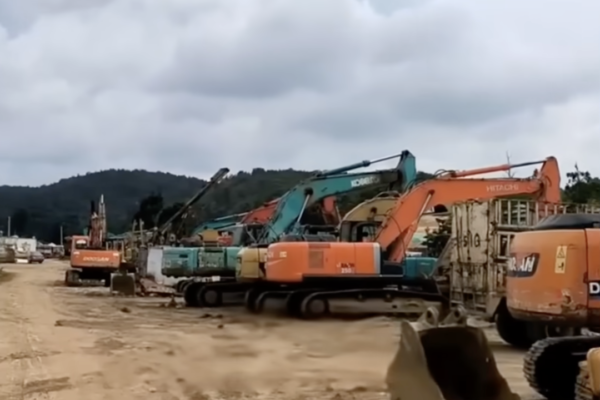
China’s real estate industry continues to slump, infrastructure investment slows down, and the construction industry is taking a hit as well. Even the top construction state-owned enterprises are experiencing drastic profit cuts.
Recently, China Metallurgical Group Corporation (referred to as China Metallurgical) disclosed that, according to preliminary calculations by the company’s financial department, it is expected to achieve profitability in 2025, but the net profit attributable to the owners of the parent company is expected to decrease by more than 50% compared to the same period last year.
According to a report by Yicai on January 19, in recent years, China Metallurgical’s net profit attributable to the parent company has been declining year by year. The data for the years 2022, 2023, and 2024 were 10.276 billion yuan, 8.670 billion yuan, and 6.746 billion yuan respectively. The net profit attributable to the parent company for 2025 is expected to further drop to around 3.3 billion yuan.
China Metallurgical explained that the decline in performance is mainly due to losses in the real estate business in 2025, as well as increases in provisions for impairment of various assets such as inventory, fixed assets, and investment properties. The company’s revenue has also declined due to the downturn in the construction industry.
China Metallurgical is a super-large state-owned construction and engineering enterprise, a central enterprise, and a wholly-owned subsidiary of the China Minmetals Corporation, directly managed by the State-owned Assets Supervision and Administration Commission of the State Council.
In the first three quarters of 2025, among the top eight central construction enterprises, China Metallurgical showed the largest performance fluctuation. Its operating income during the period was 335 billion yuan, with a year-on-year decrease of 18.78%; the net profit attributable to the listed company’s shareholders was 3.97 billion yuan, a decrease of 41.88% year-on-year. For the full year of 2025, the new contracts signed by China Metallurgical totaled 1.136 trillion yuan, a decrease of 10.8% compared to the same period last year.
In the first three quarters of 2025, among the top eight central construction enterprises, only China Energy Construction, China Power Construction, and China Chemical Engineering achieved revenue growth. During the same period, only China Chemical Engineering saw a 10.28% increase in net profit attributable to the parent, while the rest of the core profit centers all experienced declines.
A report from China Galaxy Securities shows that in the first three quarters of 2025, the main 152 listed companies in the construction industry achieved a total revenue of 5.84 trillion yuan, a decrease of 5.14% year-on-year; the net profit attributable to the owners reached 123.62 billion yuan, a decrease of 9.76%, mainly due to the slowdown in fixed asset investment and pressure from local government debt.
The National Bureau of Statistics of China released data on December sales prices of new and existing homes in 70 large and medium-sized cities. According to calculations by Reuters based on data from the National Bureau of Statistics of China, in December, the price of new homes fell by 2.7% year-on-year, the largest drop in five months, and a slight acceleration from the 2.4% decline in the previous month. On a month-to-month basis, prices fell by 0.4%, the same as in November.
Regarding the sales prices of new homes, in tier-one cities, prices fell by 1.7% year-on-year, an increase of 0.5 percentage points from the previous month; tier-two and tier-three cities saw decreases of 2.5% and 3.7% respectively year-on-year, with declines of 0.3 and 0.2 percentage points month-on-month. Furthermore, new home prices in tier-one cities fell by 0.3% month-on-month, while tier-two and tier-three cities saw a 0.4% decrease.
As for the sales prices of existing homes, tier-one, tier-two, and tier-three cities saw year-on-year declines of 7%, 6%, and 6% respectively, with month-on-month decreases of 0.9%, 0.7%, and 0.7% respectively.
In December 2025, the prices of existing homes in all 70 large and medium-sized cities fell. In tier-one cities, Beijing fell by 8.5%, Shanghai by 6.1%, Guangzhou by 7.8%, and Shenzhen by 5.4%. Compared to new homes, existing home prices better reflect real-time housing demand, highlighting the subdued demand in the Chinese real estate market.
Following the collapse of large real estate developers such as Evergrande and Country Garden, the Chinese real estate giant Vanke came close to the brink of debt defaults at the end of last year. On January 21 this year, a creditors’ meeting will be held to extend the maturity of two bonds totaling 5.7 billion yuan. Market analysts have long warned that the worsening problems at Vanke may drag down the Chinese economy and exacerbate the real estate market decline.
Not only private construction enterprises but also many state-owned construction enterprises responsible for building city infrastructure and residential housing are heavily indebted and facing frequent defaults.
According to an announcement by Xi’an Construction Group, as of November 20, 2025, Xi’an Construction Group and its subsidiaries had accumulated overdue debt amounting to 3.071 billion yuan.
Since Jiangsu Construction declared bankruptcy with debts of 18.7 billion yuan in 2023, life has been very difficult. As of August 2025, the group is still embroiled in legal disputes, with 4,108 civil cases against it, involving 3.882 billion yuan, of which 2.897 billion yuan has been executed.
Guangxi Construction and Tianjin Construction are facing multiple pressures such as broken funding chains, huge debts, and declining performance. In the first half of 2025, Guangxi Construction reported a net loss of over 800 million yuan, with some subsidiaries laying off up to 80% of their staff. The group was exposed in 2024 for severe funding chain fractures, arrears of over 1.6 billion yuan in wages to farmers, and unrecovered project funds.
The Chinese construction industry is deeply tied to the real estate sector, and the fatal issue is that real estate companies often require construction enterprises to advance project funds. Before the collapse of Jiangsu Construction, for example, the proportion of advance funding reached 30% of the total project cost, turning this model of “advance payments by the party” into a liquidity black hole during the industry downturn.
Data shows that Jiangsu Construction has been unable to recover over 10 billion yuan in project funds due to the bankruptcies of companies like Evergrande. Nearly 70% of Xi’an Construction’s default principal and interest totaling 263 million yuan is related to real estate projects, with real estate-related businesses accounting for 65% of the 8 billion yuan net loss in the first half of 2025 by Guangxi Construction.
One real estate blogger summed up the current situation in the industry as follows: “The entire construction industry is lying down. The developers aren’t starting new projects, the contractors aren’t pushing deadlines, the foremen aren’t showing up for work, and the managers are slacking off. Construction workers have no work, and are at home. Especially in recent years, construction companies are either transforming or going bankrupt. They can no longer juggle finances, and when the funding chain breaks, even wages cannot be paid, leading to declarations of bankruptcy.”
A mainland Chinese real estate blogger stated, “In recent years, there have been more and more large infrastructure projects with low or even abandoned utilization rates, including high-speed rail, subways, highways, as well as government public buildings such as sports stadiums, libraries, museums, etc. On the other hand, investments in infrastructure projects that remain strong continue. The blogger pointed out that the authorities have been using a simple method of relying on investment to drive economic growth, which is unsustainable.
Chinese Vice Premier He Lifeng stated on December 12, 2025, at the national financial system work conference that efforts must continue to prevent and resolve risks in local small and medium-sized financial institutions and real estate companies involved in finance, to strictly guard against “explosive defaults.”
Wanjun Qiu, a professor of finance and economics at Northeastern University in Boston, USA, told The Epoch Times that He Lifeng’s warning is quite rare. He noted that the official culture in China tends to report good news rather than bad news, so this public call to guard against defaults indicates that the situation is severe.