
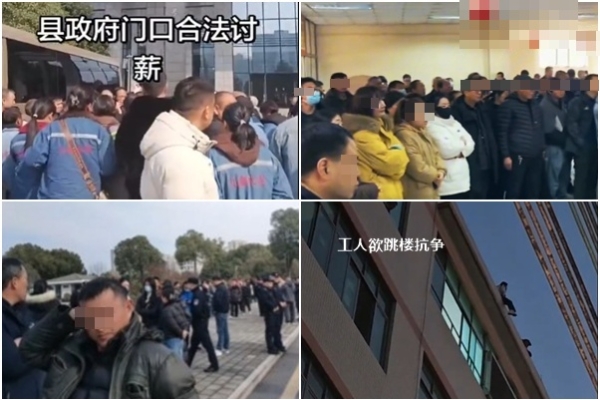
For a long time, the issue of wage arrears for migrant workers in mainland China has persisted, despite the authorities introducing some relevant policies, the problem remains unresolved. With the continuous decline in the Chinese economy and tight local finances, the wage arrears issue has not only failed to ease but has intensified, sparking a new wave of wage collection protests across the country.
As the traditional Chinese New Year approaches, migrant workers who have been working outside their hometowns for a year were hoping to receive their wages to reunite with their families. However, since January 2026, there have been successive incidents of wage collection protests by migrant workers in many regions.
On January 6, a core production base of China’s high-end home furnishings representative enterprise, Meike International Home Products Co., Ltd., with its flagship brand “Meike Home” in Tianjin, was shut down, leading to thousands of workers demanding their overdue wages. Workers reported that the company not only owed wages but also tried to persuade frontline employees to resign without compensation.
On January 15, construction workers at the China Railway Wushan project in Guiyang, Guizhou Province, resorted to jumping off buildings to demand their wages.
On January 15, due to wage arrears, workers from Jiuxin Cement Factory in Chongqing gathered in front of the county government to demand intervention.
On January 14, workers at the Baohai Hospital project of the People’s Hospital in Shenzhen blocked the entrance to demand their wages.
On January 14, hundreds of sanitation workers in Tongliao, Inner Mongolia, went to the Petition Bureau to demand the payment of their overdue wages.
On January 14, at the Jin’an International Port project in Kaifeng, Henan Province by China Construction Eighth Bureau, over three million yuan in wages owed to migrant workers have not been paid for more than a year. Workers brought their luggage to the company to demand their wages.
On January 13, workers from Hubei Tongshang Construction were beaten by company personnel during a wage collection protest. On the same day, workers at a Traditional Chinese Medicine Hospital project in Huidong County, Huizhou, Guangdong, protested by threatening to jump off buildings due to wage arrears, which attracted widespread attention.
In fact, a wave of wage collection protests had occurred in many parts of mainland China on the eve of the 2026 Lunar New Year. Workers surrounded China Railway Sixth Bureau Group for wage collections; workers visited the Guangxi Daily, an organ of the Guangxi Party Committee, to demand their wages; at a project site in Qinghai by China Electric Power Construction Corporation, workers even brought their children to demand their wages.
Cheng Lin (pseudonym), a person in charge of a construction team in Jiangxi Province, told Epoch Times on January 13th that his team had completed part of the local railway system project but has been owed over seven million yuan for more than a year.
“I can only borrow money to survive now, I can’t make ends meet, and my family has fallen apart. I am determined to get this money back at all costs. The whole society is on the brink of collapse,” Cheng Lin said.
Chen Gang (pseudonym), a manager at a labor service company in mainland China who has long helped workers with their rights protection, revealed the extremely difficult process. He told Epoch Times, “Blocking the door and holding banners during wage protests are illegal, but those companies that owe wages are not. We have been cooperating with the Labor Inspection Brigade for over two years without getting any money.”
Wang Yu (pseudonym), a mainland China observer who has long been concerned about migrant workers, told Epoch Times, “Workers work to support their families, how can they survive without getting paid? This forces workers to demand their wages from the government.”
He pointed out that the root cause of the frequent wage collection protests lies in systemic issues. Against the backdrop of an economic downturn, ordinary people bear all the pressure, while power and wealth are concentrated in the hands of officials. “A very important reason is the public ownership of the economy, dictatorship, which holds a lot of this power, so they can embezzle tens of millions to hundreds of millions.”
Jie Li Jian, the chairman of the International Alliance of the China Democracy Party, told Epoch Times that the worsening of local finances has further deteriorated the wage collection environment. “The fiscal deficit is tightening, private enterprises, state-owned enterprises, and those within the system have no money, intensifying efforts to grab more money from innocent people.”