
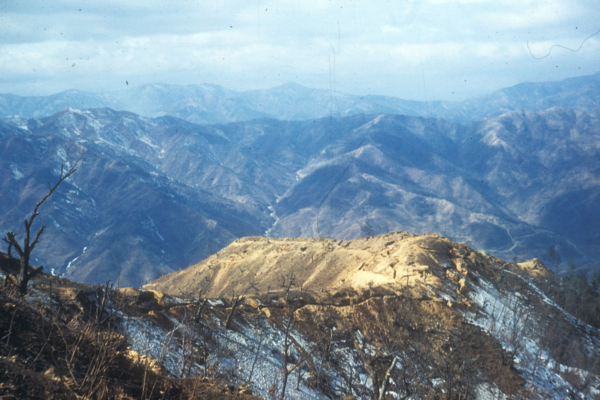
In 1951, after bloody battles at Bloody Ridge and Pork Chop Hill in August and September, the UN forces occupied more favorable positions. The Korean troops established new defensive fortifications on a ridge 1,400 meters away from Bloody Ridge, initiating intense and brutal battles to control this key point just north of the 38th parallel, later known as Heartbreak Ridge.
The US Army assessed the situation and, although the enemy suffered higher casualties, they believed that the UN forces should not continue paying such a high price in future operations. The UN forces shifted to limited attacks, reconnaissance, and patrols, aiming to seize Heartbreak Ridge and further flatten the defense line.
Heartbreak Ridge featured three main peaks: the southern end was Hill 894, 1,200 meters north was the highest peak on the ridge, Hill 931, and another 1,900 meters north stood the needle-shaped protrusion of Hill 851. The Korean troops constructed bunkers, trenches, and gun positions in the jungle.
On September 13, the 2nd Division of the US Army, 23rd Regiment, and the attached French battalion launched an attack. When they encountered the Korean forces’ machine gun and small arms fire, the US assault unit paused, dug trenches at the base of the ridge, and waited for the right moment.
On September 14, with support from the 72nd Tank Battalion, the 2nd Battalion of the 9th Regiment concentrated their attack on Hill 894. By nightfall, facing minimal resistance, they climbed to a point 590 meters from the summit of Hill 894. On September 15, with only 11 casualties, the 2nd Battalion took control of Hill 894.
Over the next two days, Korean forces launched fierce counterattacks but were repelled. When the US forces continued to advance towards Hill 931, they encountered resistance. They then decided to expand their attacks to multiple peaks around Heartbreak Ridge to disperse Korean forces.
On October 4, after a US air raid with 49 warplanes, the assault teams began operations, and the reorganized firepower was more effective in attacking the Korean fortifications. The US’s overall offensive forced the Korean forces to divide their attention, and by October 8, they had planned to take control of multiple peaks around Heartbreak Ridge.
In the early morning of October 9, three battalions of the 23rd Regiment of the US Army coordinated their actions to attack Heartbreak Ridge again, quickly seizing the southern half of Hill 931 and repelling Korean counterattacks. By noon of the same day, the US Army had completely occupied the second peak of Heartbreak Ridge.
On October 10, with tank support, the US Army attacked the last peak, Hill 851. They discovered that the Chinese forces were preparing to take over the Korean positions. The US tanks immediately launched an assault, intercepting the advancing Chinese forces and cutting off their supply lines. The Chinese and Korean forces believed that US tanks could not operate effectively in mountainous terrain, but the US engineers quickly built roads, causing confusion among the Chinese and Korean forces. The US easily captured Hill 851 and several nearby peaks.
The month-long battles took a toll on both sides. The 2nd Infantry Division of the US Army suffered over 3,700 casualties, with the 23rd Regiment and the attached French battalion accounting for almost half of the total casualties.
The Korean 6th, 12th, and 13th Divisions, along with the Chinese 204th Division, suffered heavy losses, with a total of nearly 25,000 casualties.
During the battle, the US Army fired 62,000 76mm shells, 401,000 105mm shells, 84,000 155mm shells, and 13,000 203mm shells, in addition to over 119,000 various mortar shells and nearly 18,000 recoilless rifle shells. The US military conducted 842 ammunition airdrops.
After the battle of Heartbreak Ridge, the UN forces broke through the Chinese and Korean forces’ “active defense,” completely flattening a salient in their frontline and occupying more favorable defensive terrain.
Several films and literary works have depicted the brutal battle at Heartbreak Ridge. The Chinese Communist Party (CCP) also attempted alternative propaganda, falsely equating it with the Triangle Hill Battle a year later, claiming it as the Battle of Shangganling. The CCP continued to confuse public opinion, concealing the true extent of their failures and heavy casualties.
By August and September 1951, after two months of intense fighting, the UN forces successfully captured some key points, once again defeating the Chinese and Korean forces. On October 25, peace talks resumed, moving to Panmunjom.
Reluctant to accept defeat, the CCP launched a partial counterattack against the UN forces’ front lines on October 30, but made no significant progress. Instead, they incurred a total of 100,000 to 150,000 casualties during the summer and fall of 1951. More Chinese troops were dispatched to Korea.
By the end of October 1951, the Chinese troops in Korea had reached 1.15 million, including 19 infantry armies, 9 artillery divisions, 5 tank regiments, 12 air force divisions, 4 railway engineering divisions, and 8 logistics corps. Although the Chinese and Korean forces had numerical superiority, they were still at a disadvantage in actual combat against the US and UN forces and struggled to break through the 38th parallel, especially in dealing with their overwhelming disadvantage in the air and at sea.
In September 1951, the Chinese Air Force attempted to build an airfield in Korea but faced significant setbacks, forcing them to abandon the planned air support missions by December 1951.
On November 1, 1950, 12 MiG-15 fighter pilots from the Soviet Air Force secretly joined the Korean War, stationed in northeastern China, primarily operating in northwestern Korea to intercept American bombers attacking Chinese supply lines and engaging in dogfights with US fighter escorts. The US military referred to this airspace as the “MiG Alley.”
The MiG-15’s engine was copied from British designs, offering better speed and climb rates than the US’s F-80 and F-84 but lacked stability at high speeds. During the Korean War, UN pilots witnessed the MiG-15 entering a spin 56 times, leading to at least 25 crashes. The MiG-15 had a larger caliber cannon but slower firing rate and used a simple optical sight resembling those from WWII Germany.
The US’s F-86 fighter jet offered comprehensive performance and was equipped with an APG-30 radar gun sight with analog computers, allowing for precision shooting from longer distances, considered high-tech at the time. With more advanced F-86 fighters stationed in Korea, US fighter jets patrolled the MiG Alley airspace every 5 minutes for a 25-minute round, successfully defeating the Soviet Air Force’s attempts to gain air superiority by the end of 1951. Pilots were allowed to cross the Yalu River when pursuing enemy aircraft.
MiG-15 fighters typically patrolled the Chinese side of the Yalu River border, seeking opportunities to attack. US fighters had only a brief window to engage the MiG-15 before the Soviet aircraft retreated into Chinese airspace after being chased or damaged.
When the armistice took effect in 1953, the US deployed 297 F-86 fighter jets in the Korean Peninsula, while the Soviet and Chinese Korean forces had an estimated 950 MiG-15 fighters.
US pilots claimed to have shot down 792 MiG-15 fighters, with 78 F-86 fighters lost in dogfights. The US reported a total of 139 aircraft downed by MiG-15 fighters.
The Soviets claimed to have shot down over 600 US F-86 fighters, while the Chinese Air Force also claimed 211 kills against F-86 fighters. These numbers far exceeded the actual deployment of US F-86 fighters.
Later declassified Soviet archives revealed that Soviet pilots flying MiG-15s in the Korean War had 335 air victories. The Chinese Air Force lost 224 MiG-15s, while North Korea lost approximately 100, totaling around 659 aircraft.
On November 18, 1952, a dramatic aerial battle occurred when two US F9F carrier-based fighter jets encountered an attack by seven MiG-15s while on a mission in the Sea of Japan. Although the F9F carrier fighters were theoretically inferior to the MiG-15s, American pilots bravely fought to protect their carriers. One F9F pilot, after losing contact with his wingman, engaged four MiG-15s alone, shooting down all four before running out of ammunition and returning to the carrier, finding his aircraft hit 263 times. Both the US and the USSR handled the incident quietly to prevent direct confrontation.
On November 16, 2025, an article in the People’s Liberation Army Daily praised the achievements of young Chinese air combat heroes in the Korean War under the title “Young aerial combat heroes leave a string of ‘stars’ on the battlefield against the US in Korea.” The article highlighted the challenges faced by Chinese pilots with limited jet flight experience, emphasizing Mao Zedong’s directive to the Air Force to “fight and build, train while fighting.”
The article recollects a humorous anecdote: when an alarm sounded, Pilot Li Han was in the restroom and hurriedly entered the cockpit without even buckling his belt. He later recalled, “I only fastened the belt after getting off the plane following the aerial combat. Due to negligence caused by busyness, the planned No. 2 and No. 4 aircraft could not take off simultaneously.”
This anecdote sheds light on the actual situation of the Chinese Air Force at the time. While the piece claimed a total of 330 enemy aircraft shot down and 95 damaged by Chinese pilots, acknowledging only 116 Chinese pilot casualties, it evaded mentioning their own aircraft losses, thus implying a 3:1 victory ratio in aerial combat, which was a fabricated claim. Today, the PLA Air Force continues such intense aerial combat training without the experience of modern beyond-visual-range air combat.
In the Korean War, the US B-29 bombers played a crucial role in bombing raids. Carrying a maximum payload of 20,000 pounds, the B-29 conducted over 20,000 sorties and dropped around 220,000 tons of bombs. The bombers lost 34 aircraft during combat, with 16 shot down by enemy fighters, 4 by anti-aircraft guns, and the remaining 14 due to other factors, resulting in a loss rate of less than one per thousand sorties.
Equipped with one cannon and 12 heavy machine guns, the B-29 bombers shot down 27 enemy aircraft in aerial combat, including MiG-15 fighters.
The US B-26 bombers, with a maximum payload of 4,000 pounds, executed approximately 60,000 sorties during the Korean War, estimated to have destroyed 38,500 vehicles, 3,700 railway cars, and 406 motorcycles.
During the conflict, a total of 17 US aircraft carriers and six British carriers were deployed, with their carrier-based aircraft participating heavily in reconnaissance, air raids, and other missions.
With the UN forces establishing air superiority over the Korean Peninsula, the Chinese Air Force was unable to establish airbases in Korea. Their ground troops and supply lines were constantly subjected to air raids.
The Soviet Air Force only engaged in dogfights near the Yalu River, without conducting operations further south or engaging in ground attack missions. The Chinese Air Force only learned some aerial combat tactics during the war, lacking a comprehensive understanding of air raids.
The Soviet Air Force’s Tu-4 heavy bombers, though copies of US B-29s, did not participate in the Korean War. In November 1951, China attacked the island of Taeyon in Korea using Soviet Tu-2 medium bombers, involved in three sorties. The first sortie included nine Tu-2 bombers with minimal results. The second involved ten bombers for a nighttime bombing mission, but none hit their targets. The third sortie had nine bombers escorted by fighters, but they were intercepted by US aircraft. The Chinese admitted losing four Tu-2 bombers, three La-11 fighters, and a missing MiG-15, while the US claimed to have shot down eight bombers and four fighters.
After this incident, the Chinese Air Force did not conduct further bombing missions and provided no support for ground operations near the 38th parallel.
(To be continued)