
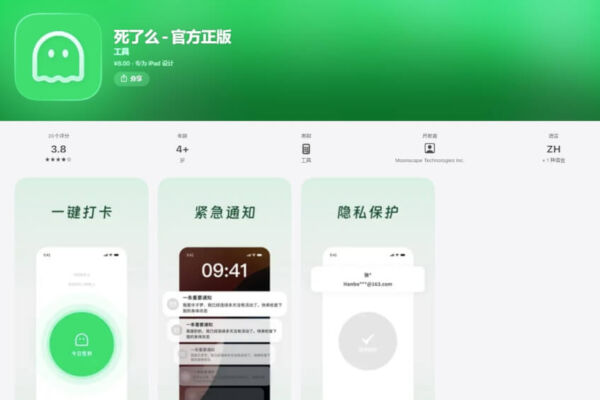
Recently, a mobile application named “Are You Dead Yet” unexpectedly became popular among young people in mainland China, drawing attention. Some commentators believe that the sudden popularity of “Are You Dead Yet” is like a social metaphor with dark humor, reminding us to pay more attention to the inner world of contemporary young people.
“Are You Dead Yet” is a “Safety Reminder for Solitude” tool designed for the solo-living population: users need to set emergency contacts and check-in every two days to confirm they are still alive to the system. If they fail to check-in for two consecutive days, the system will automatically contact the pre-designated emergency contacts.
Last week, the app became the top paid application downloaded in China’s Apple App Store.
According to a report released by the Shell Research Institute, by 2024, the number of solo-living individuals in China had reached 123 million.
Yuan Sangsang, a Shanghai-based designer who has lived alone for ten years, doesn’t expect this application to save her life but hopes that if she were to pass away alone, it could help her family members.
“I just don’t want to die without dignity, with my body decaying and smelling before being discovered,” said 38-year-old Yuan Sangsang. “It’s just not fair to those who have to deal with the corpse.”
Although at first glance, this application seems more suitable for the elderly, in reality, it is being avidly used by young people as a somewhat ironic social media check-in method.
In a commentary, He Tao, an editor at First Finance, pointed out that this unexpectedly popular internet application is like a mirror reflecting the hidden side of the current young people’s survival and mindset – beneath the self-deprecating humor lies their real pressures and struggles. This prompts us to ponder whether there is insufficient understanding and care for them in society.
He Tao expressed that the pressures contemporary young people face are multidimensional. Economically, they encounter the “internal competition” and uncertainty of the job market, with cultures like “996” spreading in certain industries, disrupting the balance between work and life. In terms of marriage and family, the high costs of housing, childcare, and conflicts with traditional family expectations make it difficult for many young people to progress on the path of “building a career and family.” On the societal and cultural levels, the amplification of social media continues to exacerbate so-called “peer pressure” and “success anxiety.” These pressures present universal challenges of the globalization era, while also bearing the societal characteristics of a specific development stage in China, making it hard for individuals to break free.
“The sudden popularity of ‘Are You Dead Yet’ seems like a social metaphor with dark humor, urging us to care about the living conditions and inner worlds of contemporary young people,” He Tao stated. “Those who download it obviously need more than just a functional safety purpose, but rather a signal of being seen and understood, a warm embrace from society.”
Death is a taboo topic in Chinese culture, to the extent that even the word “death” is stigmatized, leading to many buildings in China skipping the fourth floor due to its phonetic resemblance to “death.”
Some quickly criticized the name “Are You Dead Yet” for not being auspicious enough, believing its usage could bring misfortune. Some suggested changing it to names like “Are You Okay?”
Earlier on Friday, this application was removed from the Apple App Store in China, at least for now. The developers did not provide a reason, but a few days ago, they announced that they would be adopting a new name. They chose “Demumu.” However, on Wednesday (January 14th), the application team posted on their Weibo account that the discussion about the name “Demumu” did not meet expectations. They are gathering new name suggestions and will announce the chosen name over the weekend. The reward for the new name is 666 yuan (96 USD).