
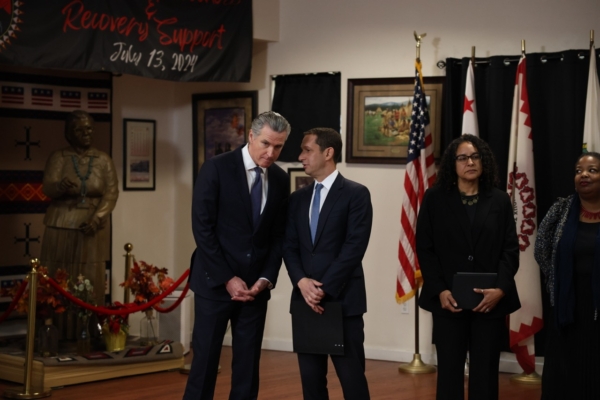
California Governor Gavin Newsom announced on January 16 that nearly $40 million in funding will be provided to San Francisco for the placement of homeless individuals.
At a press conference held by the Friendship House Association of American Indians in San Francisco, Newsom announced that the state government will provide approximately $419 million in new state funding through the Homeless Housing Assistance and Prevention Program (HHAP) to San Francisco, Los Angeles, and San Diego. San Francisco will receive around $39.9 million to support shelters, navigation centers, and related services.
According to the current allocation plan of the sixth round of HHAP funding, San Francisco will use the funds to maintain two and a half centralized shelters and three navigation centers until June 2029, with an estimated capacity to serve over 600 adults and 75 youth each night.
Newsom noted that despite significant progress in addressing homelessness and behavioral health crises in San Francisco and California, there is still much work to be done. He emphasized that the issue of homelessness is the most pressing and requires concentrated resources to solve.
In terms of funding allocation, Newsom mentioned that California has invested nearly $4.5 billion through HHAP since 2019. The sixth round will add $419 million in funding, with additional funds to be disbursed in the coming months. Unlike before, this round of funding distribution will be linked with stricter accountability measures.
One of the core requirements of the sixth round of HHAP funding, Newsom stated, is that local governments must propose and implement specific strategies to address encampment issues and comply with housing element regulations, holding themselves accountable for the effectiveness of past funding usage. Newsom emphasized that the state government will no longer tolerate hoarding of funds without tangible outcomes, and the new funding will emphasize transparency and performance requirements.
Discussing the behavioral health system, Newsom pointed out a severe systemic degradation in California over the past few decades. He highlighted the drastic reduction in behavioral health beds from approximately 37,000 in 1959 to just around 5,500 in 2023, despite the doubled population size during the same period. He believes this is a fundamental reason for the worsening intertwining crises of homelessness and mental health.
Newsom highlighted Proposition 1, approved by voters in 2024, as a crucial opportunity for reform. The proposition established around $6.4 billion in bond funding for repairing, expanding, and rebuilding California’s behavioral health and supportive housing system. Currently, most of the funds have been swiftly allocated for specific projects.
In concluding his remarks, Newsom emphasized that there is no one-size-fits-all solution to homelessness and mental health issues. Each community, especially indigenous communities, has unique histories and needs, requiring tailored policies.
“People should not struggle alone, and they might not be able to recover on their own. It takes a collective effort of a community, where individuals are willing to be part of that community,” Newsom stated. He expressed gratitude towards frontline nurses, counselors, and support workers for their critical roles in driving systemic changes.
San Francisco Mayor Daniell Lurie, speaking at the press conference, mentioned that San Francisco is changing how it addresses homelessness, aiming to help more people leave the streets and achieve stable lives.
He further cited a 44% decrease in tent encampments of homeless individuals across the city in December 2025 compared to 2024, attributing this progress to continuous support and collaboration from the state government. “We cannot accomplish all of this on our own; the resources provided by the state government are vital,” Lurie stated.
According to the Mayor’s Office data, since June 2020, San Francisco has carried out over 2,400 tent camp clearances, assisting 8,434 people in entering shelter or housing systems. While not all projects are funded by HHAP, state government funding has added over 1,850 shelter beds in San Francisco over the past few years, playing a critical role in expanding service capacity.
The Mayor’s Office press release mentioned that with the current round of funding in place, San Francisco has received nearly $227 million in HHAP funds since 2020.
Based on the 2024 data from the California government, San Francisco currently has around 8,323 homeless individuals, with roughly 4,354 being unsheltered. Despite an increase in total bed capacity from the previous year, homelessness remains a serious issue in the city.
As San Francisco faces an estimated $937 million budget deficit in the next two fiscal years, this funding provides crucial support for the city to continue its services for the homeless population.
The Mayor’s Office stated that the funds will continue to be used for street outreach, temporary and permanent housing, system optimization, performance monitoring, and regular publication of progress reports to ensure transparent and accountable fund usage.