
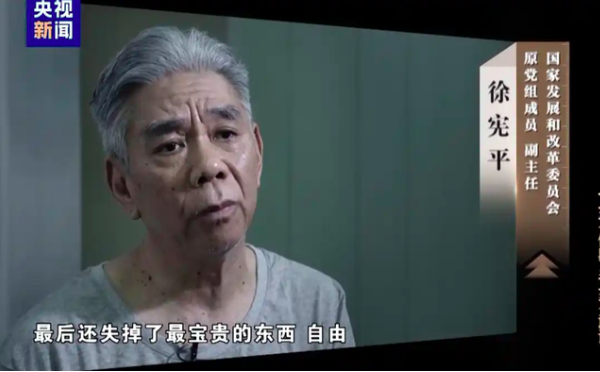
Amidst the continuous extension of the Chinese Communist Party’s anti-corruption investigation into historical issues, Xu Xianping, former member of the Party group and deputy director of the National Development and Reform Commission of the Communist Party of China, recently appeared in a special anti-corruption program. Some commentators believe that these televised confessions are not simply anti-corruption measures, but carry a clear sense of political intimidation.
On January 12th, Xu Xianping, a retired senior official of the Chinese Communist Party for many years, was arranged to repeatedly cooperate with the authorities in narrating his story in the anti-corruption special program. He “confessed” around topics such as “not retiring and continuing to be greedy,” concluding with words like “the world is really wonderful, only after retiring did I realize” and “I finally lost the most precious thing – freedom.”
Retired Feng Qin (pseudonym), from a research institute of the Chinese Academy of Social Sciences, told Epoch Times that these televised “confessions” do not belong to normal judicial procedures but are highly politicized public displays. He criticized, saying, this is a political humiliation carried out by the CCP under the guise of anti-corruption.
He said, “Before a person has been judged by a court, they have already been characterized in front of a national audience. This is not a trial at all, but a spectacle. I have been to many countries and have been online for a long time, and I have never seen such a thing. In what era, they are still doing this, it is completely regressive.”
Mr. Chen stated that the so-called “confessions” in the televised repentance often have a clear narrative direction. “These words all sound similar, emotional, sloganized, rarely involving specific factual details, more like lines prepared in advance by the authorities, said to the public, rather than a natural confession by the individuals involved.”
Xu Xianping’s televised confession footage has sparked questioning from netizens, who believe that Xu Xianping has been retired for many years, the related allegations have not been publicly tried, yet he was prematurely put in front of the camera for a public “confession,” which deviates from normal judicial procedures. Some comments bluntly point out that in the absence of independent judiciary and open trial, televised confessions will only further amplify the risk of abuse of power. “Today it’s him, tomorrow it could be anyone, it all depends on what the higher-ups are thinking.” Meanwhile, related reports previously released by Phoenix News have been removed, with the page displaying “404”.
Xu Xianping officially retired in 2023 after serving as the deputy director of the National Development and Reform Commission and was expelled from the party in November 2025 after accepting discipline inspection and supervision investigation by the Chinese Communist Party in March 2025. His appearance in the “confession” occurred before any judicial verdict, and the related content was produced by the CCP’s official publicity department and broadcasted by CCTV.
In the program, Xu Xianping is described as a case of “not retiring and continuing to be greedy.” The special program reveals that after stepping back from the “frontline,” he continued to benefit through his past job influence by using others to hold shares on his behalf, with relatives acting on his behalf, among other means. These details were edited into the special program, stringing together a clear narrative: even after retirement, one cannot completely remove themselves from such activities.
Zhao Xin (pseudonym), a veteran media person from Hunan, told reporters that the impact of televised confessions on officials often exceeds formal punishments. “Its essence is political intimidation. Xu Xianping being investigated is one thing, being pulled onto national television for all to see is another. It is a public warning, telling you that it’s not just about dealing with you but also using you to scare others. I remember in 2017 when Sun Zhengcai appeared in the anti-corruption special program, he said he was disloyal to the party.”
Veteran commentator Cai Shunkun wrote on Platform X that based on the official disclosures, the so-called “evidence of guilt” repeatedly emphasized in Xu Xianping’s program, including accepting businessmen’s high-priced house renovations, enjoying water, electricity, gas, and cleaning services, receiving an old model Mercedes-Benz car, and having a small amount of company shares held by relatives. Compared to cases in the CCP officialdom that involve huge sums of money and systemic power-money transactions, these details are not particularly outstanding.
Cai Shunkun also noted that after Xu Xianping stepped down from the National Development and Reform Commission, he continued to serve as a counselor to the State Council, providing policy advisory services to Li Keqiang. After the 20th National Congress, Li Keqiang stepped down and passed away, leading to the decline of related relationships, and Xu Xianping was subsequently reactivated for the so-called “corruption investigation.”
Beijing scholar Li Yun (pseudonym) told reporters that televised confessions are not simply anti-corruption propaganda but are a mode of power display with clear political purposes. In a normal legal system, whether something constitutes a crime is determined by the court through an open trial, not by the propaganda department giving a conclusion in advance.
He said, “When a person has not completed a judicial trial and is arranged to ‘confess’ on a national media platform, it has in fact negated the presumption of innocence. This is not a judicial process but a pre-determined political classification.”
In the past anti-corruption propaganda of the Communist Party of China, those arranged to confess on CCTV have almost always been senior officials or cases involving the highest levels of power. In 2017, former member of the Politburo of the CPC Sun Zhengcai appeared in an anti-corruption special program, where his “confession” content mainly focused on political accusations like “disloyalty to the party” and “expanding political ambitions.” In 2019, former chairman of China Huarong Asset Management Lai Xiaomin also appeared in a CCTV anti-corruption program for confession, and later was sentenced to death and executed.