
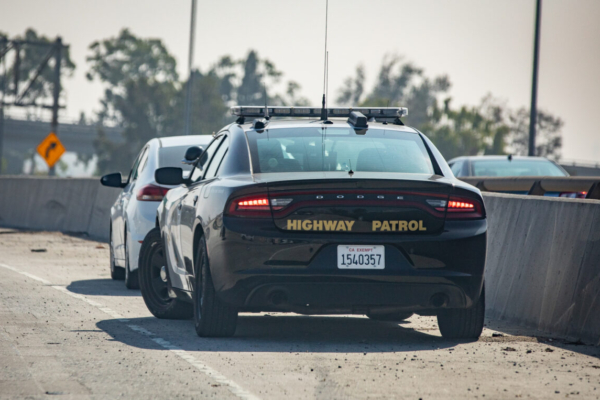
California passed some new traffic regulations last year, with some already implemented on January 1, 2026, and the rest to be enforced later. These regulations include speed limits in school zones, construction zones, penalties for running red lights, and fake license plate fines. Below are some regulations that drivers in California should pay special attention to and comply with. Some items only list basic fines, and typically California’s additional fees are higher.
In terms of point deductions, if a driver accumulates 4 points within 12 months, 6 points within 24 months, or 8 points within 36 months, their driver’s license may be suspended.
Unless otherwise indicated, the maximum speed for vehicles traveling on California two-way roads is 55 miles per hour (mph), and the maximum speed on highways is 70 mph. Generally, for speeding by 1-15 mph, the basic fine is $35; for speeding by 16-25 mph, the basic fine is $70; for speeding over 25 mph, the basic fine is $100. However, with additional fees, court costs, and a 20% state surcharge, fines for speeding by 1-15 mph may exceed $230.
California Vehicle Code (CVC) Section 22400 prohibits vehicles from traveling, slowing down, or stopping on the road at speeds lower than the posted minimum speed to avoid obstructing normal traffic flow. Violators will be fined $238 and receive a 1-point deduction.
In 2025, California passed the AB382 law, reducing the speed limit for vehicles passing through school zones from 25 mph to 20 mph. This law will come into effect in January 2029, unless announced earlier by local authorities.
The law stipulates that: 1) the school speed limit signs with flashing lights should indicate “Flashing Speed Limit 20” and be flashing; 2) the school speed limit signs should indicate “Children Present” and there should be children present; 3) at school speed limit sign locations with specific time periods, speed limits for passing vehicles should be reduced to 20 mph during those times; when approaching schools, drivers should reduce speed to 30 mph in advance.
Additionally, at railway crossings, when drivers cannot see traffic within 100 feet at intersections, or within alleys, speeds should be limited to 15 mph. Speed limits on roads in commercial and residential areas are set at 25 mph.
In 2025, California passed the AB289 law, known as the “State Highway Work Zone Speed Safety Program”, which mandates the use of fixed or mobile automated speed monitoring systems in construction zones on highways to protect construction workers’ safety. It also stipulates that, depending on the extent of speeding violations, fines range from $50 to $500.
Section 22108 of the code requires drivers to continuously use turn signals 100 feet (30.5 meters) before turning or changing lanes. Violators will be fined $238 and receive a 1-point deduction.
Section 21806 states that when encountering emergency vehicles with activated warning devices or at least one red warning light, drivers must slow down and drive to the right edge of the road, stopping until the emergency vehicle passes. The basic violation fine is $490, with a 1-point deduction.
In 2025, California enacted the AB390 law, which mandates cautious driving when approaching vehicles parked by the roadside with emergency hazard lights on, trailers with yellow flashing lights, road maintenance vehicles, or vehicles belonging to the California Department of Transportation (Caltrans). Violators will be fined $50.
Sections 22100 and 22108 entail stopping at red lights when making right turns at intersections. Unless otherwise directed, violating this rule results in a $238 fine and a 1-point deduction. While turning, drivers must yield to pedestrians on adjacent sidewalks and approaching vehicles; if faced with a red turn arrow, they must not enter the intersection but wait for a green signal. Violations incur a $238 fine and a 1-point deduction.
In 2025, California passed the SB720 law, authorizing local governments to use cameras to capture vehicles running red lights, with fines to be paid by vehicle owners rather than drivers. Penalties range from $100 for vehicles with no violations in the past three years, to $500 for repeated violations.
The implementation times of this law may vary among cities, with some already installing cameras at intersections, while others have not done so. This law might be enforced concurrently with another law installing automated speed monitoring systems.
Section 21655 stipulates that drivers are fined $490, with no points deducted, for driving on carpool lanes without passengers.
Section 21460 prohibits drivers from crossing double parallel yellow or white lines. For a first offense, the basic fine is $234, which, after additional fees, can amount to $480 or more.
Section 22100 requires drivers not to make U-turns at intersections where they are prohibited; and at intersections where U-turns are allowed, they must make the U-turn from the leftmost lane. Violators face a $234 fine, which can rise to $400 after additional fees, and may result in a 1-point deduction.
Section 24250 mandates the use of front lights when visibility is poor or objects are not clearly visible. Lights should be turned on half an hour after sunset or half an hour before sunrise, with a $230 fine for violations.
In 2025, California passed the AB1085 law, concerning “License plates: obstruction or alteration”. It increases penalties for altering license plates, with fines of $1,000 for manufacturing or selling obscured plates. Vehicles with altered plates or those that erase, obliterate, or change the reflective layer of license plates to evade monitoring will be fined $250 per violation.
Section 23123 prohibits the use of mobile or electronic communication devices by drivers, including when stopped at a red light, except when devices are designed and configured for hands-free calling, mounted on the windshield, dashboard, or require minimal touch to activate certain features.
The above regulations exclude making emergency calls to law enforcement agencies, healthcare facilities, fire departments, or other entities. The first violation incurs a $20 fine, with subsequent violations amounting to $50 each, but including additional fees, fines can exceed $160.