
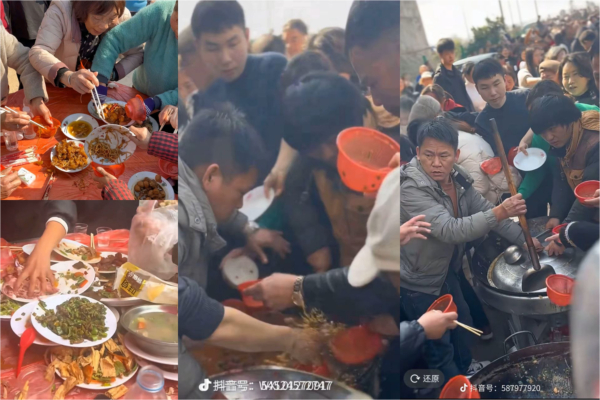
In recent days, the unexpected “pig slaughter feast” trend on the mainland has gained popularity, with various internet bloggers calling on netizens to gather in their hometowns to have pig slaughter feasts. On January 14th, a blogger in Zhangxiang Town, Fengcheng City, Jiangxi Province, hosted a pig slaughter feast that turned chaotic, resulting in a scene of unruly scrambling.
This trend originated from a rescue video by a woman named “Daidai” from Hechuan District, Chongqing, where she sought help from netizens on January 11th as her elderly father was unable to slaughter pigs. She invited everyone to come over and enjoy some pig soup. Subsequently, visiting “Daidai” for pig soup became an online sensation, with over 100,000 viewers in the live broadcast.
Not only that, the local culture and tourism bureau seized this opportunity to promote vigorously, with the official account releasing 9 videos in a day, showcasing scenic spots and local specialties in Hechuan. The “pig slaughter feast” eventually saw the slaughter of 5 pigs, with a peak attendance of around 3,000 people on-site simultaneously and a total of tens of thousands of participants over two days.
Inspired by this, internet bloggers in various regions quickly followed suit. The TikTok blogger “Fengcheng Wolong Brother” in Dongling Village of Zhangxiang Town, Fengcheng City, Jiangxi, posted a video announcing a pig slaughtering event on January 14th, where netizens could simply show up and join in for a lively gathering to experience the festive atmosphere.
He prepared 100 tables, along with a fireworks show worth 50,000 RMB. Three pigs were slaughtered, and there were also roast lamb, lamb soup, barbecue skewers, 1,000 braised duck feet, and 100 boxes of Hami melons. Unexpectedly, the event spiraled out of control, leaving the blogger in tears as he looked at the chaotic mess in the yard and realized the elderly had not eaten all day, admitting that he was ill-prepared.
The reason behind the chaotic scene at the event was the unexpected arrival of local elderly residents from within a ten-kilometer radius, who came with the intention of taking advantage of the “free feast” by promptly seizing the opportunity to join the ruckus and engage in a “battle” for resources.
Video footage showed that as soon as the dishes were brought out, a swarm of people rushed to grab food, causing plates to break and food to be scattered on the ground. The chef’s large pot of hot soup was instantly swarmed by people disregarding the scalding temperature, and within seconds, the pot was emptied. Despite the chef’s attempts to control the situation, some individuals pulled at his clothes or lifted the lid off the pot, leading to a free-for-all food-grabbing frenzy. Eventually, tensions escalated with one group sitting for hours without food, leading to a public outburst overturning tables and even pushing those trying to intervene.
The scene descended into chaos, with out-of-towners unable to squeeze in and becoming mere onlookers amidst the commotion.
One netizen who drove over from Xinyu City mentioned that they didn’t get to eat any food or drink water despite thousands of people being present. Frustrated by the situation, they ended up buying a bottle of water and a $10 egg and rice dish, just to be a part of the event briefly before leaving abruptly.
Other netizens shared their experiences in the comment section, with one lamenting a harrowing journey that involved being stuck in traffic, trekking for miles on foot, arriving exhausted, hungry, and thirsty, only to find the seats occupied, unattended by local villagers or distant relatives. Food service was slow and chaotic, resembling a landscape of disorder with people shamelessly resorting to thievery over meager resources.
Some netizens shared how they couldn’t even buy water, walked four kilometers after parking their cars, only to find a lack of food options such as barbecue or frozen sugar candies. Even those who traveled thousands of kilometers from Fujian left with just a pair of chopsticks, disappointed by the anticlimactic turnout.
This phenomenon, common in China, mirrors instances of unruly behavior witnessed during instances of chaos, such as villagers madly scrambling for goods from overturned trucks, looting supplies at marathon aid stations, or taking advantage of supermarket shortages during floods. It reflects a societal anxiety for resources, moral decadence, and a utilitarian mentality of “first come, first served” perpetuated under the Communist regime.