
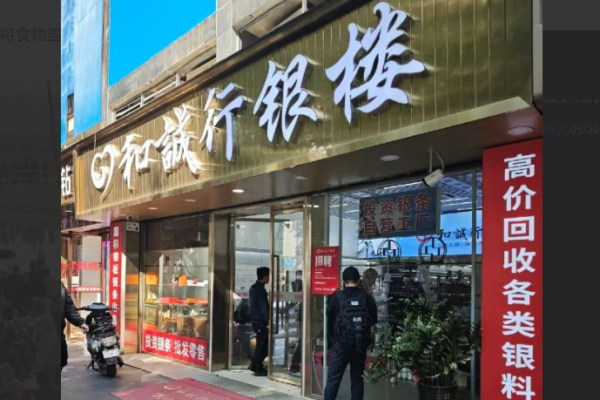
Against the backdrop of international gold prices repeatedly hitting historic highs and significant adjustments to the domestic gold tax system, the Shuibei Gold and Jewelry Wholesale Market, hailed as the “China Gold Capital,” is facing a wave of panic among traders following a recent incident where several gold shops in the market collapsed in September last year. The recent news of another incident involving the owner of a silver shop running away has further fueled anxiety among both upstream and downstream merchants.
In the past few days, the local “Hechenghang Silver Shop” in Shuibei was reported to have suddenly closed down. Overnight, all the gold and silver jewelry in the store was emptied, triggering panic among traders. Videos circulating on Douyin (the Chinese version of TikTok) showed several police officers maintaining order in front of the shop’s large signboard.
One of the victims, Zhao Cheng (alias), interviewed by Dajiyuan, revealed that upon hearing the news early in the morning, he and other customers rushed to the store to check the situation, only to find the store sealed off. “From the first glance, we all knew what had happened, and without saying a word, everyone immediately called the police.”
According to Zhao Cheng, Hechenghang Silver Shop completed the operation of clearing out the store in an extremely short period of time. “He moved all those gold and silver jewelry, and it only took him two to three hours in one night,” Zhao remarked. The amount of goods originally stored in the shop was astonishing, ranging from several million yuan, tens of millions of yuan, and even “there were goods worth tens of millions” disappeared the next morning, leaving almost no physical assets for recovery.
Not only were the customers caught off guard, but the internal staff of the silver shop were also completely unaware. Zhao Cheng recounted the situation at the scene, noting that the employees were baffled when they arrived at the shop that day, not knowing what had happened, only to see the shop suddenly turn into its current state. Regarding salaries, the owner had only paid up to December of the previous year, with January’s wages still pending.
According to Zhao Cheng’s observations, around one to two hundred victims have registered at the scene, but the actual number of victims is likely much higher. This is because the silver shops and material traders in Shuibei have not only served the local market but have also extended their business nationwide. “Many of those who set up in Shuibei can already conduct nationwide business; it depends on how their systems operate.”
He asserted that in cases of collapse on this scale, the amounts involved “must be in the tens of millions, no doubt,” and possibly even reaching hundreds of millions. “Because the merchandise in the store alone is worth so much, being moved all in one night; when it’s discovered the next day, there’s no way to recover.”
In terms of losses distribution, some people lost just a few thousand yuan or tens of thousands of yuan, but there were also those who suffered losses ranging from several hundred thousand yuan to even millions of yuan. Zhao Cheng mentioned overhearing someone whispering about losing “four or five hundred thousand,” highlighting the significant gap in the amount of losses suffered.
Having been in the industry for about eight years, Zhao Cheng initially engaged in jade trading, later switching to gold and silver products due to the good operational conditions of Hechenghang. He played a role in the supply chain by providing goods from the source, and despite not being a large-scale operation, his actual loss this time is around seven to eight thousand yuan.
He pointed out that in general, when customers order gold or silver bars from the silver shop, they are required to pay a deposit. “Some pay ten percent, some pay half, and there are those who pay in full.” If no deposit is paid at all, the seller often considers the buyer as “insincere” and is unwilling to assist with the procurement process.
However, it was precisely this system based on trust and experiential judgment among acquaintances that became a significant risk amplification factor during the collapse. Some customers who were new to the industry or engaged in cross-region transactions assumed that since the other party had been operating in Shuibei for many years with a large store scale, they trusted that “this store won’t run away,” and thus felt comfortable depositing the full payment or a substantial deposit, only to end up suffering significant losses.
Regarding the cause of the collapse, Zhao Cheng emphasized multiple times that the core issue was not a complete collapse of the entire industry but rather individual operators being unable to withstand the operational pressures amidst the sharp fluctuations in gold prices.
He explained that when gold prices rise rapidly, silver shops often face the dilemma of “losing if the order is late.” “For example, if I ordered goods worth one million yuan today, and the price rises to over one million the following night, if the order is delayed even a bit, the difference will result in a loss.” However, the silver shop had promised delivery to customers, not fulfilling the order would mean breaching trust, hence they were left with no choice but to bear the loss.
Conversely, when gold prices plummet, there are cases of customers defaulting on orders. “They placed an order, but if the price drops drastically, they abandon the order without taking the deposit.” However, the silver shop had already made purchases from upstream suppliers based on the order, and with the goods in hand, the loss had to be borne by themselves. Zhao Cheng described the customers’ transactions as “simultaneously buying and selling” while the silver shop had to bear the risks of price fluctuations unilaterally.
In addition to price risks, financial pressure was also a crucial factor that overwhelmed many merchants. Zhao Cheng pointed out that in the past, a business that could be conducted with just one million yuan as capital now often requires two to three million yuan due to the rising gold prices. “Without that much money, one can only resort to loans.” The interest costs of loans further erode the already slim profit margins.
Illustrating the slim profits from his own experience, Zhao Cheng mentioned that about two years ago, when he first bought a gold bar, it was priced at around 460,000 yuan, with a profit margin of only 2,000 yuan. However, nowadays, even such profits are difficult to sustain. “If you deposit one million in the bank, you’d earn twenty thousand in interest per year; but in gold and silver trading, where you bear risks, you might only make two thousand a year, and after deducting rent, labor costs, living expenses, you actually don’t make any money.”
From a macro perspective, the Shuibei business district is currently undergoing a period of structural adjustment. The essence of the Shuibei model is a wholesale distribution center with a “front store and rear factory” setup where the front serves as the retail space, while the manufacturing and processing take place in the rear. Most establishments do not have on-site licenses, so the overall system does not follow financial investment logic but functions based on physical wholesale principles.
According to a report by 21st Century Economic Report, against the backdrop of tax reforms, the proud “investment gold” market model in Shuibei quietly exited in December last year.
The report stated that Shuibei currently gathers nearly 8,000 market entities with annual revenue exceeding 155 billion yuan. However, following the “gold tax reform,” if a merchant is not a member of the Shanghai Gold Exchange, their “investment gold” business is almost no longer profitable, leading many stores to either exit or specialize in “jewelry gold” (gold jewelry sales) operations.
Zhao Cheng also mentioned that since the relevant tax adjustments began to be implemented in October and November last year, approximately one-tenth, and even up to one-fifth of the stores in Shuibei have closed or ceased operations, with an additional portion expected to follow after the Chinese New Year. Faced with pressure from rental costs, labor wages, tax burdens, and market demands, many merchants can only struggle to stay afloat.
Currently, the only recourse for the victims is to resort to legal means. Police stations have set up registration points on-site, where as long as they can confirm past transaction records with Hechenghang, they can be recorded for further actions. However, Zhao Cheng admitted that he is not optimistic about the ultimate outcome.
“Many of these cases end up without resolutions; you can’t wait for results.” He pointed out that gold and silver transactions are not registered or recorded, and their liquidation is extremely rapid. “You can’t even find out who it belongs to.”
He mentioned that even if there are some remaining items in the store, they are far from enough to offset the “tens of millions, possibly hundreds of millions” in losses. Although some victims have discussed forming groups to seek legal recourse, everyone is aware that their hopes are “almost minuscule.”
Looking towards the future, Zhao Cheng does not believe that the gold and silver industry will completely vanish, but he anticipates that within the next one to two years, “at least half of the people won’t engage in this industry anymore.”
He lamented that no one enters into business with the intention of breaching trust from the start. “In an unfavorable economic environment where the overall societal living conditions aren’t that great, the collapse of Hechenghang Silver Shop may just be a microcosm of the larger adversities.”