
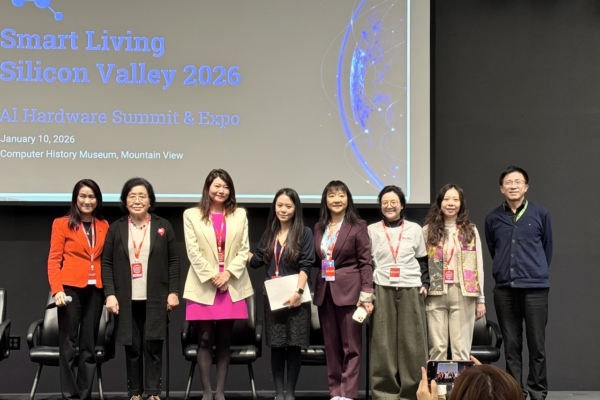
“Smart Living Silicon Valley 2026”, a summit focusing on artificial intelligence (AI) and hardware innovation as its core, took place in Mountain View on January 10th. The summit aimed to explore the transition of AI from concept to practical applications and delve into its impact on future intelligent living patterns.
The event was organized by the US-China Silicon Valley Chamber of Commerce (USCCSV) and featured two venues, with 30 booths and 40 startup presentations, attracting around 1,500 participants. The activities included keynote speeches, industry forums, startup pitches, AI art exhibitions, as well as exclusive closed-door discussions and a VIP dinner, bringing together professionals in the fields of AI, robotics, biotechnology, financial technology, and sustainable development.
During the opening remarks, Marian Chaney, the president of USCCSV, shared the origin and vision of “Smart Living Silicon Valley 2026”. She emphasized the chamber’s role as a bridge connecting the East and West through technology to foster innovation and assist the Chinese community in global industry growth.
She highlighted the chamber’s aspiration to build a fast lane to the future in the AI era – a smart life driven by AI. As a member of the Chinese community in the United States, she stressed the importance of active participation in reshaping industries rather than being mere observers. She also emphasized that AI is not meant to replace humans but to become partners in manufacturing and industry upgrades; failing to help communities understand and embrace AI could lead to the obsolescence of many traditional industries in the new era.
The forum theme, “Smart Living in the Era of AI”, focused on the practical application of AI in areas such as smart homes, healthcare, robotics, green energy, and wearable technology.
Several speakers noted that AI is rapidly transitioning from software tools to hardware and the physical world, making balancing efficiency with safety, ethics, and human-centric design a key focus for the next phase of the industry.
The event featured heavyweight speakers sharing the latest observations and research findings, including Peter Norvig from Stanford University’s Human-Centered AI project and Dylan Patel, founder of SemiAnalysis, providing insights into the development trends of AI and hardware integration from academic and industry perspectives.
A special highlight of the agenda was the startup pitch session, allowing entrepreneurial teams to showcase their products and business models directly to investors and industry leaders, with some focusing on real-world case studies of AI and hardware integration.
Simultaneously, an AI Arts Exhibition showcased visual artworks combining generative AI with human creativity, illustrating how technology has become a new medium for creation.
Furthermore, the summit included closed-door high-level discussions inviting senior corporate leaders, investors, and founders to engage in confidential exchanges covering topics such as US-China and Asian investment strategies, hardware product globalization, supply chain transformation, as well as startup branding and market growth directions.