
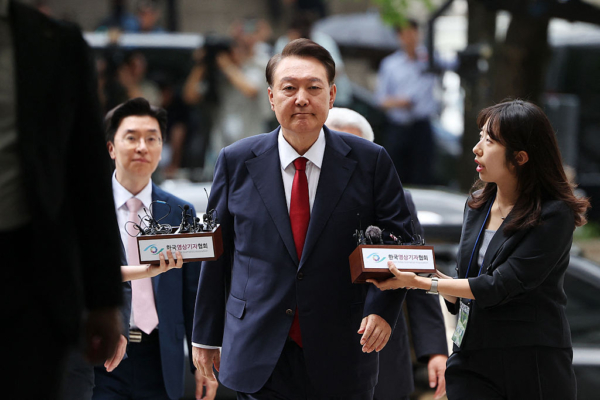
In the late hours of Tuesday (January 13th), after a marathon 17-hour court session, the special prosecutor in South Korea requested the death penalty for former president Yoon Suk-yeol for his alleged involvement in inciting insurrection. The case stems from Yoon’s brief declaration and implementation of martial law. The Seoul Central District Court has concluded the trial and is expected to deliver the verdict on February 19th.
The independent prosecution team investigating the insurrection and treason case stated in court that Yoon Suk-yeol led the insurrection, a charge not protected by presidential immunity and punishable by death under the law.
The prosecution pointed out that evidence showed the martial law was not a spur-of-the-moment decision but a plan devised by Yoon Suk-yeol and former Defense Minister Kim Long-hyun starting from October 2023, aimed at maintaining Yoon’s grip on power.
Prosecutor Park Ik-su stated that Yoon Suk-yeol’s use of force to block the parliament and election commission was fundamentally an act of “anti-state activity” that violated national security and the people’s right to life.
The independent prosecution team emphasized in court: “Yoon Suk-yeol’s announcement of martial law, driven by the desire to control the judicial and legislative branches for his long-term rule, and the unauthorized use of resources that should be used for the common good of the nation, constitutes extremely heinous crimes.”
Yoon Suk-yeol himself denied the related charges. In a lengthy closing argument lasting an hour, he described the independent prosecution team as a “blind charge of wolves” and condemned the accusations in the case as “fantasy and fabrication.”
The 65-year-old Yoon Suk-yeol stated in court that the imposition of martial law was to resist “evil forces that would destroy the nation.” He claimed that issuing martial law fell within the scope of presidential authority and was meant to send a warning to the opposition parties hindering the government’s governance.
When the prosecution announced its sentencing recommendation, Yoon Suk-yeol’s supporters in the gallery laughed and even muttered curses, leading the judge to intervene to maintain order.
The martial law incident occurred on the late night of December 3, 2024, when the military forcibly entered the parliament building and clashed with the public. However, within a mere three hours, 190 parliament members broke the blockade to enter the chamber and voted unanimously to revoke martial law, ultimately ending the political crisis within 6 hours.
At the time, Yoon Suk-yeol accused the opposition party of engaging in “anti-state activities” and colluding with “North Korean Communists.”
While South Korean law still retains the death penalty, it has not been implemented for nearly 30 years since 1997 and is considered by Amnesty International as a country that is “effectively abolitionist.”
The current government of President Lee Jae-myung issued a statement through the office, expressing confidence that the judicial authorities would render a fair judgment based on “law, principles, and public standards.”
South Korea’s legal expert from Sejong University, Lim Jibong, stated that it had been widely expected that the prosecution would seek the death penalty.
South Korea’s Criminal Law stipulates that those who lead an insurrection are subject to only three statutory penalties: death, life imprisonment, or indefinite imprisonment.
Lim Jibong told “This Week in Asia” that he believes the court is more likely to sentence Yoon Suk-yeol to life imprisonment, as the death penalty could “turn Yoon into a martyr among his supporters, further exacerbating political divisions.”