
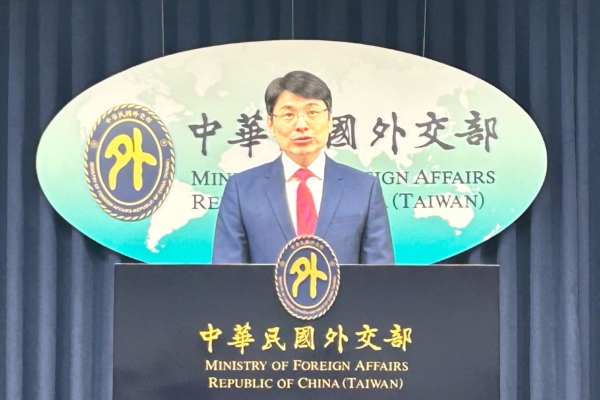
In response to foreign media reports, the Chinese Communist Party’s Ministry of Foreign Affairs has proposed to European Union officials to ban Taiwanese officials from entering EU countries. The spokesperson for the Ministry of Foreign Affairs of the Republic of China, Hsiao Guang-wei, condemned the Chinese Communist Party for using various despicable methods to suppress Taiwan’s international space, stating that such actions should be condemned.
According to the UK’s The Guardian, the Chinese Communist Party has been providing legal advice to European countries, requesting them to ban Taiwanese politicians from entering their territories.
Hsiao Guang-wei, the spokesperson for the Ministry of Foreign Affairs of the Republic of China, responded to the media today (14th), expressing strong condemnation for the Chinese Communist Party’s continued use of various despicable methods to suppress Taiwan’s international space.
Hsiao Guang-wei pointed out, “The visits of high-level officials from our country to EU countries are a normal exchange and interaction between Taiwan and Europe, welcomed by various parties in Europe, contributing to the development of mutually beneficial relations between Taiwan and Europe, and have nothing to do with the People’s Republic of China.”
He emphasized that the Chinese Communist Party has no right to interfere. On the contrary, it is the Chinese Communist Party that resorts to various forms of coercion towards other countries, threatens Taiwan with force, disrupts peace and stability in the global and Indo-Pacific regions, jeopardizing the direct interests of the European Union. Their behavior should be condemned.
He stated that in the face of the Chinese Communist Party’s attempts to undermine Taiwan’s relationships with international partners, the Ministry of Foreign Affairs will strengthen cooperation with like-minded countries, consolidate universal values such as democracy, freedom, and the rule of law, deepen substantive exchanges and cooperation bilaterally and multilaterally, and jointly promote regional and global peace, stability, and prosperity.