
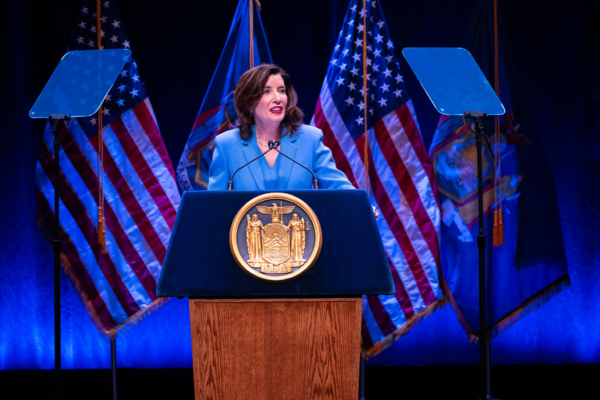
New York Governor Hochu delivered her fifth State of the State address on Tuesday, January 13, with a focus on affordability. She presented a policy blueprint aiming to shape New York into a state with more affordable cost of living, increased security, and easier construction of housing and infrastructure projects.
In her address, Governor Hochu stated, “The core of this agenda reflects the kind of state we aim to be.” The proposals she unveiled cover a wide range of areas, including expanding childcare subsidies, streamlining environmental reviews for housing and infrastructure, lowering car insurance premiums, expanding nuclear power generation, and imposing stricter limits on federal immigration enforcement.
Regarding the affordability issue, Governor Hochu continued her recent policy direction, particularly emphasizing childcare and family financial stress. Last week, she announced a $1.7 billion investment to increase access to childcare services for an additional 100,000 children within the next year, with a total childcare budget reaching $4.5 billion.
This investment plan makes New York the second state after New Mexico with a clear plan to move towards “universal childcare.” The policy will first consolidate existing pre-K and 3-K programs in New York City and extend the service age down to 2 years. The state also proposes expanding pre-K education funding in areas outside NYC over the next four years to achieve statewide universality.
Echoing discussions on affordability during last year’s New York City mayoral elections, Governor Hochu’s speech also focused on the pressures faced by the middle class and working families. Unlike Mayor Mamdani, she did not target high-income wealthy individuals nor propose raising income taxes as a funding source. Regarding how to finance this ambitious policy blueprint, Hochu briefly touched upon it, mentioning that detailed financial information would be provided in next week’s state budget presentation.
New York State Senator Chen Xueli, on behalf of the Republican Caucus of the New York State Senate, responded to Governor Hochu’s State of the State address on January 13. Chen Xueli expressed concerns that families across the state continue to face rising cost of living and deteriorating public safety without clear and effective solutions from the state government to address the challenges they encounter daily.
In the housing sector, Hochu continues the policy direction of “increasing supply” and “shortening development timelines.” She advocates for relaxing or adjusting the long-criticized overly stringent environmental review processes applicable to housing and infrastructure. Advocacy groups supporting development argue that rules originally designed to protect air and water quality are increasingly used to delay or block housing construction, making it harder for local governments to push forward large infrastructure projects.
Apart from childcare, Hochu proposed ideas to reduce car insurance costs. New York’s auto insurance premiums have long been among the highest nationally, with an average annual premium of around $4,000, far exceeding the national average of $2,679. The Governor pointed out that one of the reasons for the high premiums is due to fraud and high-value claims involving criminal activities.
Her measures include cracking down on fraud to lower auto insurance rates, strengthening insurance companies’ anti-fraud mechanisms, limiting compensation for illegal actions in accidents such as drunk driving or drug-related driving, restricting compensation for those deemed primarily at fault in accidents, tightening the threshold for “serious injury,” ensuring cost savings are passed back to consumers (rather than insurers), enhancing transparency in the auto insurance market, and improving incentives for safe driving.
In terms of energy policy, Hochu proposed a significant upgrade goal to raise nuclear energy generation capacity from 1 gigawatt to 5 gigawatts. Nuclear energy will serve as the “backbone” of New York’s zero-emission energy system.
Nuclear power is seen as a stable energy option, especially with the rapid increase in power demand driven by artificial intelligence (AI) and cloud computing, where data centers consume high levels of electricity. Hochu also stated that in the future, if large data centers are established in New York, they must pay their fair share for electricity costs and are required to assess self-built or paired with independent, clean power sources to reduce pressure on the public power grid while avoiding transferring costs to ordinary users.
On the immigration issue, Hochu stated support for legislation allowing individuals to sue federal immigration officers for alleged violations of constitutional rights, a mechanism currently applicable to state and local law enforcement agencies.
Additionally, she will push for legislation requiring immigration enforcement agencies to obtain warrants before entering sensitive locations such as hospitals, places of worship, and schools. These measures are expected to gain support in the state legislature where Democrats hold the majority. The State Senate leader also stated this week that protecting immigrant rights will be a priority for this session.
On public safety policy, Hochu continued her administration’s focus, emphasizing that over $3 billion has been invested in security and law enforcement systems over the past four years. She announced plans to expand the crime analysis network, increase subway police presence, install platform security enhancements, and strengthen interventions for mental health patients.
In terms of gun control, the Governor proposed several groundbreaking ideas nationally, including requiring 3D printing equipment sold in New York State to include software to prevent printing firearm parts and banning the sale of handguns that can be modified into high-capacity rapid-fire weapons.