
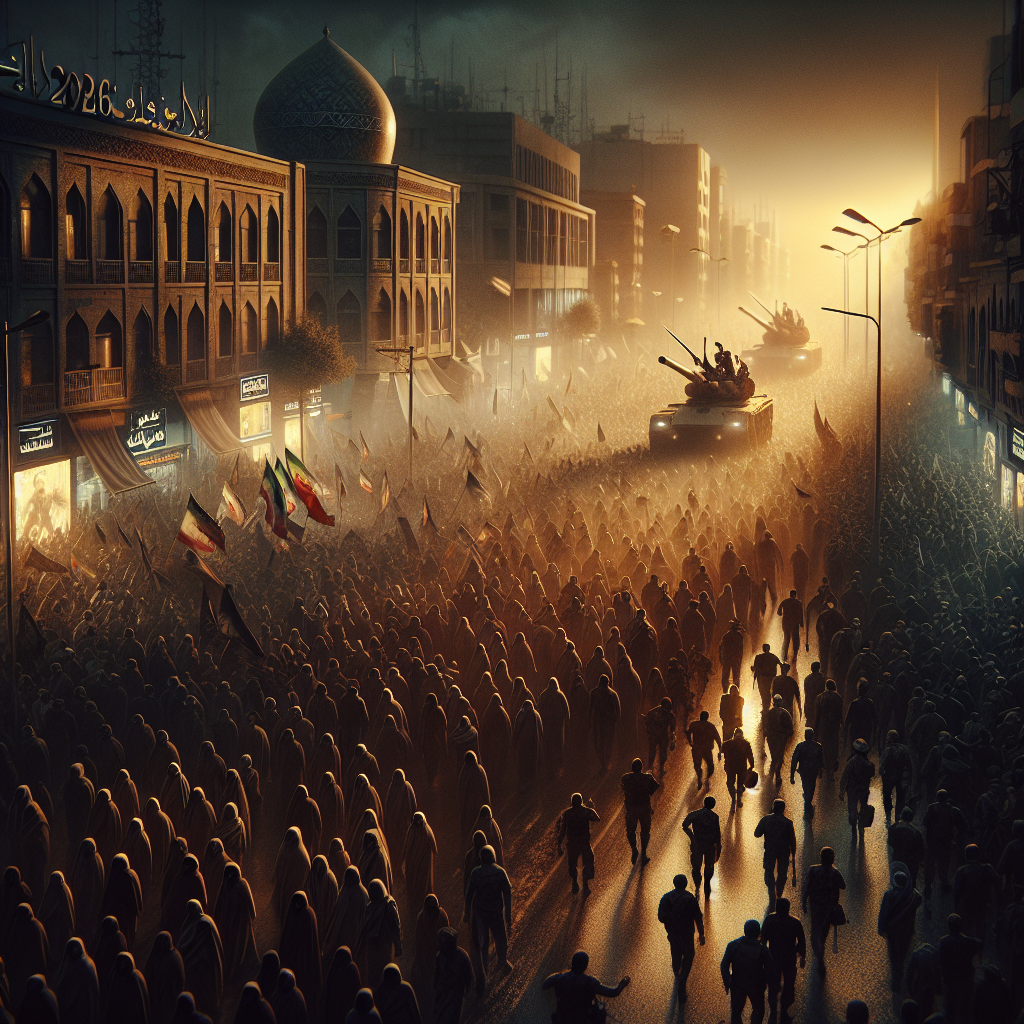
Iran erupts in nationwide anti-government protests, brutally suppressed. Experts point out, “Iranians fear not death, but fear being afraid of death.” They analyze that the situation in Iran has now shattered the ruling theory of the Axis of Evil and 2026 is destined to be an extraordinary year. With such a fiery start to the revolution, the domino effect could lead to unpredictable outcomes.
Political commentator Wu Kunyu posted on Facebook, stating that the current situation in Iran cannot be described as a mere protest but rather a revolution. The rapid development, widespread impact, and escalating level of confrontation over the past two weeks have left the world in awe. This case confirms theories proposed by many scholars: an authoritarian government often collapses not gradually but in a moment of public outrage.
Wu Kunyu mentioned that no one, including the Iranian leadership, the US President, European countries, and the media, foresaw the situation escalating so rapidly to complete chaos. With no contingency plans, credible information sources, resources for quick deployment, or authoritative figures to address the crisis, all parties are left helpless as the wildfire spreads uncontrollably, like a train wreck until one side collapses completely.
He analyzed that the catalyst for the Iranian revolution was the sharp drop in the exchange rate of the rial to the dollar, reaching 1 USD to 1.4 million rials. Combined with a staggering inflation rate of 50% and a food price increase of up to 70%, the crisis culminated in December 2025. Urban residents started going hungry, and as food is a basic human need, they had to spend more to buy what little was available, exacerbating inflation further.
“The severe inflation now means that the middle class in cities can only afford one egg with a month’s salary, wiping out a lifetime of savings in a single night. All transactions have come to a halt, life has turned dark, and the future is uncertain. Neither the government’s financial capacity nor its currency devaluation can support subsidies, distribution, or transportation of food from rural areas to alleviate the crisis. Hungry people took to the streets, directing their anger at the entire ruling system. In such dire circumstances, religious appeals and political slogans are no longer effective; they only fuel people’s will to fight against the oppressors,” Wu Kunyu said.
He pointed out that the military’s use of gunfire for repression has not been as effective as before because for those with empty stomachs, fulfilling their hunger becomes the priority. Sitting idly at home equals slow death by starvation, while taking to the streets may result in being shot, but a quick death is preferable to a slow one. The Revolutionary Guards and Basij militia deployed snipers to target leaders and organizers, resulting in many people being shot in the eyes, a signature of sniper attacks.
Furthermore, in some cities, shotguns were used to target people’s legs to deter them from advancing. It is reported that heavy machine guns were deployed in some areas, causing numerous casualties, with the main objective still being to prevent the crowd from advancing. In large-scale street protests involving tens of thousands or even hundreds of thousands of people, especially in a tsunami of hungry crowds, the military force is insufficient to eliminate them; blocking their advance will only force the hungry crowd to move elsewhere.
Wu Kunyu analyzed that if people are blocked in cities, their first choice would be to migrate to rural areas where food is available. This implies that the current urban protests and political demands in Iran, including the wish for the return of the Pahlavi dynasty, are merely short-term measures. True leadership that can mobilize and organize the crowd is one that can ensure people have a bowl of porridge to eat today – those who can buy or exchange goods, and if unable to, resort to looting.
He expressed that US President Trump, Israeli Prime Minister Netanyahu, and the exiled Crown Prince of the Pahlavi dynasty must not only prepare for military actions to defeat the Revolutionary Guards and other armed forces but also plan a massive transportation initiative similar to the Berlin Airlift and implement a comprehensive currency reform and financial restructuring to stabilize the situation in Iran.
Wu Kunyu stated that Iran meets all five criteria for a successful revolution: “financial crisis, elite split, diversified opposition alliance, persuasive resistance narrative, and favorable international environment.”
As for whether Ayatollah Khamenei will flee to another country, Wu Kunyu speculated that he would want to, but the probability is low. Even if he wanted to escape, the military leaders around him would not allow him to, as his escape would lead to a complete collapse. If the military leaders themselves cannot flee, they can only wait for their downfall. Khamenei has no choice but to remain firm until the US or Israeli troops destroy his entire armed forces or intervention from China and Russia. The theocratic government he leads appears unsustainable.
Wu Kunyu remarked that Iran’s revolution has dealt a heavy blow to the Axis of Evil. Suppressing popular movements by eliminating leaders no longer applies when facing massive uprisings triggered by a complete economic collapse. This vulnerability of authoritarian rule showcases the inherent asymmetry between establishment and crumbling. The stability of currency and transactions is the fundamental and essential mechanism for any regime.
He emphasized that as long as the currency mechanism remains stable, people can struggle to survive; however, once they cannot afford a simple meal, everyone will turn against them, even the military and police forces. The situation in Iran has shattered the ruling theory of the Axis of Evil. An administration ruling for fifty years, causing people to go hungry and markets to cease trading, cannot maintain its normal operations, let alone foster growth and development.
Wu Kunyu mentioned some pro-government media outlets in Taiwan have remained silent about the Iranian revolution because they have nothing to say. The collapse of such a significant country has exposed the fragility of authoritarian rule, leading to a loss of respect and trust. When trust disintegrates, grand narratives of external propaganda become mere self-consolation wallpaper, unable to convince people or leave the borders, becoming an elderly person’s murmurs and painful memories.
“2026 is destined to be an extraordinary year, kicking off with such a fiery revolution. Where the domino effect will stop, no one can predict. The Red Horse and the Black Horse apocalypse is not a fantasy; the real drama may not have even begun, with over three hundred days left on the schedule. Everyone should buckle up,” Wu Kunyu concluded.