
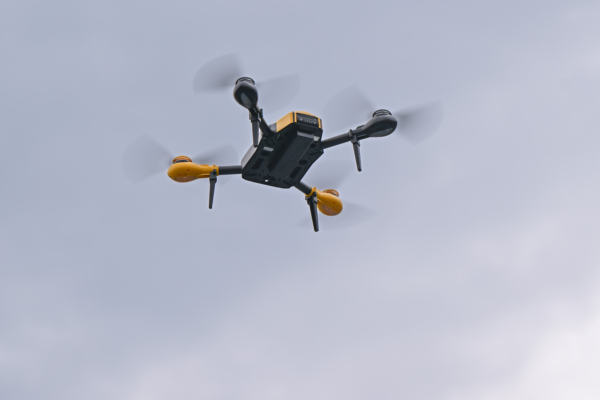
Recently, Guangdong traffic police have deployed drones to track and apprehend electric vehicles from the air, sparking heated discussions and criticism among netizens. Many internet users expressed disappointment that this type of technology is being used as a surveillance tool instead of being utilized for public assistance.
The video footage shows that on December 27, in the airspace above a city road in Guangdong, a drone was seen hovering at low altitude, tracking and filming electric vehicles on the road. Subsequently, ground traffic police intercepted the vehicles based on the aerial footage. The person recording the video claimed that the drone locked onto the target throughout the pursuit and was able to maintain tracking in complex road conditions.
After the video spread, the barrage of comments increased rapidly. Many comments revolved around the use of drones, with many netizens contrasting drone surveillance scenes with public emergencies such as fires or search and rescue operations for missing persons, leading to repeated sarcastic and questioning responses being shared.
In response to this, Mr. Yin, a Guangdong resident, expressed his concerns in an interview with Epoch Times on January 13, stating that the local authorities have been frequently using drones for patrols. He said, “The Chinese Communist Party talks every day about how high technology is changing lives, but the only thing that has changed is that common people are being monitored more closely. Ordinary citizens who use drones for filming are strictly limited in height, these technologies were originally meant for saving people, but now they have become tools for surveillance. Who dares to hope for technological progress under these circumstances?”
In the comment section, some netizens suggested that in the hands of these individuals, a drone could cause harm to ordinary people, and if more advanced technology were to fall into their hands, it could be even more dangerous. There were strong calls for European and American restrictions. Some netizens mentioned the scarce presence of drones in scenarios like fires or search and rescue missions for missing persons, highlighting the selective use of technology and its implications.
Furthermore, the questioning remarks continued, with a netizen sarcastically stating, “If you can’t find missing children, it’s not used; if you can’t investigate corruption, it’s not used; but if you’re riding an electric vehicle, bring out the drones immediately.” Another netizen taunted, “Will we soon be tracked from the sky for walking too slowly?”
Mr. Yin, a rights activist who has long been concerned about public affairs, mentioned that the government entities have been adept at controlling drones and continuously tracking a single target, indicating the maturity of the technology. He queried, “Although these technologies are used daily in law enforcement, they are rarely seen being used for rescue missions or locating missing persons. This demonstrates that their primary purpose is not to assist ordinary people but to monitor them.” He believed that when technology is repeatedly used to control individual actions instead of aiding the public, people become aware of this contradictory situation.
In recent years, various public security, traffic police, and city management departments in China have introduced drone systems for traffic patrolling, evidence collection for violations, and urban management. Meanwhile, regulations for the civilian use of drones are also being tightened.
Public information indicates that mainland China implements classified airspace management for unmanned aircraft, categorizing airspace into controlled airspace, permissible flying airspace, and temporary controlled airspace. The regulations specify that drones above 120 meters should generally fall under controlled airspace and require prior application for relevant permits. In urban airspace, the drone flight activities of ordinary users must adhere to height restrictions and follow the respective approval or reporting procedures based on their purpose and airspace arrangements. Previously, there were reports of individuals being warned by the authorities after testing newly purchased drones at home.
Some netizens sarcastically remarked that electric vehicles cannot be ridden and drones cannot be flown, prompting questions about the authorities’ state of anxiety, indicating that even elite forces like the U.S. Delta Force do not rely on drones for descending from the sky.
Mr. Zhu, a scholar from Zhejiang, mentioned in an interview that technical regulations are often established around primary usage scenarios. He believed that under the current governance structure of the Chinese Communist Party, technology must first adhere to political dictates. He stated, “When the political priorities of the ruling elites determine the use of technology, it no longer serves the public interest but rather governance needs. No matter how advanced the technology may be, it ultimately becomes just another method of social control.”
Mr. Zhu voiced that the height restrictions, approvals, and scheduling rules of drones themselves are not the issue; the critical aspect lies in how the priority levels for various purposes are set. He suggested that in an authoritarian system focusing on stability and controllability as core objectives, technology is more likely to be prioritized for restraining individuals rather than responding to their needs. These differences in utilization will accumulate over time and ultimately transform into the public’s intuitive perception.