
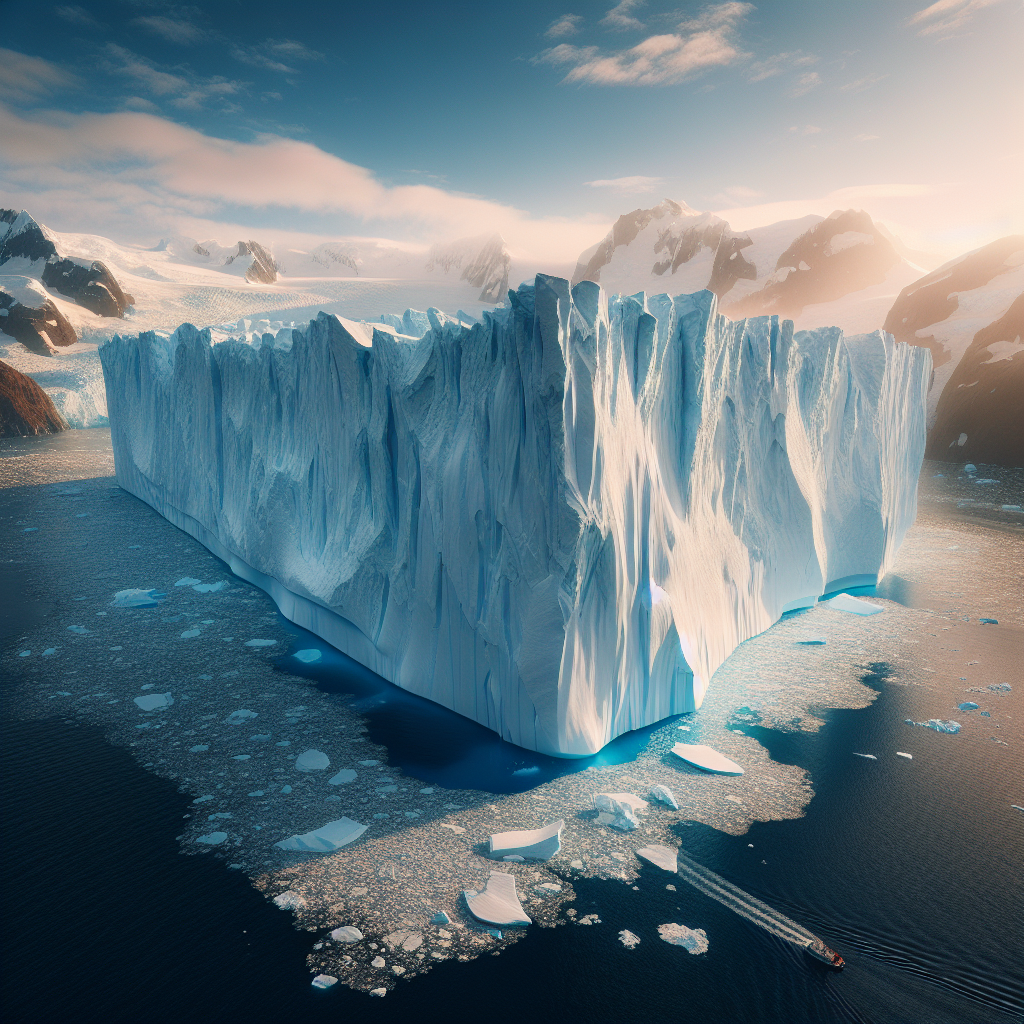
A-23a, which was once the largest iceberg in the world and one of the longest-lived icebergs tracked by scientists, is now on the brink of complete disintegration after drifting for 40 years. As it continuously shrinks and turns blue due to the infiltration of blue meltwater, the massive iceberg has caught the attention of researchers worldwide.
According to a press release from the National Aeronautics and Space Administration (NASA) on January 8, when A-23a calved from an Antarctic ice shelf in 1986, its size was nearly twice that of Rhode Island, covering an area of approximately 4,000 square kilometers.
Previously reported by the British Broadcasting Corporation (BBC), A-23a remained grounded in the Weddell Sea, one of Antarctica’s marginal seas, for over thirty years after calving from the Antarctic ice shelf. It began slowly drifting north in 2020 but encountered a whirlpool near the South Orkney Islands in April 2024, spinning in place for months before resuming its northern drift.
Now, satellite data from NASA shows that A-23a is drifting in the South Atlantic Ocean between the eastern tip of South America and South Georgia Island, saturated with blue meltwater and on the verge of complete collapse.
The U.S. National Ice Center stated that as several larger ice fragments split in July, August, and September 2025, and entered a relatively warm summer environment in December, the area of A-23a had decreased to 1,182 square kilometers by early January 2026.
On December 26, 2025, the Moderate Resolution Imaging Spectroradiometer (MODIS) on NASA’s Terra satellite captured an image of A-23a (as shown in the top image), revealing large patches of blue meltwater on the iceberg’s surface. Despite its significantly reduced size, it remains one of the largest icebergs in the ocean, covering an area larger than New York City.
A day later, on December 27, astronauts aboard the International Space Station captured a closer image of A-23a (as shown in the following image), displaying an even larger extent of its meltwater pools.
Ted Scambos, a senior research scientist at the University of Colorado Boulder, explained that the “blue slush” visible in the images is likely the ongoing result of the iceberg’s continued disintegration. The weight of water pooling in crevasses forces them to widen, possibly causing the observed phenomena.
The distinctive blue and white linear patterns on the iceberg are likely related to scratches formed hundreds of years ago when the iceberg was part of a glacier and dragged over Antarctic bedrock.
From the MODIS images, it appears that A-23a is developing cracks, with the white area on the left possibly resulting from a water geyser which could lead to the iceberg’s eventual fracturing. This eruption could result in freshwater discharge plumes mixing with the floating ice near the iceberg.
Scientists indicate that these indicators suggest the iceberg may disintegrate completely in just a matter of days or weeks, unable to withstand the Southern Hemisphere’s summer. Rising temperatures and water temperatures during the summer season are expected to accelerate the iceberg’s demise.
For scientists who have spent a lifetime tracking this iceberg, its imminent disappearance is bittersweet. Retired scientist Chris Shuman from the University of Maryland Baltimore County expressed gratitude for the satellite resources that allowed close monitoring and documentation of the iceberg’s evolution.
Shuman reflected, “A-23a, like many other Antarctic icebergs, is destined to meet its end, but its trajectory has been exceptionally long and winding. It’s hard to believe it will soon depart from us.”