
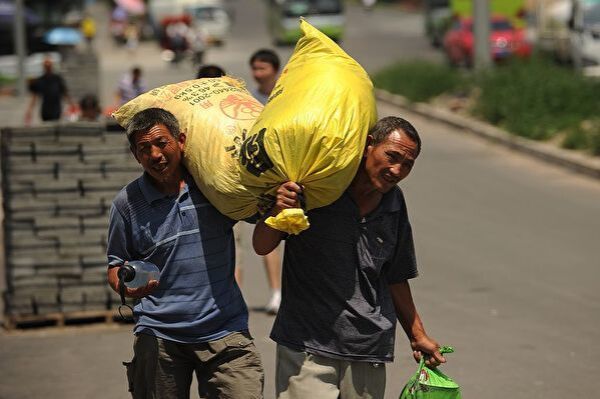
Recently, the news of a significant increase in the maximum payment limit for farmers’ pension has gone viral on the internet and become a trending topic. Official interpretations from various regions emphasize the principle of “the more you pay, the more you receive,” with claims that after paying for 15 years, individuals could receive over a thousand yuan per month. However, this statement has sparked strong backlash in the rural communities.
On one side, policies keep raising the payment limits, reaching levels that even the annual income of ordinary farmers cannot cover. On the other side, despite multiple increases in basic pension payments, they still remain around a hundred yuan. The stark difference in data has left many farmers stating, “It’s not that we don’t want to pay, but we simply can’t afford it.” Some farmers express desperation, saying, “It’s not that we don’t hope for financial security in old age, but at the moment, just living takes all our effort.”
At the beginning of 2026, provinces like Yunnan, Anhui, Guizhou, and Liaoning successively raised the highest payment levels for rural and urban residents’ basic pension insurance. Yunnan directly jumped to 10,000 yuan per year, becoming the first province with a “ten-thousand yuan tier” nationwide. Anhui, Guizhou, and Liaoning also doubled their payment levels, with the highest tier ranging from 5,000 to 9,000 yuan.
An article by Anhui blogger “Social Wide-angle Mirror” shared that when his mother heard the news, she remarked, “We should check our family’s account books first.” In a small village in southern Anhui, every penny needs to be stretched. Despite the official policy of “the more you pay, the more you’ll get,” the reality is that farming livelihoods depend on the unpredictable nature, and with this year’s plummeting corn prices, a plot of land could result in a net loss of two hundred yuan. In such circumstances, discussing saving for thirty years later is akin to discussing home renovations in a leaking house. Every household has a more pressing account – whether there’s enough rice to eat today, if medicine can be skipped tomorrow, or where the money for a grandchild’s wedding will come from in a couple of years.
Most farmers earn only a few thousand yuan in annual income from a lifetime of cultivating land, making it impossible for them to pay ten thousand yuan annually for pension contributions. Even if the payment limits rise higher, it becomes futile for farmers who can’t afford it, as these policies are tailored for affluent rural individuals and not the typical farmers.
Currently, China’s pension insurance system mainly consists of two categories: rural and urban resident pension insurance and employee pension insurance. The former covers farmers and non-employee residents in urban areas, with annual payment standards ranging from 200 yuan to tens of thousands of yuan, supported by government subsidies. The latter is for enterprise employees and flexibly employed individuals, with payments typically calculated as a certain percentage of the average social wage, commonly exceeding ten thousand yuan annually.
Rural resident pensions are composed of “basic pension + individual account pension.” The basic pension primarily relies on fiscal subsidies, while the individual account pension entirely depends on the individual’s payment capability. From a design perspective, there is an annual limit on individual payments, which serves as the highest standard for farmers’ pension contributions.
In reality, the majority of farmers have limited annual incomes throughout their lives, making it challenging to sustain high payment levels in the long term.
Data indicates that in 2023, the average rural pension per person in the nation was around 214 yuan per month, while the average pension for enterprise retirees had already exceeded 3,000 yuan, marking a difference of over ten times. Even in regions with higher payment tiers and significant subsidies, the level of rural resident pensions still falls short compared to employee pensions.
Some lament that their parents have toiled in the fields for a lifetime, yet now they receive only 180 yuan per month, barely enough left after buying blood pressure medication. Meanwhile, neighbors who are enterprise retirees receive over 3,000 yuan monthly, allowing them to enjoy activities like strolling in the park and participating in square dancing, highlighting the stark inequality.
Netizens have commented that instead of comparing with enterprise retirees, the disparity is even more shocking when compared to civil service retirees.
Apart from institutional differences, the significant disparities between regions are also apparent. While Shanghai’s rural residents may receive over a thousand yuan in basic pension payments, areas like Henan and Gansu remain at the national minimum standard of 143 yuan.
An article by blogger “Do You Eat Oil Cakes?” questions why there is such a significant gap among farmers. Some argue that farmers have contributed to public grain reserves, paid agricultural taxes, and supported urban development for decades, yet in old age, they struggle to secure even basic retirement benefits. Unlike enterprise employees who share social security payments with their employers, farmers must bear the burden on their own, raising the question of fairness.
The concept of “the more you pay, the more you receive” essentially requires farmers to fill the pension gap with their hard-earned money. Yet, local financial subsidies are meager – for instance, Guizhou only subsidizes 30 yuan for the 300 yuan tier, and 300 yuan for the 6,000 yuan tier. This isn’t incentivizing but rather miserly.
What’s particularly disheartening is that while urban elderly enjoy retirement pensions and healthcare coverage, rural elders have no choice but to continue working in the field even after the age of 60, as the 214 yuan they receive is barely sufficient. It can only afford about 20 kilograms of rice and a few eggs. The rural elderly are compelled to work because their pensions are inadequate for a decent life.
Moreover, many farmers feel distress from the information asymmetry. Some villagers were primarily encouraged to “pay more if possible” during promotions, with little clarity on the specific amounts they could receive in the future. Some farmers found out after increasing their payment tiers that the increments in their payouts were minimal, with no possibility of refunds or adjustments.
Others shared stories of relatives’ experiences – in Anhui, a family member had been paying the 5,000 yuan tier for three years, and when they fell ill last year and wanted to stop payments, they were informed it wasn’t possible. They now have to squeeze out money from their medical expenses annually to cover the pension contributions, making their lives even more challenging.
Furthermore, some struggling farmers who sought to benefit from the government’s policy of proxy payment faced obstacles such as being required to provide numerous documents, causing frustration and ultimately leading them to give up on enrolling.
Public opinion widely asserts that while the logic of “the more you pay, the more you receive” holds true, the prerequisite should be that income matches payment capability. Given the current income levels in rural areas, relying solely on individual responsibility for retirement is not practical and fails to ensure genuine financial security in old age.
The concerns raised by “Do You Eat Oil Cakes” highlight the plight of farmers who have contributed to public welfare for decades, yet in the twilight of their lives, they receive meager pensions that don’t even compare to scraps received by corporate retirees. Is this the reward for their lifelong dedication?
While corporate pension payments have increased annually to several thousand yuan, rural pensions have only risen to 143 yuan after several adjustments. This slow growth fails to keep up with the rising prices and living costs, deepening the disparity.
It’s widely believed that the principle of “the more you pay, the more you receive” is sound in theory, but it must align with income and payment capacity. Given the modest income levels in rural areas, relying solely on personal contributions for retirement is not realistic and fails to ensure a dignified old age.
Many voices call for equal basic protection for all rural residents across the nation, urging increased fiscal subsidies to enable farmers to attain decent living standards in their old age without emptying their pockets. The emphasis should be on enabling realistic solutions rather than continuously raising standards on paper that are impractical in reality.