
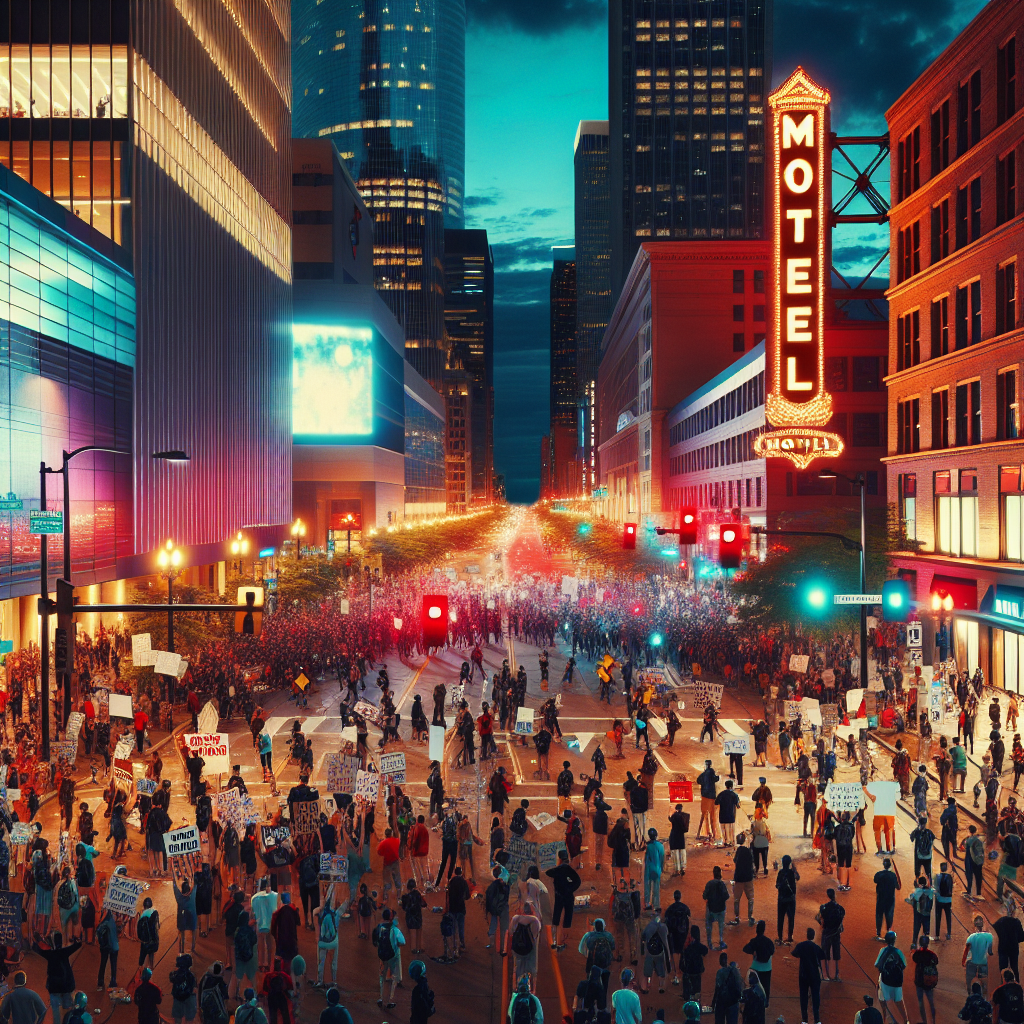
For the third consecutive night, protests against the U.S. Immigration and Customs Enforcement (ICE) erupted in downtown Minneapolis, Minnesota. Local police reported that during the protest on Friday night, demonstrators blocked roads, clashed with law enforcement, and disrupted hotels. The authorities declared the gathering illegal, leading to the arrest of 30 individuals who were later released after receiving citations.
Hundreds to thousands of protesters gathered in downtown Minneapolis on the night of January 9th to protest the enforcement actions of ICE. The tension escalated around 8 p.m. local time when some protesters targeted hotels where they suspected immigration enforcement officers were staying, including the Canopy by Hilton and the historic Depot Renaissance Hotel.
Approximately half an hour later, the police responded to a report of a vehicle approaching a building but found no evidence of an incident and instead were surrounded by the demonstrators. Some protesters threw snowballs, ice, and rocks at officers and police vehicles and hurled verbal insults. One officer sustained minor injuries but did not seek medical treatment.
As the situation worsened, around 200 additional law enforcement personnel, including state troopers and conservation officers, were deployed to support enforcement operations in the area of Third Street and Park Avenue.
Around 10:30 p.m., the police first announced the illegal assembly and repeatedly urged the crowd to disperse. Arrests began after 11 p.m. Despite the cold temperatures and continuous snowfall, protesters continued to gather in various parts of downtown, prompting multiple reminders from the police about the illegal assembly order.
The demonstration persisted into the early morning hours, resulting in the detention of 30 individuals who were later released after receiving citations. Authorities confirmed that some protesters forcibly entered the Canopy hotel through alleys, while others vandalized windows and walls of the Depot Renaissance Hotel, causing approximately $6,000 in property damage.
The protest stemmed from a fatal incident on January 7th when a clash between an immigration enforcement officer and protester Renee Nicole Good resulted in the latter being fatally shot. The event sparked strong backlash in the local community, demanding ICE to leave Minneapolis.
Minnesota Governor Tim Walz had previously instructed the state National Guard to be on standby. However, it was confirmed that on the night of the 9th, no formal request was made for National Guard support by local law enforcement.
Mayor Jacob Frey of Minneapolis stated at a press conference on January 10th that any acts of vandalism or endangerment of public or private property would result in lawful arrests. While criticizing the immigration enforcement policies of the Trump administration, he emphasized that the city would not respond with violence but rather with restraint and unity.
Meanwhile, in Portland, Oregon, a Border Patrol shooting incident occurred. On January 8th, law enforcement intercepted a vehicle allegedly associated with the Venezuelan gang “Tren de Aragua,” with the driver reportedly attempting to ram officers, leading to officers firing in self-defense and injuring two Venezuelan individuals in the vehicle.
The Trump administration later stated that both recent controversial police-involved shooting incidents were deemed to be acts of “justifiable defense” by law enforcement facing immediate threats. The purpose was to stop suspects from using vehicles as weapons and posing lethal risks to officers.
The government highlighted that under U.S. law enforcement and judicial practices, vehicles can be considered “lethal weapons” in situations of immediate life-threatening danger, allowing officers to use deadly force for self-protection. Washington emphasized that this stance aimed to provide policy and legal support for frontline police officers and address the escalating risks of violence against police evaluated by the government in recent years.