
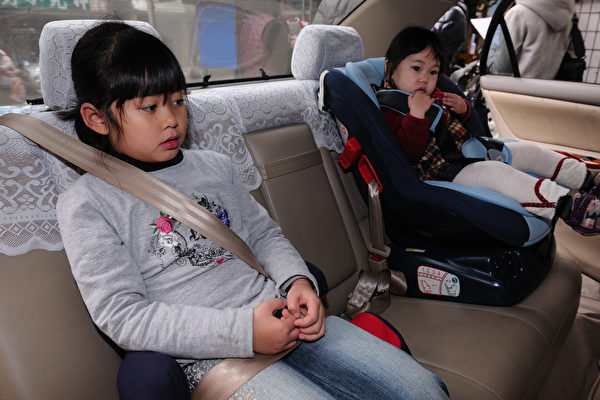
California’s AB435 bill regarding child passenger safety was passed in 2025 and signed by the governor in October. Starting from January 1, 2027, the “Five-Step Test” will be required for children and other passengers, replacing the existing law based on age, height, and weight requirements.
The correct use of the “Five-Step Test” involves: 1) Ensuring the child, guardian, or passenger sit all the way back on the car seat; 2) Their knees bend comfortably at the edge of the car seat; 3) The shoulder belt fits snugly across the chest and shoulder center, not on the neck; 4) The lap belt is as low as possible on the thighs; 5) Maintaining this sitting position throughout the trip. If the child or passenger does not pass the test, a booster seat must be used.
The bill titled “Vehicles: child passenger restraints” was introduced by Democratic African American Assemblywoman Lori Wilson from the 11th District, receiving 42 votes in favor and 16 against in the Assembly (21 abstentions) and passing in the Senate by a vote of 40:0.
This bill amends, repeals, and adds to sections 27315, 27318, 27360.5, and 27363 of the California Vehicle Code. The state law requires both drivers and passengers to properly buckle up, with specific provisions for exemptions for mail carriers, waste collectors, people with disabilities, or those with a doctor’s note.
The research supports the Five-Step Test, aiming to improve parents’ and children’s understanding of correctly using seat belts. It has been approved by the California Traffic Safety Commission, considering variations in vehicle dimensions, as the existing height-based criteria have not adequately addressed safety issues.
The Southern California Auto Club and the Northern California, Nevada, and Utah branches of the American Automobile Association (AAA) expressed support for children under 13 always sitting in the back seat and using appropriate safety devices. The initial proposal also included age restrictions for children sitting in the front seat.
The Sutter Yuba Taxpayers Association initially opposed the bill, believing that current laws are sufficient and California parents should decide if their children can safely sit in the front seat without intervention.
Current regulations in 2026 still apply, requiring children under 2 to use rear-facing car seats unless they reach 40 pounds or 40 inches in height (2016 law); children under 8 in the back seat must use a child safety seat or booster seat, while those over 8 and at least 4 feet 9 inches tall can sit in the front passenger seat (2011 law); and individuals 16 and up must wear a seat belt.
According to the state legislature, a report released in 2024 by the Safe Transportation Research and Education Center at UC Berkeley on “Traffic Safety Facts: Occupant Protection and Child Passenger Safety” cited improper use of seats and lap-shoulder seat belts as contributing factors to child fatalities.
Additionally, a 2021 inspection by AAA and the National Safety Council found that 52% of child seats and 73% of forward-facing child seats were improperly installed, indicating that 90% of children under 10 using adult lap-shoulder belts should be using booster seats.
Furthermore, the National Highway Traffic Safety Administration (NHTSA), the American Academy of Pediatrics (AAP), and the Centers for Disease Control and Prevention (CDC) pointed out that the minimum height exemption standard of 4 feet 9 inches for children due to safety airbags has proven unreliable. While some cars have smart sensors to evaluate passenger size and position before airbag deployment, not all vehicles are equipped with this feature. NHTSA recommends children under 13 use appropriate safety seats and sit in the back seat. Louisiana (2021) and Minnesota (2024) have already implemented the Five-Step Test.
The California Vehicle Code explicitly mandates the use of safety restraints for all occupants in a vehicle, allowing law enforcement officers to stop vehicles for “unbuckled” occupants. Failure to wear a seat belt for those 16 and above is a minor offense, with a first-time violation carrying a base fine of $20; subsequent violations may not exceed $50. However, when factoring in additional assessments, litigation fees, the total fine amount is roughly $162.
If an individual under 16 is found unbuckled, the penalty is stiffer, with a first-time violation base fine of $100, resulting in a total fine of around $490 when considering additional fees.
According to Section 42005 of the Vehicle Code, first-time offenders can attend traffic violator school or other approved courses by the court to learn the correct use of seat belts in place of fines and any additional assessment or litigation fees. Ignoring a citation could lead to misdemeanor charges or imprisonment. Additionally, having a violation on record may increase your vehicle insurance premiums for the following year.