
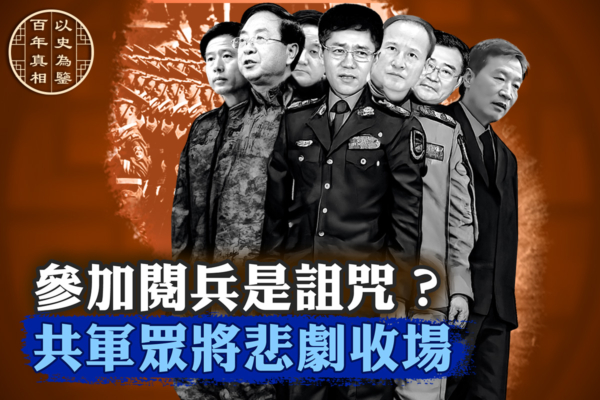
In 2025, the Chinese Communist Party’s military is undergoing another round of large-scale purges. However, at this time, Beijing held a grand military parade on “Nine Three” to commemorate the 80th anniversary of the victory in the War of Resistance against Japan, showcasing its so-called “strong military power.”
Ironically, many of the once proud and prominent CCP generals who participated in these military parades eventually ended up in jail or even took their own lives.
Today, let’s take stock of those CCP generals who participated in military parades, only to tragically meet their downfall.
Many people think that military parades are just about marching and displaying formations, not costing much money. In reality, every CCP military parade can be seen as a “super show” burning a lot of money.
The military parade to celebrate the CCP’s seizure of power the 60th anniversary in 2009 was estimated to have cost over $300 million, about 20 billion yuan.
During the 2015 “Nine Three” military parade, the cost was calculated by foreign media to be over 3 billion yuan, including security, equipment transportation, and fuel consumption.
The military parade for the CCP’s 70th anniversary of seizing power in 2019 was even larger, with Reuters estimating the total cost to be around 5 billion yuan.
And for the 2025 “Nine Three” military parade, it is rumored that just the transportation of missile equipment, urban control, and fuel consumption for aerial formation flying will burn through at least tens of billions of yuan.
In summary, CCP military parades are among the most money-burning “face projects” in the world, draining the nation’s resources!
What is even more staggering are the hidden costs of these military parades far exceeding the surface numbers. In order to ensure the absolute security of Beijing during the military parade, strict traffic control measures were implemented, flights were canceled on a large scale, factories were forced to shut down, and even ordinary citizens were required to stay indoors. During the 2015 military parade, industrial production in surrounding provinces nearly came to a standstill, resulting in immeasurable economic losses. Citizens’ lives were greatly disrupted: schools closed, hospitals restricted appointments, and even express delivery services were suspended.
These huge expenditures could have been used to improve people’s livelihoods, such as building more hospitals, schools, or helping impoverished areas lift themselves out of poverty. However, the CCP chose to invest these resources into extravagant military parades, attempting to cover up its corruption and governance failures through displays of military prowess.
Ironically, while the CCP aimed to showcase its so-called “strong military power” through military parades, the high-ranking military officials’ successive downfall exposed serious issues within the military.
On October 1, 2009, during the military parade commemorating the 60th anniversary of the CCP’s seizure of power held in Tiananmen Square, Fang Fenghui served as the overall commander of the parade, accompanying then Central Military Commission Chairman Hu Jintao in reviewing the troops, becoming the most attention-grabbing figure.
Fang Fenghui’s career was going smoothly. In 2007, at the age of 56, he was promoted to the Beijing Military Region Commander, becoming the youngest commander among the seven major military regions at that time; promoted to General in 2008; in 2012, he became the first high-ranking official to be directly promoted from Beijing Military Region Commander to Chief of the General Staff; after the military reform in 2016, he served as the first Chief of the Joint Staff of the Military Commission.
With his momentum at the time, Fang Fenghui was considered a frontrunner for the position of Vice Chairman of the Central Military Commission at the 19th CCP National Congress. However, in August 2017, just two months before the 19th Congress, his position as Chief of the General Staff was suddenly replaced. Rumors spread both domestically and abroad that Fang Fenghui “got into trouble.”
In January 2018, Fang Fenghui was officially arrested, and in October, he was expelled from the party and the military, stripped of his rank of General. In February 2019, Fang Fenghui was sentenced to life imprisonment on charges of bribery, corruption, and unclear sources of vast wealth.
Fang Fenghui’s downfall shocked both inside and outside the military. It was reported that he was suspected of amassing huge wealth through manipulating military personnel matters, equipment procurement, among other things, involving amounts in the hundreds of millions. His case not only exposed personal corruption but also revealed the nexus of power trading among high-ranking military officials. From being the lead commander of the military parade to being incarcerated, Fang Fenghui’s fall epitomizes the corruption within the CCP military.
On September 3, 2015, the CCP held a grand military parade to commemorate the 70th anniversary of the victory in the War of Resistance against Japan in Beijing. This was the first time the CCP held a military parade on the “Victory Day of the Anti-Japanese War.”
Qu Rui was the Deputy Director of the Leading Group Office for the 2015 “Nine Three” military parade. At that time, he held the position of Deputy Chief of the Operations Department of the General Staff Department, with the rank of Major General.
In January 2016, Qu Rui was appointed as the Deputy Director of the Operations Bureau of the Joint Staff Department after the military reform. Months later, he disappeared from the public eye.
Soon, several media outlets reported that Qu Rui was taken away by disciplinary investigation personnel at the end of July and during the investigation, he tore his clothes into strips, tied them into a rope, and hanged himself on a beam above the door, becoming the first general to commit suicide during an investigation since Xi Jinping’s anti-corruption campaign started.
Qu Rui was a close confidant of the late Vice Chairman of the Central Military Commission, Xu Caihou, and his investigation was possibly related to his oversight of military equipment at the General Staff Department. Some analysts also don’t rule out connections with “buying official positions.”
Former Rocket Force Commander Li Yuchao participated in two military parades:
In October 2009, during the military parade commemorating the 60th anniversary of the CCP’s seizure of power, Li Yuchao, then Deputy Chief of Staff of the 56th Strategic Missile Base of the Second Artillery Corps, drove a strategic missile vehicle and was reviewed by Central Military Commission Chairman Hu Jintao.
At the same time, in 75th Base of the Second Artillery Corps, Li Yuchao, as the commander, led the missile troops and was reviewed by CCP General Secretary Xi Jinping.
Li Yuchao’s military career was smooth sailing. Starting in 2013, he successively held positions as the commander of multiple Rocket Force bases, was promoted to Rocket Force Commander in 2022, and became a member of the 20th Central Committee. He was a protégé handpicked by Xi Jinping, seen as a “rising star” in the military.
However, in June 2023, former Navy Colonel Yao Cheng revealed on X Platform that Li Yuchao was taken away for investigation during a meeting in his office. In December of the same year, the Standing Committee of the National People’s Congress of the CCP announced the termination of Li Yuchao’s status as a national People’s Congress representative, citing “serious violations of discipline and law.” In July 2024, the CCP confirmed Li Yuchao was expelled from the party, but the specifics of the charges, the amount involved, or whether he was sentenced remains unknown to this day.
Li Yuchao became the third Rocket Force Commander to be investigated following Wei Fenghe and Zhou Yaning. His downfall highlighted the systematic corruption within the Rocket Force and raised doubts about the reliability of the CCP’s strategic forces.
Li Hanjun was also a frequent participant on the military parade stage. In the military parade commemorating the 60th anniversary of the CCP’s seizure of power in 2009, he served as the leader of the Navy cadet squadron who was reviewed by Hu Jintao.
After Xi Jinping took office, Li Hanjun steadily rose through the ranks, serving in positions such as the Dean of the Naval Command College and Chief of Naval Staff. His promotions were closely related to the Director of the CCP Central Military Commission’s Political Work Department, Miao Hua, who was considered his confidant, and Miao Hua, in turn, was close to Xi Jinping.
In June 2025, Li Hanjun had his status as a national People’s Congress representative terminated due to “suspected serious violations of discipline and law.” Analysts believe he may have been investigated for providing benefits to Miao Hua or participating in group activities. His downfall was not just a personal tragedy but also pointed to the power trading network within the top ranks of the Navy.
Wu Guohua participated in the military parade as the Deputy Commander of the Rocket Force in 2015 and was reviewed leading an equipment squadron. After retiring in 2020, he was supposed to enjoy his senior years. However, in July 2023, the 66-year-old Wu Guohua was found hanged in the third-floor bathroom of his home.
According to Zhang Xiaoyang, the son of former Vice Chairman of the CCP Central Military Commission Zhang Zhen, and a CCP Colonel, Wu Guohua’s death may be related to the massive Rocket Force case in 2023. Did the pressure of the investigation lead to his suicide? Does it involve deeper military scandals? Official answers are yet to be provided.
During the 2015 “Nine Three” military parade, Deng Zhiping led a squadron that participated in the “Hundred Regiments Battle” during the War of Resistance against Japan period. He had experience in the Sino-Vietnamese War and was one of the few generals with combat experience. In 2021, he was promoted to Lieutenant General and appointed Deputy Commander of the Army.
In June 2024, Deng Zhiping was stripped of his status as a national People’s Congress representative due to “serious violations of discipline and law.” To date, the official charges against him have not been disclosed. Deng Zhiping’s downfall raises more questions about the image of “heroes” created by the CCP within the military.
The CCP’s military parades are a drain on resources and cannot conceal the deep-seated corruption within the military.
The Rocket Force corruption scandal in 2023, the downfall of CCP Political Work Department Director Miao Hua in 2024, the “disappearance” of CCP Vice Chairman of the Central Military Commission He Weidong in 2025, and the successive toppling of senior military leaders indicate the arrival of a third wave of purges.
After a decade of Xi Jinping’s rule, over 160 generals have been investigated, surpassing the total number of generals who fell during China’s internal wars, external wars, and the Cultural Revolution. Even now, the cleansing continues. These generals who once displayed their power on the military parade stage, from glory to downfall, have exposed the true face of the CCP military: appearing strong on the surface but rotten inside.
With such a military force, do you think they can fight a war?