
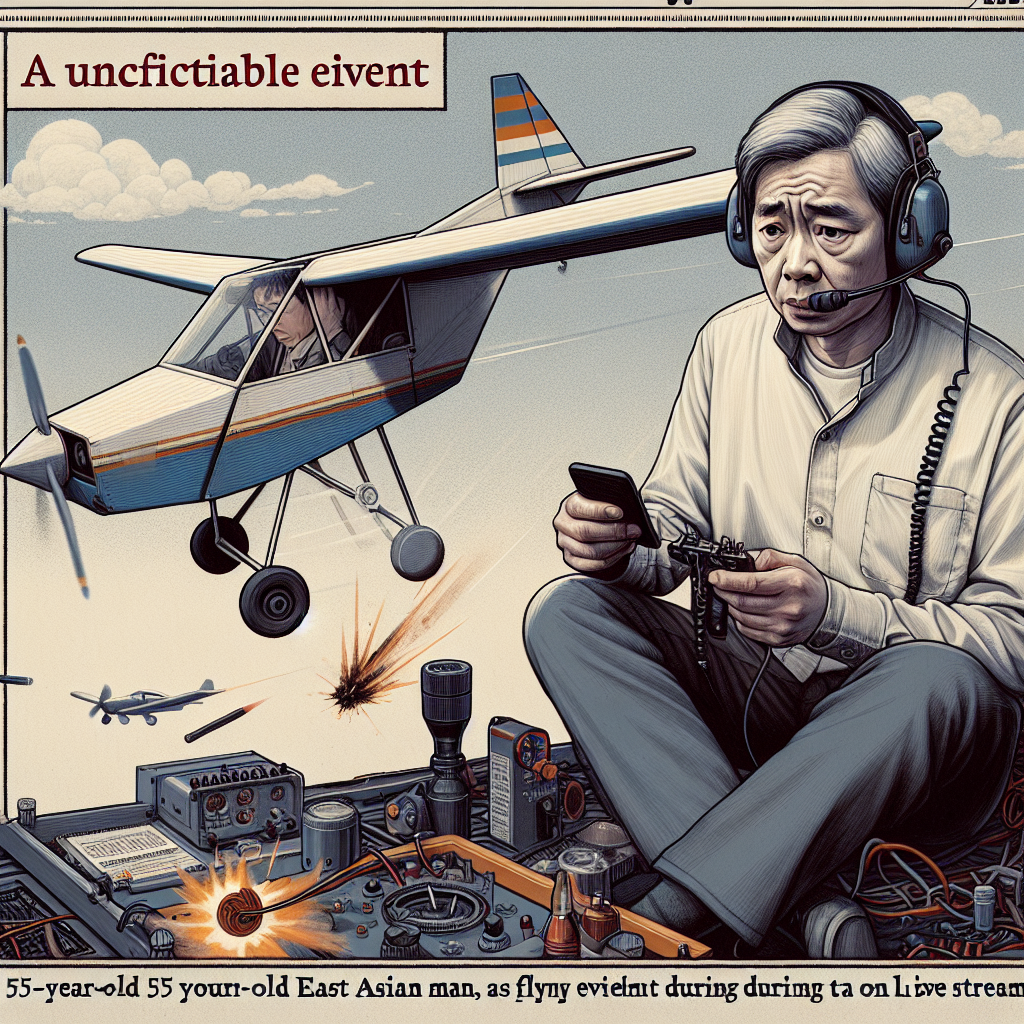
【Epoch Times January 10, 2026】On September 27, 2025, the news of 55-year-old Sichuan internet celebrity “Tang Feiji” crashing and dying during a live stream went viral online. Chinese official sources referred to it as a “low-altitude flying accident.” In the video, he was seen piloting a home-built ultralight coaxial twin-propeller aircraft he purchased for 350,000 RMB, weighing only 115 kilograms, with a single seat and no protective cabin cover, resembling a flying metal chair, taking off and landing in the fields. And this time, he did not return.
The accident shocked the country and brought the topic of “civil aviation safety” to the forefront of discussions.
Within the aviation profession, the response was one of somber familiarity. Sky, a professional pilot with US and Australian ATPL (Airline Transport Pilot License) and owning a private small aircraft, bluntly stated, “This is not bravery, but a lack of training, systems, and safety culture.”
According to Chinese media reports, “Tang Feiji” had a passion for flying but did not receive systematic training. In 2024, he downloaded online tutorials for self-study, claiming to be able to perform maneuvers such as straight flight, inverted flight, and hovering after just one week and about 9 hours of self-study time.
In Sky’s view, flying recklessly without knowledge of mechanics, aerospace engineering, airflow, or understanding of failure risks already puts one at high risk. He was flying a home-built ultralight aircraft, with a structure resembling assembled toys; under high engine speed operation, whether the aircraft structure could withstand vibration pressure, whether the materials would fatigue, he did not have the ability to judge, nor did he possess any verification mechanism.
Before this crash, he had already been in two accidents: in May 2025, he made a forced landing on a beach due to a fuel gauge malfunction; and in July of the same year, he crashed due to an engine failure, breaking a rib. Surviving two accidents did not deter him from engaging in risky flights until this fatal live streaming performance in September became his last.
Sky said, “The biggest problem with small aircraft is not their ‘small’ size, but the lack of backup and the absence of final safeguards. Once a wrong judgment is made, there often won’t be a second chance.”
Small aircraft are not downsized versions of commercial airliners – their safety foundation is completely different. Behind commercial aviation lies years of training combined with multiple layers of assessment, maintenance systems with professional engineers and a signing responsibility chain, strict clearance procedures, and risks shared collectively by the system. Personal flights are often individual judgments, maintenance, and bearing consequences by one person.
Many are unaware that pilots cannot see the internal aircraft structure before boarding. They rely on experience, intuition, and familiarity with procedures.
Sky said, “Before we board, we often have the feeling that something is not quite right with this aircraft.”
This is not superstition, but a pattern recognition accumulated through over twenty years of flying experience. If ground maintenance lacks experience, provides vague answers, or maintenance records are not clear, senior pilots will directly request personnel changes or upgrade signing levels, demanding higher-level engineer reviews – not out of mistrust but to prevent risks from solely falling on one person and ensuring the final safety gate for passengers.
Describing his years of being on high alert, Sky’s belief is simple: “I don’t want to be a hero, I just want to return home.”
As Chinese media and the public applaud the “big aircraft” C919, viewing it as a “national emblem” and a symbol of the nation’s industry, Sky’s reaction is sober: “The real issue is not whether it can fly, but how many times it can fly safely. Aviation safety is statistical: accident probability × flight frequency. One or ten safe flights do not mean much. If the failure rate of a system is one in ten thousand, then flying ten thousand times will likely result in an accident.”
This is why some older aircraft models are more reliable – because their technology is outdated, systems are simple, behaviors predictable. Many core designs of Boeing/Airbus have remained almost unchanged for decades not out of conservatism but because they have been validated through millions of flights. “In the aviation industry, ‘old’ is not behind, it means survival.”
He gave an analogy: aviation is more like Toyota than Tesla. Progress in the aviation industry is not achieved through complete overhauls but is based on technologies that have been repeatedly validated over 10 to 20 years, continually fine-tuning, strengthening, and correcting; what is truly dangerous is introducing a whole new untested system directly into the sky, turning pilots and passengers into testers.
Sky pointed out the four major core risks of the C919: reliance on the supply chain – critical systems such as engines, avionics, materials, still rely on the West. Once the supply of key components is restricted, not only will production halt, but existing fleets might face repair difficulties, even affecting airworthiness certification.
Secondly, training and maintenance systems are immature – training, maintenance, manual updates, supervision, feedback, and correction mechanisms have not formed a complete closed-loop system, leading to ineffective problem detection and resolution, and preventing recurrence.
Thirdly, weak safety culture – lack of transparency in accident investigations, closed data, difficult accumulation of “safety knowledge.” Fourth is the high risk of the new aircraft model itself – not having undergone sufficient high-frequency, extreme condition verifications.
He further explained that in mature aviation systems, pilots, airlines, and regulatory bodies rely on “accident records” to accumulate experience. With new aircraft models posing high risks, test flights must be carried out by the most senior pilots who have encountered a wide range of system failures. The “airworthiness test” of the Airbus A320 series aircraft is a long and multi-stage process, taking years before they can be put into commercial operation; in contrast, “how many test flights has the C919 undergone? With passengers on board, it’s like conducting an experiment.”
By the end of 2025, the three major airlines in China (Air China, China Southern, China Eastern), which were supposed to receive 32 C919 aircraft, only received 12 – the delivery and operation fell short of expectations.
Sky said, “Aircraft aren’t just purchased, they need to be maintained.” Maintaining an aircraft requires over ten years of continuous maintenance, manual revisions, slow accumulation of accident data feedback to “mature.” These aspects cannot be accelerated by slogans or political will.
Furthermore, aircraft are not “assembled products” but engineering marvels. An aircraft contains millions of components; any one part’s failure could potentially put the entire system in a precarious state. The core of aerospace engineering is pushing all components to their material and structural limits while maintaining a safety margin.
He cited an example where China Eastern Airlines in 2022 released a documentary showing the process of their own repair of a Boeing 737-800NG’s “pitch trim” but accidentally exposed several worrying details.
The documentary mentioned that sending the aircraft to Boeing’s maintenance station in California would take at least six months. After evaluating the economic losses and operating costs, China Eastern decided on self-repair. However, the tools were not suitable, the space was narrow, and the holes were difficult to access. Engineers had to “modify existing tools,” with a 25.43mm hole that lacked matching tools, necessitating manual “step-by-step hole widening.”
Sky was shocked after watching it. He said aircraft manufacturing is extremely precise; every hole must endure immense pressure, and discrepancies in hole spacing could directly affect the structural load capacity during flights. The international standard practice is to use computerized instruments for precise measurements, utilizing professional drills for one-time molding. Hand-widening holes are extremely rare in aviation manufacturing, and whether the accuracy meets standards is concerning.
The documentary praised China Eastern Airlines for completing the repair in the situation of “outdated tools,” but Sky believed that while self-repair might save costs, it was uncertain whether the repair met the necessary safety and professionalism standards.
Many people get excited when introduced to new technology, perceiving it as “more advanced and safer.” However, within the aviation industry, “new” signifies the unknown and risk. Sky said, “The meaning of new technology is that not enough people have died.”
It may sound harsh, but that’s the operational reality of the real world.
The reasons are simple: “after an airplane falls, adjustments are made.” Each flight regulation, each screw specification, each maintenance manual page is the result of crash investigations and human lives. The thick documents of FAA, NTSB are not theoretical deductions but the result of tears and blood.
A screw that is too hard can fracture, too soft can break; a metal plate missing 2mm may lead to the whole structure’s fatigue. These are part of the critical decisions made to prevent accidents. Someone commented online that the crash of Tang Feiji this time was likely caused by the rotor control failing, these problems might never appear during computer simulation or in the lab but only under actual flight pressure.
Sky said, this is also why the act of “copying” is impractical in the aviation industry. “Following schematics” and true flight are two different things. Even if the entire aircraft is dismantled for reproduction, without data accumulation, flight statistics, and accident feedback, safety cannot be guaranteed.
He straightforwardly mentioned that new aircraft mean new designs, new systems, new failure modes, new human errors, and new “unforeseen issues.” Nearly all major aircraft accidents in history occurred in three phases: initial service entry, just before extensive deployment, and after system modifications.
“The reason is straightforward: because you don’t know what you don’t know. True safety doesn’t come from being advanced but emerges from long periods, big data, numerous ‘close calls but documented.’ Sky said.
From Tang Feiji to C919, Sky connected the two with the same logic: “Tang Feiji is not an isolated case but reflects systemic issues.”
He believed that Tang Feiji’s problem lay in the lack of training, aviation knowledge, systems, maintenance, supervision, and reverence; while C919 faced challenges such as unstable supply chains, insufficient verification, limited technical accumulation, lack of safety culture, opaque accident investigations, and imperfect legal and regulatory frameworks among others, posing long-term challenges. Tang Feiji represents small-scale risks of C919; the only difference is one person versus the passengers on an entire aircraft.
In conclusion, Sky said, “The essence of the aviation industry is only one: safety.” It is not about overtaking on curves, national sentiments, technological displays, or political engineering. It is about ensuring the safe landing of every individual.
He hoped that society would realize that “safety” is the core value of the aviation industry. Technology can catch up, but only systems and safety culture can sustain progress. Safety in the skies cannot be attained through slogans or passion but require steadfast commitment to ensure a secure airspace.