
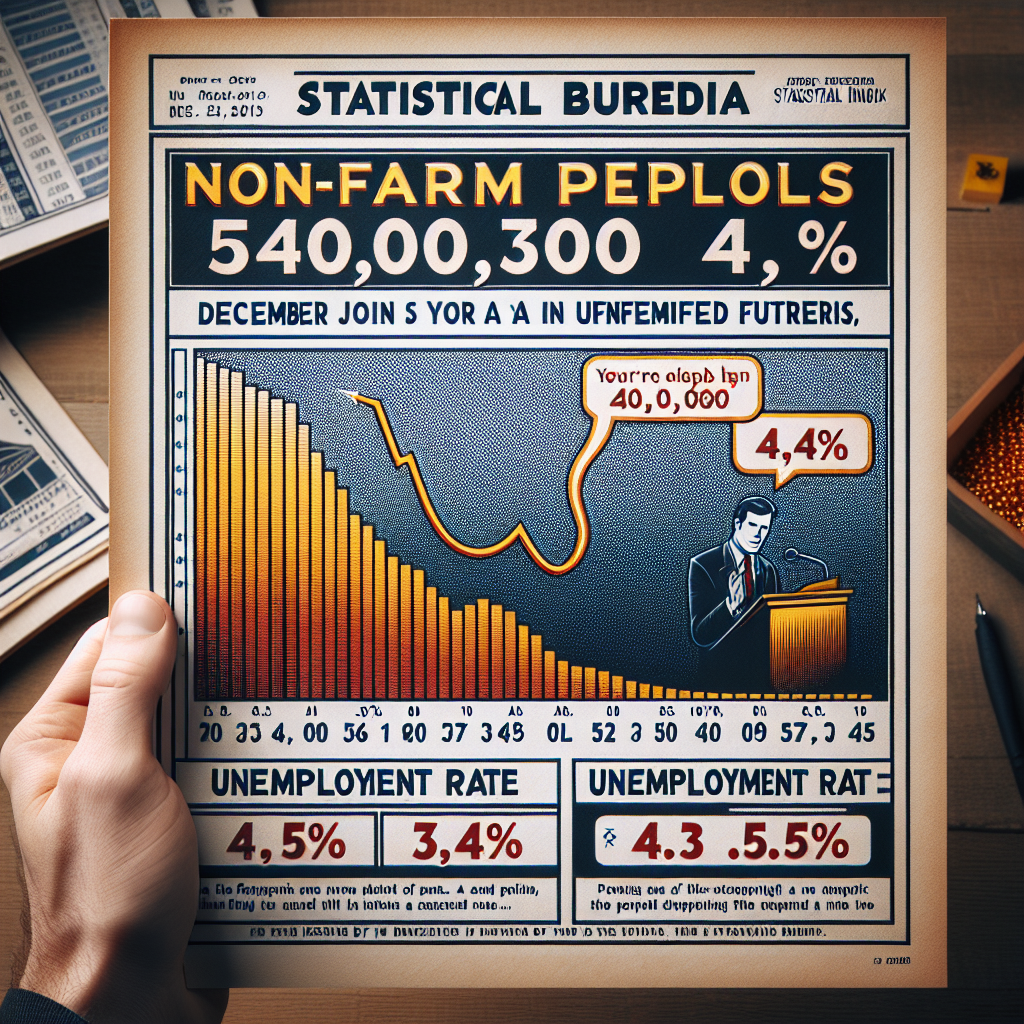
The U.S. Bureau of Labor Statistics (BLS) released a report on Friday, January 9, showing that the non-farm payrolls increased by 50,000 in December 2025, falling short of the Dow Jones’ earlier prediction of 73,000. The unemployment rate dropped to 4.4%, lower than the expected 4.5%.
In terms of specific industries, the food service sector saw the largest increase in employment, adding 27,000 jobs in December last year; the healthcare industry added 21,000 jobs; the social assistance industry added 17,000 jobs; and the federal government sector added 2,000 jobs. However, the retail industry saw a decrease of 25,000 jobs.
Regarding the average hourly wage, which is closely monitored as an inflation indicator, the average hourly wage increased by 0.3% in December to $37.02, a 3.8% increase compared to the previous year.
The BLS also revised down the November job growth figure from 64,000 to 56,000.
According to a report by CNBC, Art Hogan, Chief Market Strategist at B. Riley Wealth, stated, “This employment report is a mixed bag with both positive and negative aspects. We continue to see companies slowing down hiring and layoffs. Overall, this is the first timely employment report in three months with more good news than bad news.”
Federal Reserve officials have been closely monitoring the employment situation in the U.S. to help determine whether to continue cutting interest rates. The market expects that after a series of rate cuts starting in September last year, the Fed will maintain interest rates unchanged for a period of time. The next rate cut is expected to come in June this year, but this expectation may change after the release of this non-farm payrolls report on Friday.
Despite a softening job market, the U.S. economy still appears robust. Economic data released by the Atlanta Fed showed a 5.4% annualized growth rate of the Gross Domestic Product (GDP) in the fourth quarter. The GDP annualized growth rate in the third quarter was 4.3%.
Moreover, with two-thirds of the U.S.’s $31 trillion economy coming from consumer spending, the holiday season saw strong consumer spending. Adobe estimates that online spending grew by 6.8% year-on-year, reaching a record $257.8 billion.
The nearly one-and-a-half month-long government shutdown that began in October last year also posed challenges to the data collection by the Bureau of Labor Statistics. The market expects that the January report will provide a clearer reflection of the labor market conditions.