
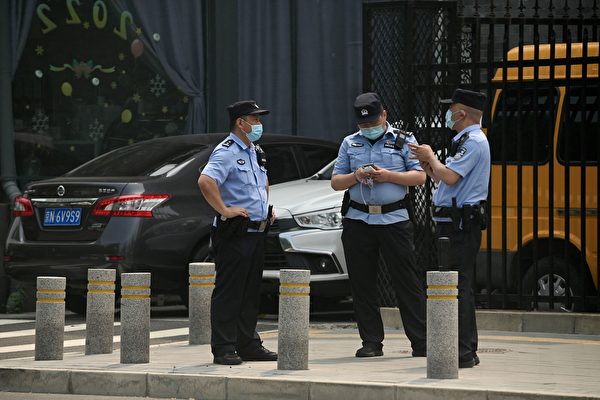
According to a report by the Public Security Bureau of the Chinese Communist Party (CCP), the number of criminal cases filed by public security agencies nationwide in 2025 decreased by 12.8% compared to the previous year, while the number of public security cases filed decreased by 3.5%. A source within the CCP’s judicial system disclosed to reporters that the decrease in the number of cases filed is not primarily due to an improvement in public security conditions, but rather related to insufficient grassroots police force and tight case handling budgets.
This information was released to the public on January 8th by the CCP’s Xinhua News Agency, citing a press conference by the Public Security Bureau. Apart from the overall decrease in the number of criminal and public security cases filed, violent crime cases in 2025 decreased by 4.7% compared to the previous year, trafficking cases decreased by 40.7%, and traditional “robbery and fraud” cases decreased by 21.2%. The Xinhua News Agency report did not provide an explanation for the decrease in the number of cases filed, nor did it mention the allocation of police force or financial resources.
Mr. Feng, a source familiar with the CCP’s judicial system, told reporters that compared to the past emphasis on filing and solving cases, the current practical constraints faced by grassroots law enforcement are more pronounced. Factors such as inadequate police force and tight budgets have directly impacted case progress, making it difficult to sustain the investigation and evidence collection process in cases that require prolonged human resources investment under limited resources.
Feng mentioned that many grassroots units are facing financial constraints, with police salaries in some township police stations being covered by local finances. When funds are tight, priorities often lie in handling straightforward, locally occurring public security cases. Complex cases that require extensive evidence collection and time-consuming investigations are often disregarded under resource limitations to save costs.
Several activists and petitioners from provinces such as Henan and Shandong noted a significant decline in interactions with local State Security personnel in recent months.
Pan Gang (pseudonym), who has been involved in rights advocacy for a long time, stated that State Security personnel used to take him out for “conversations” or meals to gather information, but such instances have become rare recently. He remarked, “They haven’t approached me for several months now, probably because they are really short on funds. They used to take me out for meals whenever they visited, and they even ordered expensive dishes.”
A petitioner from Shanghai, Mr. Wang, mentioned that not only activists but also scholars and public figures who have been vocal on public issues are being contacted less frequently by State Security personnel nowadays. He said, “I heard from people in Shandong and Henan that State Security has basically become less active, with just a phone call check-in, rather than inviting them out for meals as was the norm before. Such interactions have mostly ceased now.”
An individual from the legal community in mainland China told reporters that a decrease in the number of cases filed does not necessarily indicate a reduction in criminal activities from an institutional perspective. He explained, “Whether a case is filed or not does not solely depend on the occurrence of an incident but also factors such as manpower availability, funding, and whether it’s worthwhile. This situation has existed for decades, where in cases of limited policing budgets, some regions choose not to file cases of low financial impact, such as small-scale robberies. When the cost of filing a case outweighs solving it, grassroots units often opt not to file.”
Xiao Yong (pseudonym), a dissenting figure from Anhui, stated during an interview that State Security has not approached him in over six months. He said, “Since they contacted me last year regarding a post on June 4th, they haven’t reached out to me again. They wanted me to report my activities proactively, but I felt no obligation and declined.”
Regarding the tight handling of public security case budgets by law enforcement, Xiao Yong confirmed the situation being reflected in some regions. He mentioned, “They are indeed facing budget constraints. A few friends around me also indicated that State Security’s contact frequency with them has significantly decreased. But I won’t actively reach out to State Security myself.”
Some interviewees pointed out that reduced face-to-face contact with State Security personnel does not mean that these groups are completely free from surveillance. Some individuals are still required to maintain communication channels or verbally warned not to engage in specific activities. Mr. Li mentioned to reporters that the current police approach appears to be a low-intensity, cost-effective form of management.
The Public Security Bureau of the CCP did not address specific external inquiries regarding the reasons behind the changes in the number of cases filed during the press conference. Issues related to grassroots financial conditions, police burdens, and law enforcement resource allocation were also not mentioned in public information. There is an opinion that within the current economic environment, the CCP’s law enforcement resources are constrained by practical conditions, leading to a concentration of limited resources in what they consider more “sensitive” areas. The decrease in the number of cases filed revealed by the Public Security Bureau is viewed as aligned with this backdrop.