
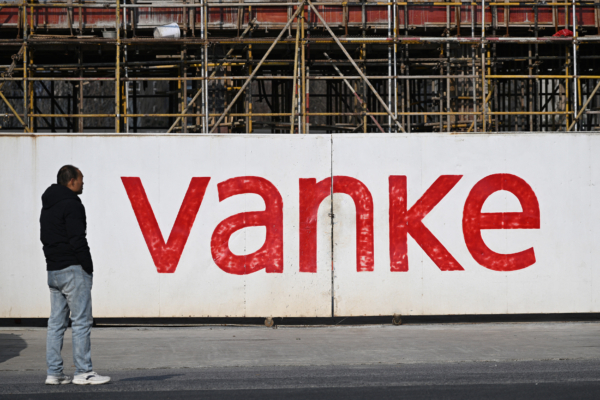
【Epoch Times January 9, 2026】Chinese real estate giant Vanke came close to the edge of default on its debts at the end of last year. On January 21, this year, the company will hold a creditors’ meeting to extend the maturity of two bonds totaling 5.7 billion RMB. At this critical moment, Vanke announced in a public statement that Yu Liang is retiring and resigning from his positions as director and executive vice president.
On the evening of January 8, Vanke announced that due to reaching retirement age, Yu Liang, a director and executive vice president of the company, submitted a written resignation report to the board on the same day, resigning from all positions he held in the company, with the resignation taking effect immediately.
According to Securities Times, as of January 8, Yu Liang held approximately 7.395 million A-shares of Vanke, with a market value exceeding 36 million RMB based on the closing price of the day.
Vanke Group was founded by Wang Shi in 1984. In 1990, Yu Liang joined the then nascent Vanke, responsible for securities and investment affairs. Two years after joining, Yu Liang became the company’s secretary to the board. In 1993, he led the listing and issuance of Vanke’s B shares. The following year, he joined Vanke’s board of directors.
In 2001, he officially became the general manager of Vanke, taking full charge of the company’s daily operations and becoming Wang Shi’s most trusted deputy.
From 2015 to 2017, Vanke went through the widely-publicized “Vanke equity dispute” in the capital market, battling over a merger and anti-merger crisis. Yu Liang and Wang Shi brought in Shenzhen Metro as a strategic investor, stabilizing control through mixed ownership reform, seen as a classic case of a market-oriented enterprise responding to the impact of capital “barbarians”.
After the conclusion of the “Baonan dispute”, Wang Shi stepped down from Vanke’s board in 2017. Yu Liang officially took over as chairman of Vanke’s board in 2017, also serving as president and CEO.
Since taking the helm, Yu Liang has been constantly in a crisis management mode. In October 2018, Vanke took the lead among real estate companies by calling for “survival” and demanding business consolidation. Subsequently, in August 2020, regulatory authorities issued strict “three red lines” requirements for real estate.
Starting in 2021, the Chinese real estate industry underwent a deep adjustment, and Vanke faced unprecedented operational pressures.
During the 2021 annual performance meeting, facing a decline in net profit, Yu Liang publicly expressed, “The 2021 Vanke performance is below expectations, disappointing shareholders. I apologize to all shareholders.”
In the following years, Vanke’s financial pressures grew increasingly apparent, with credit rating downgrades, debt negotiations, and loss-making performances piling up. In 2023, Vanke faced a debt crisis in the sluggish real estate market. In 2024, Vanke’s attributable net profit to shareholders of the listed company reached a loss of 49.478 billion RMB, setting a historical record.
To cope with the crisis, in 2024, Yu Liang and the management team launched the “slimming and health” plan, committing to reduce debt by hundreds of billions within two years, and actively revitalizing existing assets.
In early 2025, Vanke underwent a comprehensive restructuring of its management team, with Yu Liang stepping down as chairman of Vanke’s board and retaining only his positions as director and executive vice president. Xin Jie, chairman of Shenzhen Metro Group, took over as chairman; by February, the Shenzhen state-owned enterprise system took full control of Vanke.
However, after the state-owned enterprises took over Vanke, they were unable to immediately rescue the company.
According to the third-quarter report of 2025, the company had an operating income of 161.39 billion RMB from January to September, with a net loss of 28.02 billion RMB attributable to the parent. The after-tax gross profit margin of the real estate development business had dropped to 2.0%.
The debt pressure was particularly pronounced. According to Interface News, based on information from WIND, Vanke’s domestic debts amounted to 16.098 billion RMB, with debts due within a year accounting for as much as 84.61%, totaling 12.366 billion RMB; the peak repayment within the next 12 months would be in July this year, reaching 4.866 billion RMB, presenting significant short-term debt repayment pressure.
At the end of November 2025, Vanke initiated a debt extension process for the first time for the remaining 2 billion RMB of the “22 Vanke MTN004” medium-term notes due on December 15, breaking the record of no debt extension since its establishment.
On December 23, 2025, S&P downgraded Vanke’s long-term rating from CCC- to SD. The Selective Default rating indicates that S&P believes Vanke has defaulted on some specific debts.
On January 7, the official website of the Bank of China disclosed two announcements. Shanghai Pudong Development Bank and Bank of Communications would act as the conveners, issuing notices regarding the holding of the first holders’ meeting in 2026 for the fourth tranche “22 Vanke MTN004” and the fifth tranche “22 Vanke MTN005” medium-term notes, involving a total of 5.7 billion RMB in bond extension-related matters for review.
Pudong Development Bank called for a holders’ meeting to review the relevant matters of the bond extension, with the meeting scheduled for 10:00 on January 21, 2026.
Bank of Communications will convene a holders’ meeting to review the relevant matters of the current tranche’s bond extension, with the meeting scheduled for 15:00 on January 21, 2026.