
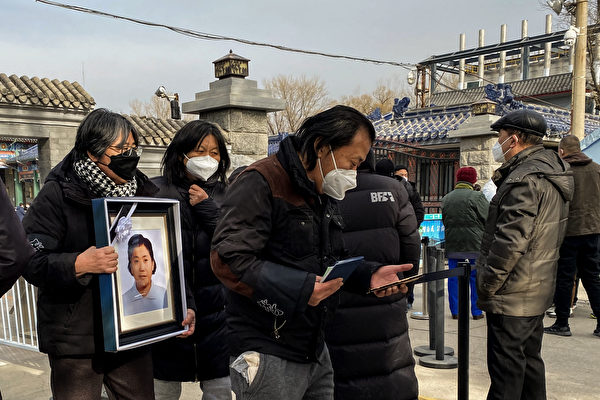
The Chinese Communist authorities yesterday (January 7) released the revised “Funeral and Interment Management Regulations,” compared to the old version, which has added many sections involving sensitive content such as the illegal sale of cremation certificates, cadavers, human tissues, and organs. Officials did not mention these parts when responding to questions from reporters.
The revised “Funeral and Interment Management Regulations” issued by the Chinese Communist authorities on January 7, 2026, will come into effect on March 30. The old regulations had only 6 chapters with a total of 24 articles, while this revision has increased to a total of 8 chapters and 73 articles. Official media claimed that this revision “enhances public welfare attributes,” “reduces the burden on the masses,” and “strengthens supervision.”
A comparison by reporters found that this revision significantly expanded the content, including outsourcing of mortuaries, oversight of cadaver cremation, international (border) transportation of bodies, remains, and unidentified bodies disposal, as well as handling crimes related to the illegal sale of bodies, human tissues, and organs.
In Chapter 3 “Funeral Services,” it is mentioned that “mortuaries in medical and health institutions cannot be outsourced and cannot provide funeral services,” “funeral parlors should promptly transport bodies with death certificates,” “funeral parlors should install image collection equipment in key areas such as body storage, cremation, and retain video image information collected for no less than 90 days for reference.”
Regarding penalties, it includes measures against “issuing cremation certificates or falsifying, forging, and selling cremation certificates; handling suspected criminal acts of selling bodies, human tissues, and organs.”
Officials from the Chinese Ministry of Justice and the Ministry of Civil Affairs did not mention the above provisions when answering questions about the revised “Funeral and Interment Management Regulations” on January 7.
Furthermore, the new regulations significantly increase efforts to combat profiteering in the funeral industry, stating that newly established funeral service institutions should be organized by the government as non-profit organizations and may not establish for-profit funeral service institutions.
Chinese affairs expert Wang He stated that the background of this revision of the funeral regulations is that China has formed a death industry chain with rampant chaos. In recent years, Chinese people have said they “cannot even afford to die” because this industry has become highly industrialized, turning into a money-making machine. The Chinese Communist Ministry opened up the funeral industry to actual businesses, some of which became publicly listed companies with deep official backgrounds, resulting in an immensely profitable industry through collusion between officials and business entities.
Wang He further stated that this industry has deeply involved the so-called “donation” of human organs with significant underlying issues. Hospitals and funeral parlors collude to deceive families, with relatives often unaware even if organs are harvested. Even during cremation, it is uncertain whose remains are being cremated, and whether the ashes given are truly those of their loved ones. Moreover, human corpses can serve as raw materials for medical purposes, creating a massive money-making trap.
Beijing lawyer Yang Qing (alias) told Da Ji Yuan that the public has limited knowledge about the dark secrets of the funeral industry, but signs can be gleaned from the revision of the funeral regulations that there might be extensive trafficking of human organs. Currently, in China from trading in human organs to issuing death certificates and conducting cremations, it has become an all-inclusive industry, where medical institutions may resort to causing deaths directly to acquire organs.
She believes that the official amendment to the regulations implies some medical institutions are colluding privately in the illegal trade of human organs. However, “official hospitals, especially military hospitals, are themselves a one-stop shop, and these aspects are extremely dark.”
In November 2020, The Paper reported that the final ruling by the Anhui Bengbu Intermediate People’s Court in a case of illegal organ harvesting from corpses. The livers and kidneys of 11 deceased individuals were unlawfully and secretly harvested, leading to six defendants being convicted of intentional destruction of a corpse, each sentenced to varying imprisonment terms of 2 years and 4 months to 10 months. Among the six defendants, four were doctors, including those who had worked as personnel of the hospital’s Organ Procurement Organization (OPO) and OPO coordinators.
In August 2024, lawyer Yi Shenghua exposed a massive case involving the purchase of corpses by Shanxi Aorui Company with ties to a central enterprise to produce “homologous heterotopic bone implant materials,” shocking the whole society. Regarding the sources of the corpses, the case mentioned crematoriums in various locations, including funeral parlors in Guilin, as well as crematoriums in Yunnan, Chongqing, Guizhou, Sichuan, among others; the anatomy laboratory of Guilin Medical College; and involvement of organ transplant centers. At the time, the incident was seen as unveiling a glimpse of the dark world of live organ harvesting.
Later, lawyer Yi Shenghua faced suppression on the internet, stating that there was “higher-level intervention.” However, there were no further developments after the incident.
(Previously Reported:
【Observation on China】How deep is the water in the central enterprise’s purchase of corpses case?)