
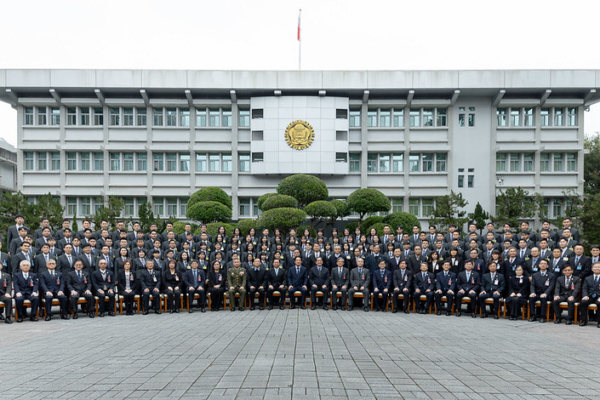
On January 8th, President of the Republic of China (Taiwan), Tsai Ing-wen, attended the closing ceremony of the 62nd session of the Investigation Class organized by the Investigation Bureau of the Ministry of Justice. She encouraged the graduating students to actively take on the role of safeguarding national security and combating serious crimes. In the face of increasingly severe threats from hostile forces abroad, she put forward four expectations, including resolutely carrying out work against anti-secession, infiltration, and annexation activities.
President Tsai Ing-wen first presented certificates to the graduating students, as well as medals for the top three graduates and honorary certificates to the counselors. In her speech, she expressed her delight at being invited once again to attend the closing ceremony of the 62nd session of the Investigation Class with the students, witnessing and sharing the glory and joy of the graduation.
She congratulated all the students for successfully completing the training and thanked the Ministry of Justice, the Supreme Prosecutors Office, and the Investigation Bureau for cultivating talents for the country. She also acknowledged the counselors who tirelessly supported the students round the clock in undergoing the most rigorous training for investigation officers in the country. She expressed gratitude to all the families for supporting their children in choosing this path that is not only crucial for the nation but also carries great responsibility and challenges.
President Tsai emphasized that as the President, she has three missions: safeguarding national security, ensuring the safety of people’s lives and property, and promoting economic development to care for the people’s livelihoods. These three missions represent the work of ensuring national security, social security, and economic security. By successfully accomplishing the “three securities” work, the country can achieve long-lasting stability, allowing the people to live in peace and contentment. These three missions are also the shared mission of all members of the Investigation Bureau, hoping that each student will uphold the spirit of “sacred loyalty and unwavering perseverance” of the Bureau, actively serving as a vital force in maintaining national security and combating serious crimes.
Facing increasingly severe threats from hostile forces abroad, evolving patterns of organized crime, fraud, and technological crimes, as well as significant challenges in ensuring security during elections at the end of the year, President Tsai outlined several expectations.
Firstly, she stressed the importance of resolutely carrying out work against anti-secession, infiltration, and annexation efforts. She emphasized that without sovereignty, Taiwan would lose everything; and without democracy, Taiwan would lose its intrinsic value. To safeguard sovereignty, build a comprehensive democratic defense mechanism, and foster social unity and trust, it is essential to actively implement the strategies and action plans proposed during the previous two National Security High-Level Meetings. Through effective investigation measures, democratic Taiwan can continue to move forward steadily.
Secondly, she called for a comprehensive crackdown on criminal gangs to eradicate the roots of crimes. Gang organizations are the source of many crimes and the core of societal problems such as organized crime, fraud, violence, and even collaborators cultivated by the Chinese Communist Party in Taiwan, which seriously threaten national and social security. She urged the students to utilize their expertise and take proactive and sustained actions in eliminating criminal gangs, punishing them rigorously without compromise.
Thirdly, she emphasized the need to combat fraud at its root and move towards zero tolerance for fraud. Fraud is a common enemy of all, posing significant security challenges globally. She thanked the Investigation Bureau for cooperating with the Supreme Prosecutors Office at the end of last year in executing the fourth wave of enlarged anti-fraud operations, mobilizing thousands of investigation officers to crackdown on fraud syndicates, uncovering staggering amounts of fraudulent and money laundering amounts, which was quite remarkable.
President Tsai pointed out that while objective data is crucial, public perception is equally important. Just like Taiwan’s largest and one of the top ten global companies, TSMC, the requirement for quality is not solely based on scientific data but also on customer satisfaction; customer satisfaction is the ultimate measure of quality. Therefore, in the fight against fraud, besides continuously improving objective data, it is crucial to ensure that the people can tangibly feel the government’s efforts and achievements.
She envisioned that future national investigators should learn from their seniors, uphold a zero-tolerance attitude towards fraud, utilize technology for investigations, cross-regional integration, and collaborate fully in exposing behind-the-scenes criminal groups to combat fraud at its root.
Lastly, she emphasized the importance of combating corruption and purifying the political environment to lay a more solid foundation for democratic politics. Upholding integrity is not only a fundamental responsibility of the government but also the most crucial demand of the people towards government officials. Therefore, she urged all investigators to regard combating corruption as a significant task once they enter their work positions, meeting the expectations of the people. She reiterated that regardless of party affiliation or individual, as long as there is evidence, investigations will be conducted in accordance with the law, with no leniency granted. It must be conducted based on evidence; without clear evidence, the exercise of public power must also be carried out with caution, handling all tasks following the principle of fairness and strictness.
President Tsai stressed that integrity has no honeymoon period, especially with the upcoming local elections at the end of the year. It is crucial to adhere to the fight against corruption, promote integrity, continuously strengthen anti-corruption work and election monitoring, comprehensively prevent illegal interventions in elections, ensure fairness and justice in elections, and safeguard the bottom line of the democratic system. Furthermore, the international community has continually warned that in the 2026, 2028, and future elections, hostile foreign forces may intervene, even utilizing emerging technologies like artificial intelligence. She hoped that Director Chen Bai-li and his team at the Investigation Bureau will prioritize this work as vital.
She acknowledged that the work of the Investigation Bureau is extremely complex and extends beyond what was discussed. From cybersecurity, security, drug prevention, to economic crimes, all fall within everyone’s defense scope. Although the work of investigators is understated and secretive, it is an essential force in safeguarding democracy and the people. She urged everyone not to forget their original intentions, uphold their oaths, act in accordance with the law, continuously enhance their professional capabilities, and not disappoint the expectations and trust of the people. She also asked each student to prioritize their health and safety, assuring that the government will provide the Investigation Bureau with the utmost support, working together to strive wholeheartedly for the country, the people, and democracy.