
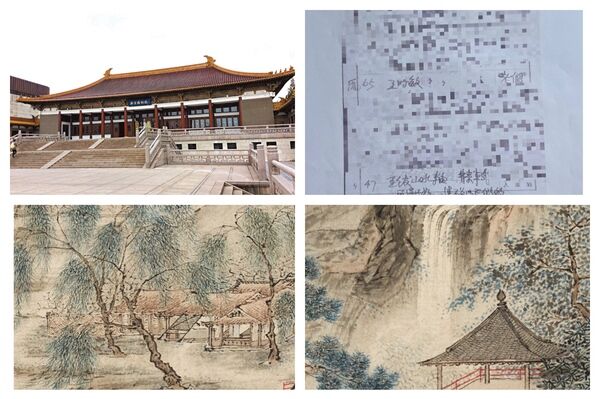
The scandal of the theft and sale of cultural relics at the Nanjing Museum (Nanjing Museum) continues to ferment, and on January 7, 2026, Jie Bing, deputy director of the State Administration of Cultural Heritage of the Chinese Communist Party, was dismissed. Jie Bing has long served in the State Administration of Cultural Heritage of the Chinese Communist Party, and was once the chief steward of Liu Yuzhu, the director of the State Administration of Cultural Heritage.
On January 7, 2026, the Chinese State Council announced personnel changes; Guo Xi was appointed as the Chief Auditor of the Audit Office, Zhang Jianmin was appointed as the Deputy Director of the National Bureau of Statistics, and Jie Bing was removed from his position as deputy director of the State Administration of Cultural Heritage.
Publicly available information shows that Jie Bing had been serving in various positions within the State Administration of Cultural Heritage for many years before being relieved of his duties. He has held positions such as Deputy Editor-in-Chief and Editor-in-Chief of the Chinese Cultural Relics Newspaper, Director of the Personnel Department of the State Administration of Cultural Heritage, Deputy Secretary of the Party Committee of the State Administration of Cultural Heritage’s Office, Director of the State Administration of Cultural Heritage Office, Secretary of the Party Committee and Deputy Dean of the China Cultural Heritage Research Institute; In 2022, he was appointed as a member of the Party Committee and Deputy Director of the State Administration of Cultural Heritage.
The timing of Jie Bing’s dismissal is sensitive, as it coincides with the unfolding controversy at the Nanjing Museum.
Since the report on December 17, 2025 by mainland media that the Ming Dynasty painting “Jiangnan Spring” by Qiu Ying in the collection of the Nanjing Museum had entered the auction market, the Nanjing Museum has been at the center of attention.
On December 21, 2025, retired employee Guo Lidian of the Nanjing Museum used a video platform on WeChat to publicly accuse former director Xu Huping of large-scale theft and smuggling of national treasures from the Forbidden City, reigniting public scrutiny over loopholes in the protection of cultural relics.
On the evening of December 23, “Asia Weekly” released a video showing that from 10 pm on December 22 to 12:30 pm on December 23, after the police surrounded Xu Huping’s villa for more than ten hours, Xu Huping, his wife, and their maid were taken away.
On the same day, the authorities in Jiangsu province announced the establishment of an investigation team composed of multiple departments to investigate the problems in the storage and disposal of donated cultural relics at the Nanjing Museum and other issues related to the security of its collections.
On that day, mainland media cited sources from the State Administration of Cultural Heritage of the Chinese Communist Party stating that a working group had been established to conduct an inspection of the situation regarding the management of cultural relics at the Nanjing Museum.
Following the news of Xu Huping’s arrest, museums in various parts of the mainland have successively announced temporary closures, sparking speculation about “hurriedly destroying evidence” and other conjectures. As of December 25, 2025, more than thirty museums have announced closures or suspensions for reasons such as renovation, with some museums closed for up to 1 year and 5 months.
Furthermore, netizens revealed that the village of Yunyunjian in Luoyang, Henan, known as the “Number One Bronze Forgery Village,” has recently seen a surge in orders, suspected to be supplying various museums and filling the vacuum. Some netizens have unearthed old videos showing villagers in the village revealing that the large quantity of finished products in the workshop were all “orders from museums”.