
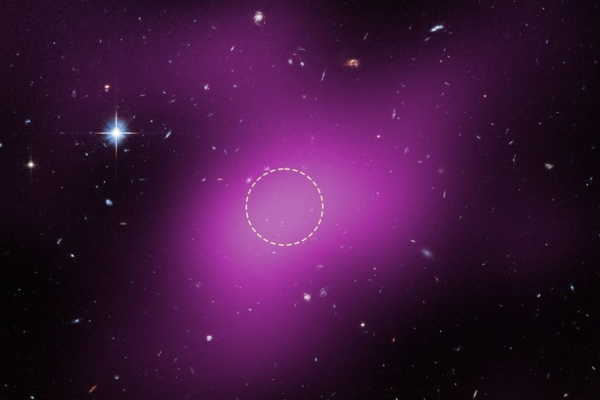
Through the Hubble Space Telescope of the National Aeronautics and Space Administration (NASA), astronomers have made the groundbreaking discovery of a new type of celestial object – a dark matter cloud devoid of stars but rich in gases, possibly a remnant of “failed galaxies” that were unable to form in the early universe.
NASA announced in a press release on January 5 that this object, nicknamed “Cloud-9,” is located 14 million light-years away from Earth, marking the first time astronomers have detected such an object in the cosmos. This discovery contributes to deeper insights into galaxy formation, the early universe, and the nature of dark matter.
Researcher Andrew Fox from the Association of Universities for Research in Astronomy (AURA) and the Space Telescope Science Institute (STScI) stated, “This cloud of gas is a window into the dark universe.”
He added, “We know from theory that most of the mass in the universe is estimated to be dark matter, but since dark matter does not emit light, it’s challenging to detect. ‘Cloud-9’ allows us a rare glimpse into this cloud primarily composed of dark matter.”
This celestial object is identified as a Reionization-Limited H I Cloud (RELHIC), describing a hydrogen cloud left over from the early universe, a fossil remnant that never gave birth to stars.
Scientists have long sought evidence of these theoretical “ghostly objects.” The confirmation of such a hydrogen cloud devoid of stars through observations with the Hubble Space Telescope has provided support for this theory.
Principal author of the research report, Gagandeep Anand from STScI, mentioned that prior to utilizing the Hubble Space Telescope, people might have mistaken this dim dwarf system as observable with ground-based telescopes. However, the advanced Wide Field Camera on the Hubble Telescope confirmed the absence of any objects in that region.
The discovery of “Cloud-9” came as a surprise. Rachael Beaton, also from STScI, likened the idea that in neighboring galaxies of the Milky Way, there might be some abandoned “houses.”
Researchers stated that the finding of this object suggests the possible existence of numerous other small, dark matter-dominated structures in the universe, which are essentially unsuccessful galaxies. This finding offers a new perspective for studying the dark matter component in the universe that is challenging to research through traditional observation methods focusing on bright objects like stars and galaxies.
Astronomers have long studied hydrogen clouds near the Milky Way, but these clouds are usually larger and more irregular than “Cloud-9.” In comparison to other observed hydrogen clouds, “Cloud-9” is smaller, more compact, and remarkably spherical, standing out in appearance.
The core of “Cloud-9” consists of neutral hydrogen, measuring approximately 4,900 light-years in diameter. Radio waves emitted by this object have been used to estimate its hydrogen mass to be around one million times that of the Sun. Assuming a balance between gas pressure and gravitational force (which seems to be the case), researchers calculated the dark matter mass of this object to be about 5 billion times the mass of the Sun.
While the formation process of this gas cloud remains speculative, if its mass continues to increase, it may eventually evolve into a galaxy.
If its mass exceeds 50 billion times that of the Sun, it will collapse, form stars, and eventually become a galaxy similar to others. If its mass is far below this threshold, the gas within it may disperse and ionize, eventually disappearing. However, it currently sits in an ideal state that could maintain its existing condition.
Researchers noted that “Cloud-9” serves as an example of a mysterious structure devoid of stars. Merely observing stars cannot unveil the complete picture. Studying the gas and dark matter contributes to a more comprehensive understanding of the processes unfolding within these systems.
From an observational standpoint, identifying these failed galaxies is extremely challenging due to the brightness of nearby galaxies overshadowing them. These systems are also prone to environmental influences, further diminishing the anticipated abundance of such galaxies.
This type of object, lacking stars, provides a unique window into the inner characteristics of dark matter clouds, aiding in the deeper understanding of the physics of the early universe and dark matter.