
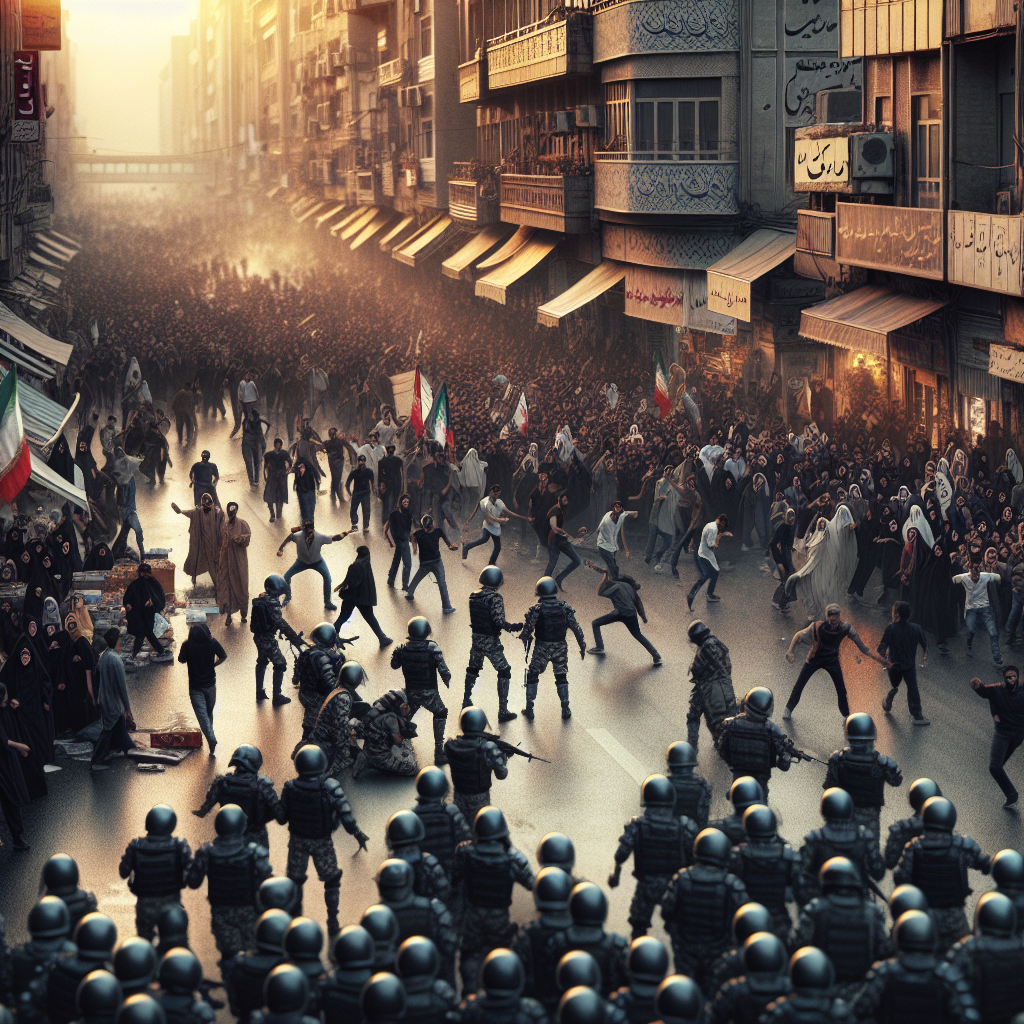
Iran is witnessing some of the most intense street protests in recent years, spreading from the bustling bazaars of Tehran to major cities nationwide. Traders, students, and civilians have taken to the streets, clashing head-on with security forces, escalating tensions. The United States and Israel have both made statements – will they intervene again?
The street protests in Iran have entered their eighth day, initiated by local traders in the capital Tehran’s bazaar. The direct trigger was severe inflation in Iran, plunging the economy into collapse. Over the past few days, a significant number of civilians and students have joined the protests, which have grown in scale and spread nationwide. The Iranian regime has deployed security forces to suppress the protests, leading to bloody clashes. At least eight Iranian protesters have been reported dead so far. In response, U.S. President Trump has made statements on the matter. Today, let’s take a detailed look at what has been happening in Iran in recent days.
We now see a video depicting the evolution of the protests in Iran over the past few days. The protests initially started in Tehran and then expanded to various regions across the country, including the central cities of Hamadan and Isfahan, and the southern cities of Shiraz and Bandar Abbas. The scale of these protests has spread nationwide.
With the protests continuing, a large number of protesters have taken to the streets, even overtaking local police stations and government offices. A video filmed in Azna City shows protesters occupying a police station and releasing dozens of detained protesters. Filmed at night, flames can be seen burning nearby.
Efforts by the Iranian government to shut down Tehran were defied by a large number of people who took to the streets on January 1st to continue protesting against the Iranian government. A video from Tehran’s central fruit market shows numerous vendors and locals chanting slogans, calling for an end to the regime led by Khamenei.
Students from Tehran University have also joined the protests, as shown in a video from Iran’s top academic institution, the University of Tehran. It is reported that students rushed towards the campus gates, engaging with organized police attempting to block the campus.
Many wonder if the Iranian government has not deployed militias and police to suppress the protests—of course, they have. A video from the heart of downtown Tehran, on Republic Avenue, shows armed individuals representing the Basij paramilitary organization under the Iranian Revolutionary Guards. The Basij militia members attempted to set up barricades on Republic Avenue but were eventually overwhelmed by the flood of unarmed protesters. The protesters resorted to throwing stones at the Basij militia, forcing them to retreat in disarray. In the video’s final moments, local residents even started chasing and attacking the militia members. The scene was highly charged, reflecting the anger of the Iranian people towards the militia, depicting them as universally reviled figures.
Turning our attention to the central city of Hamadan, on the day before New Year’s Day, the streets were filled with protesters.
A local protester in Hamadan sets fire to a flag symbolizing the regime of Khamenei. In Iran, such actions are punishable by death.
In the southern city of Shiraz, numerous people took to the streets at night to continue protesting against the Iranian regime.
In the central city of Isfahan, tens of thousands of people marched through the streets, demonstrating that the numbers of protesters remained significant and the scene was impressive.
As the protests expanded, the Iranian regime mobilized police, security forces, and militia organizations to suppress them. A video from the night of January 1st in the Hamadan region shows masked Basij militia members, a unit of the Islamic Revolutionary Guard Corps, armed with guns carrying out operations on the streets.
In the past two days, there have been increasingly more clashes between the two sides. On the night of January 1st in Naft-e-Kavous, an Iranian city, a large number of people picked up stones and threw them at members of the Iranian security forces.
In the central city of Arak, local protesters attacked police with Molotov cocktails, setting the officers on fire. Soon after, the fires on the police were extinguished by others at the scene.
In another precious piece of footage, filmed in a central city, Hamadan, police fired tear gas canisters into the crowd, only for the demonstrators to pick them up and throw them back at the police.
The resistance of the Iranian people has shown some effect. In a video from Marv Dasht in the central city, Iranian Revolutionary Guard soldiers were forced to retreat by local civilians. The footage included numerous heavily armed soldiers riding armored vehicles, firing sporadically as they retreated.
In the city of Kolmanshah, many heavily armed Iranian security forces faced a large number of protesting civilians, with no effective response; they had no choice but to continuously retreat and withdraw from the protest scene. The protesters at the scene were visibly outraged, shouting slogans at the retreating forces.
The situation was similar in Hamadan in the central region, one of the areas with the most intense protests. Locals took to the streets night after night, chanting slogans calling for the downfall of the Khamenei regime. Some citizens even infiltrated a secret location owned by an intelligence agency and successfully freed detained protesters. In the Abadad region, a Basij base was stormed by protesters and set on fire. The emotions of the protests have heightened significantly, and the situation seems out of control for the Iranian regime.
In Farad Sahel, nighttime protest scenes showed a massive fire burning in the distance. It was reported that military equipment belonging to the Islamic Revolutionary Guard Corps was being set alight by protesters.
Over the past few days, the Iranian authorities have shot and killed eight protesters. On January 2nd, in Isfahan, a large number of people attended the funeral of Dariush Ansari, a 37-year-old protester who had been killed, continuously protesting against the Iranian Islamic regime at the funeral.
In the city of Kudahshat, protester Amir Hossam was killed by the Islamic security forces. At his funeral, at least a thousand people were in attendance.
Some of the Iranian protesters at the funeral continued to throw stones at a group of individuals, chanting slogans persistently. These individuals were reportedly pro-regime militia members affiliated with the Basij organization. They attempted to seize the deceased protester’s body, misrepresenting him as one of their own for propaganda purposes. However, the locals’ anger drove them back.
President Trump declared on January 2nd that if Iran continues the practice of shooting at peaceful demonstrators, the United States will come to their rescue, being on high alert and prepared for action at any moment. After Trump’s remarks, a senior Iranian diplomat condemned his statements and warned that Iran might retaliate against U.S. bases and troops in the Middle East.
During the 12-day war in 2025, Iran launched ballistic missiles at the Udeid Air Base in Qatar, causing no casualties, as most of the missiles were intercepted by the Patriot air defense system deployed at the base. The scene was spectacular, with Patriot missiles rising one after another to intercept the Iranian missiles in the distance.
What military actions will the United States finally take? We are yet to know, but Israel certainly seems eager to act. During the final week of 2025, Israeli Prime Minister Netanyahu met with President Trump to discuss the possibility of launching another attack on Iran in 2026.
In the 12-day war, the United States and Israel demonstrated sufficient military strength, asserting control over Iran’s airspace. Israeli fighter jets freely entered and left Iranian territory, bombing key government facilities in Tehran, including the state television station, Islamic Revolutionary Guard headquarters, Foreign Ministry, and police stations, flying back without any losses. The climax of the 12-day war saw the U.S. Air Force sending B-2 bombers and F-35 fighter jets to strike Iran’s three major nuclear facilities.
If Israel obtains approval from the United States, they can certainly deploy their F-35 fighter jets again to bomb Revolutionary Guard military bases within Iran. Following last year’s war with Israel, many Iranians realized that the current Islamic regime is nothing but a paper tiger. Despite domestic media hype, they were proven vulnerable in the face of Israeli and American strikes.
Ultimately, the protests in Iran have been ongoing for over a week now, with the Iranian regime showing no ability to control the situation locally. Faced with threats from the United States and Israel, the Iranian government seems hesitant to resort to overly violent crackdowns. Whether these protests in Iran will lead to the downfall of the Khamenei regime remains to be seen; we will continue to bring you the latest updates.