
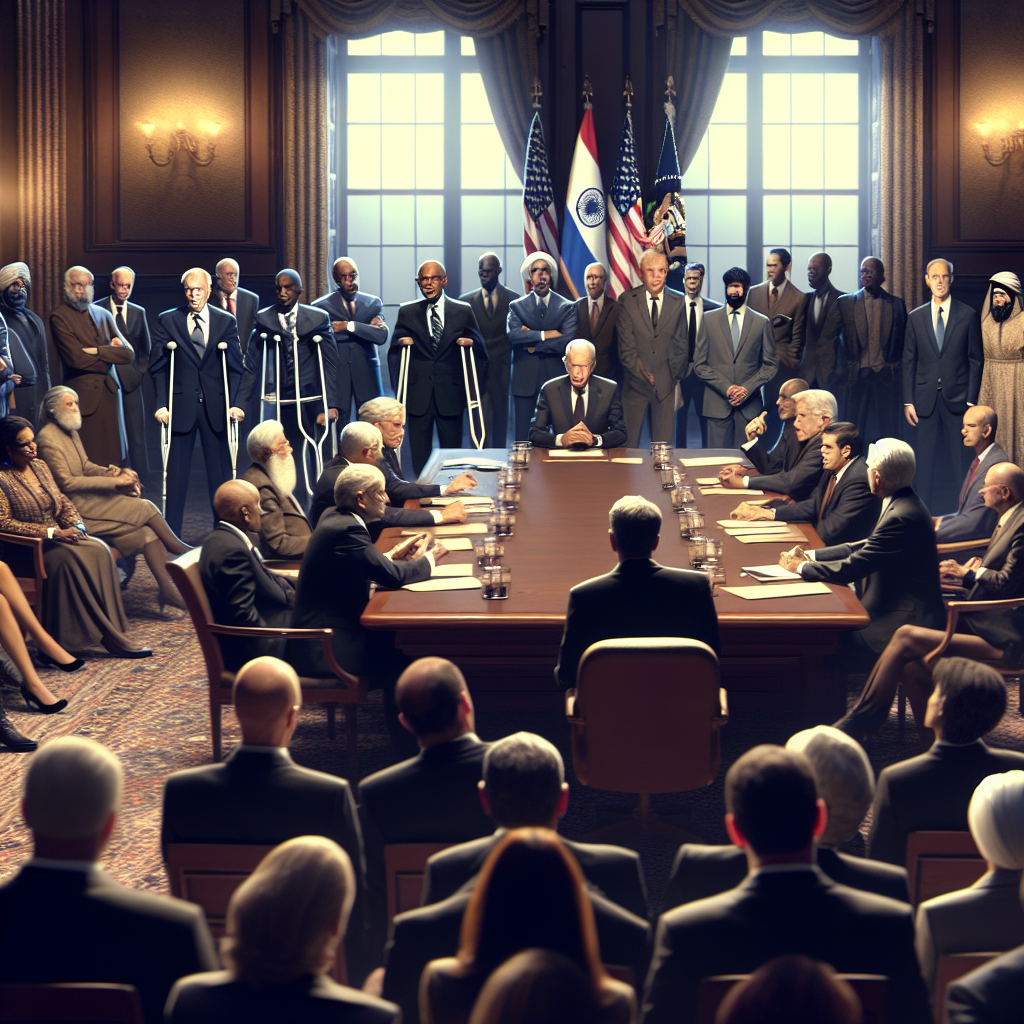
On the evening of January 5th, senior officials of the American government briefed some experienced senators and congressmen on the confidential military raid in Venezuela to arrest Maduro. Following the briefing, Brian Mast, the Chairman of the House Committee on Foreign Affairs, stated that the United States will not engage in an endless war in Venezuela.
The briefing lasted for about two hours and was attended by Secretary of State Rubio, Secretary of Defense Heggseth, Attorney General Bondi, and several other government and military officials.
After the briefing, Speaker of the House Johnson expressed that the U.S. military action in Venezuela was decisive and justified. He pointed out that Maduro has been trafficking drugs to the U.S. and fueling violent drug cartels for years, causing numerous American deaths. The arrest warrant for him had already been issued.
Johnson stated, “Under President Trump’s leadership, the U.S. will no longer allow criminal regimes to profit from the destruction and chaos they cause to our country. He prioritizes Americans first and succeeds where others have failed, which is very clear.”
The U.S. military action in Venezuela has sparked controversy in American politics. Many Democratic lawmakers are concerned that this could escalate into an endless war similar to Afghanistan.
In response, Chairman Brian Mast of the House Foreign Affairs Committee said, “If someone wants to use the term ‘nation-building,’ that is not consistent with any situation under President Trump… They are not a government that prolongs wars.”
Speaker Johnson emphasized, “We are not at war. We do not have U.S. armed forces in Venezuela, and we are not occupying that country.”
Republicans argue that the arrest of Maduro does not require congressional approval because it is brief and involves “law enforcement” action to bring Maduro to a New York court.
Johnson added, “The Constitution grants Congress the power to declare war, and that is correct. But it also gives the U.S. president broad authority as commander-in-chief. According to Article II of the Constitution, the president has the authority, like all presidents, to deploy military forces to address threats to the U.S. and enforce U.S. laws.”
The War Powers Act of the United States stipulates that Congress should be notified within 48 hours of the commencement of hostile actions. Johnson stated that due to the sensitive nature of this operation and the need for perfect conditions to begin, the exact timing of the operation could not be predetermined.
Johnson revealed that he personally received a call from Secretary of State Rubio at 4 a.m. on January 3rd, informing him that the U.S. military had captured the Maduro couple and was on their way back to the U.S.
Senate Minority Leader Chuck Schumer stated that the briefing was broad, but he believed that it raised more questions than answers.
He said, “Their plan for the U.S. managing Venezuela is unclear, and based on unrealistic ideas, which is unsatisfactory.”
Schumer also expressed concern that the Trump administration did not guarantee it would not take similar actions against other countries. He mentioned, “When the U.S. engages in such regime changes and so-called nation-building, it always ends up harming the U.S. I left the briefing feeling it would happen again.”
Republicans also did not rule out the possibility. Mast said, “There is definitely an ongoing plan to use the U.S. military to protect the U.S. homeland.”
The Senate is expected to vote this week on whether to prevent further military actions in Venezuela without congressional approval.