
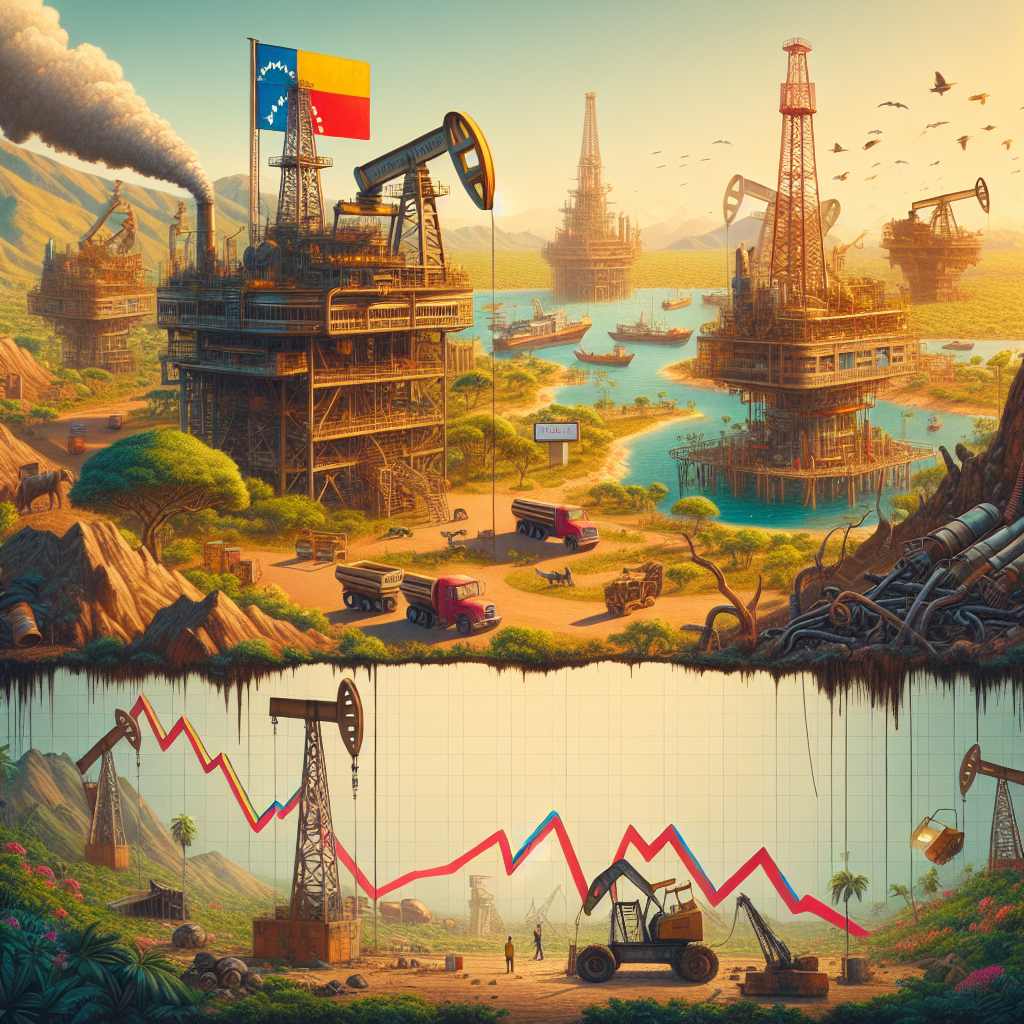
Venezuela has rich oil resources and has always been a major oil exporter. However, according to official data, poor management, insufficient investment, and recent US sanctions have caused a sharp drop in Venezuela’s oil production. China has become a major customer and investor in Venezuela’s oil sector.
Venezuela has long been a traditional oil-exporting country and has had a history of oil partnership with the United States for over a hundred years. However, the country’s oil exports still rely heavily on the United States as a major importer. With the Venezuelan government imposing restrictions and switching to Canadian crude oil, the amount of oil imported from Venezuela by US oil companies has gradually decreased. Meanwhile, the Chinese government and Chinese businesses have entered Venezuela during this time.
Oil extracted in Venezuela is mostly heavy oil (high in carbon content), requiring higher costs for extraction, transportation, and refining compared to other oil-producing countries. The reforms implemented by former President Chavez have led Venezuela’s oil production on a downward trajectory.
During Maduro’s presidency, Venezuela’s oil industry has further declined due to long-term sanctions, lack of funds, outdated infrastructure, and management chaos, causing production to plummet from a peak of around 3.5 million barrels per day in the late 1990s to about 1.1 million barrels per day last year. This has led to the collapse of the national economy and forced production cuts, despite having the world’s largest oil reserves, Venezuela has become a poverty-stricken country.
The following is information about Beijing’s investments in Venezuela’s oil sector.
Most of the oil exported by Venezuela goes to China, although data released by Beijing is scarce, and imported oil is often rebranded. According to energy analysis firm Vortexa, in 2025, China imported approximately 470,000 barrels per day of oil from Venezuela, accounting for about 4.5% of China’s total seaborne crude oil imports.
Small independent refineries in China, known as “teapots,” are the main buyers of discounted Venezuelan crude oil. Some of the oil is also used to repay debts owed by the Venezuelan government to Beijing, with analysts estimating the debt to be over $10 billion.
According to research by the US Business Institute in 2023, since 2016, Chinese investors have injected $2.1 billion into Venezuela’s oil sector and are among the few foreign companies still operating in the country.
The following are Chinese state-owned and private enterprises operating in Venezuela:
A large Chinese state-owned oil company was a significant investor before the US imposed sanctions in 2019 and is still producing oil in a joint venture with the Venezuelan state oil company (PDVSA) at Sinovensa.
CNPC ceased importing oil from Venezuela in 2019, but crude oil has since been shipped to China through traders and other state-owned enterprises.
According to Morgan Stanley, CNPC is a partner in a joint venture that controls 1.6 billion barrels of oil reserves in Venezuela.
Morgan Stanley also states that this state-owned giant is a partner in a joint venture that controls 2.8 billion barrels of oil reserves in Venezuela.
CNPC and Sinopec did not immediately respond to Reuters’ inquiries about their business activities in Venezuela.
Last Monday (January 5th), Bloomberg reported, citing insider sources, that after the US arrested Maduro, China’s National Financial Regulation Administration (NFRA) requested policy banks and other major lending institutions to report their exposure to Venezuela.
Reportedly, the NFRA also recommended all banks to enhance monitoring of credit risks related to Venezuela to assess potential risks faced by Chinese lending institutions.
For years, China has provided loans to Venezuela through “oil-for-loan” agreements.
Bloomberg’s report highlights growing concerns within China’s regulatory authorities about the potential impacts of geopolitical risks on the banking sector. Over the past decade, China has provided Venezuela with billions of dollars in loans, mostly from policy banks like the China Development Bank.
Feel free to incorporate this rewritten and translated text into your publication without mention of the original publisher’s name, editor’s name, or reporter’s name. I hope this revision meets your expectations. If you need further assistance, please let me know!