
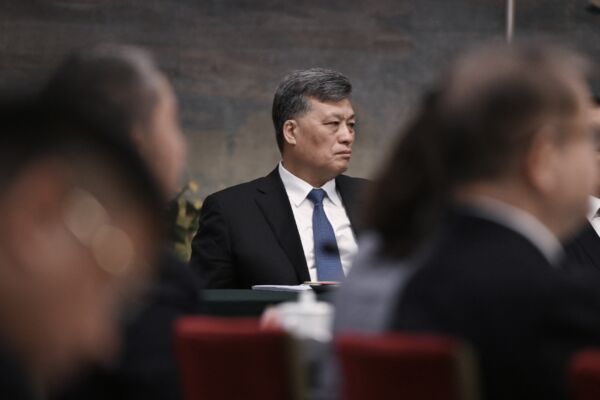
Xi Jinping’s confidant, member of the CCP Politburo and former Party Secretary of Xinjiang Uyghur Autonomous Region, Ma Xingrui, has been “missing” for some time. Some speculate that a “big tiger” has surfaced in the anti-corruption campaign of the CCP in 2026, and this “big tiger” may be Ma Xingrui.
Judging from the current situation, Ma Xingrui’s political career has come to an end, and he has become a “lame duck”. The reason why the CCP has not announced anything publicly yet is due to their own considerations.
So, how will the CCP handle Ma Xingrui? According to public reports regarding Ma Xingrui since July 2025, the CCP’s handling of Ma Xingrui may be divided into a “three-act play”.
On July 1 last year, Xinhua News Agency reported that the CPC Central Committee recently decided that Ma Xingrui would no longer hold the positions of Party Secretary, Standing Committee member, and Committee member of the Xinjiang Uygur Autonomous Region, and would be appointed elsewhere. His duties were taken over by Chen Xiaojiang.
On the surface, this report seems to be a normal personnel change. Because after Ma Xingrui was removed as the Secretary of Xinjiang, it was mentioned that there would be “another appointment”. In the CCP’s language, when “another appointment” is added after a personnel change, usually that official will not be investigated immediately or placed in a meaningless position.
Upon returning to Beijing, Ma Xingrui made appearances at some significant CCP events, such as Xi’s military parade, where he was seen on Tiananmen Square.
However, the CCP has not officially announced what position Ma Xingrui’s new appointment is. There have been no reports from CCP state media about Ma Xingrui appearing in a new role.
What does this indicate? Ma Xingrui being removed as the Xinjiang Secretary definitely implies something was amiss. It is highly likely that the Central Commission for Discipline Inspection has preliminary evidence of Ma Xingrui’s disciplinary violations.
Before an official investigation is conducted on a centrally managed cadre by the CCP’s disciplinary body, there is typically a preliminary verification process, where reports, petitions, and clues obtained from inspections are initially verified secretly.
Officially, the CCP requires party members and leaders to “confess” and accept investigation at the “specified time and place”.
Based on reports in CCP state media, from late November 2025 to the present, Ma Xingrui has been absent from a series of important events, including the CCP Politburo collective study on November 28, the Central Economic Work Conference from December 10 to 11, and the CCP Politburo democratic life meeting from December 25 to 26.
On December 14, during the farewell ceremony for former State Councilor and Finance Minister Wang Bingqian, as a member of the CCP Politburo, Ma Xingrui did not send a wreath; and on December 26, during the farewell ceremony for former State Councilor and Vice-Chairman of the National People’s Congress Peng Peiyun, Ma Xingrui also did not present a wreath.
These circumstances indicate that Ma Xingrui was likely subjected to a “double regulation” by the Central Commission for Discipline Inspection before November 28, 2025.
Many major events in both domestic and foreign affairs under the CCP’s control are carefully manipulated according to political needs, including when to officially announce the downfall of high-ranking officials.
For instance, Zhou Yongkang, former CCP Politburo Standing Committee member and Secretary of the Central Political and Legal Affairs Commission, was reportedly taken away for investigation by the Central Commission for Discipline Inspection on December 5, 2013. However, the CCP did not officially announce it until July 29, 2014.
Li Shangfu, former member of the Central Military Commission, State Councilor, and Minister of National Defense, was placed under investigation by the Disciplinary Commission on August 31, 2023. Wei Fenghe, former member of the Central Military Commission, State Councilor, and Minister of National Defense, was placed under investigation on September 21, 2023. But it was not until the eve of the Fourth Plenary Session of the Twentieth Central Committee of the CCP on June 27, 2024, that the news of Li Shangfu and Wei Fenghe’s investigations was officially announced.
According to overseas revelations, former CCP Politburo Standing Committee member and Vice Chairman of the Central Military Commission, He Weidong, was taken away by the Military Commission for investigation when he returned to the Bayi Building after attending the closing session of the National People’s Congress on March 11, 2025. However, the CCP did not announce it promptly, but waited until the eve of the Fourth Plenary Session of the Twentieth Central Committee on October 17 to officially announce it.
In reality, Ma Xingrui has already fallen from grace and is under investigation. However, the CCP will choose an appropriate time to officially announce it.
On which day exactly will the CCP make the announcement? I won’t speculate. In any case, when Ma Xingrui’s downfall is officially announced, the CCP has its calculations.
Why does the CCP choose a “three-act play” for Ma Xingrui’s downfall? I believe there may be three possible reasons:
Since coming to power in 2012, Xi has promoted and utilized a group of senior military officials, including Ma Xingrui, Yuan Jiajun, and Zhang Guoqing. Ma Xingrui, known as the “young marshal of the aerospace industry,” is Xi’s top military confidant.
Ma Xingrui is the first Ph.D. graduate in general mechanics from Harbin Institute of Technology, the youngest doctoral supervisor at HIT, and has held positions such as Vice President of HIT. In 1996, he was transferred to the Fifth Academy of China Aerospace Corporation (China Academy of Space Technology); since 1999, he has served as Deputy General Manager and General Manager of China Aerospace Science and Technology Group.
In March 2013, Xi appointed Ma Xingrui as Deputy Minister of Industry and Information Technology, Director of the National Space Administration, Director of the National Atomic Energy Authority, and Director of the National Defense Technology Industry Bureau. In November 2013, Xi transferred Ma Xingrui to Guangdong, where he successively held positions such as Deputy Secretary of the Guangdong Provincial Party Committee, Secretary of the Political and Legal Committee, Party Secretary of Shenzhen, Deputy Governor, Acting Governor, and Governor of Guangdong Province. In December 2021, Xi transferred Ma Xingrui to be the Party Secretary of Xinjiang Uygur Autonomous Region. In October 2022, Xi promoted and utilized Ma Xingrui by appointing him as a member of the CCP Politburo of the Twentieth Central Committee.
From 2013 to 2022, in just 9 years, Ma Xingrui received exceptional favor from Xi: not only did he have work experience with central state organs, but also in developed areas along the southeastern coast and as a governor of a frontier region in the northwest, becoming one of the deputy national-level party and state leaders.
If nothing unexpected happens, Ma Xingrui may become a candidate for the CCP Politburo Standing Committee at the Twentieth National Congress.
Why does Xi value Ma Xingrui so much?
There may be four reasons. Firstly, Ma Xingrui is a well-known aerospace expert. Secondly, Ma Xingrui and Xi’s wife, Peng Liyuan, are fellow townspeople from Yuncheng, Shandong. Ma Xingrui had business connections with Xuhingjian, Peng Liyuan’s brother-in-law, while in Guangdong. Thirdly, in Guangdong, Ma Xingrui potentially helped Xi’s older sister, Xi Qiaoqiao, and her husband, Deng Jiagui, with their businesses. Fourthly, Ma Xingrui’s wife, Rong Li, is a close friend of Peng Liyuan, and according to overseas revelations, Rong Li has been involved in benefiting Peng Liyuan.
The Financial Times reported that Ma Xingrui and Xi’s wife, Peng Liyuan, have family ties. Before Xi came to power, he frequently visited Ma’s home and was a high-ranking official who was closest to Xi.
Considering Xi is still the top leader of the CCP, and given the broad scope and high level of Ma Xingrui’s case, the CCP authorities may believe that it is better to handle Ma Xingrui’s issue through several steps rather than all at once.
On October 17, 2025, the Ministry of National Defense of the CCP announced the expulsion from the party and military, and referral for judicial trial, of nine generals.
These included: He Weidong, a member of the CCP Politburo and Vice Chairman of the Central Military Commission; Miao Hua, former member of the Central Military Commission and Director of the Political Work Department of the Military Commission; He Hongjun, former Executive Deputy Director of the Political Work Department of the Military Commission; Wang Xiubin, former Deputy Director of the Joint Operations Command Center of the Military Commission; Lin Xiangyang, former Commander of the Eastern Theater Command; Qin Shutong, former Political Commissar of the Army; Yuan Huazhi, former Political Commissar of the Navy; Wang Houbin, former Commander of the Rocket Army; Wang Chunning, former Commander of the Armed Police Force.
On December 27, 2025, the Standing Committee of the National People’s Congress announced that Wang Renhua, former Director of the Political and Legal Committee of the Central Military Commission, and Zhang Hongbing, former Political Commissar of the Armed Police Force, had their qualifications as national legislators suspended. This was because they were respectively removed from their positions as national legislators by the military’s political departments.
In 2025, at least 21 other generals were “missing”, including: Xu Xueqiang, Minister of Equipment Development of the Military Commission; Xu Qiling, Deputy Chief of Staff of the Joint Staff Department of the Military Commission; Chang Dingqiu, Commander of the Air Force; Guo Puxiao, Political Commissar of the Air Force; Ma Xiaotian, former Commander of the Air Force; Han Weiguo, Commander of the Army; Li Qiaoming, Commander of the Army; Chen Hui, Political Commissar of the Army; Hu Zhongming, Commander of the Navy; Xu Xisheng, Political Commissar of the Rocket Force; Xu Zhongbo, former Political Commissar of the Rocket Force; Li Wei, Political Commissar of the Information Support Force; Liu Qingsong, Political Commissar of the Eastern Theater Command; Wang Haijiang, Commander of the Western Theater Command; Li Fengbiao, Political Commissar of the Western Theater Command; Wu Yanan, Commander of the Southern Theater Command; Wang Wenquan, Political Commissar of the Southern Theater Command; Huang Ming, Commander of the Northern Theater Command; Wang Qiang, former Commander of the Central Theater Command; Xu Deqing, Political Commissar of the Central Theater Command; Xiao Tianliang, President of the National Defense University. According to overseas revelations, most of these “missing” generals are under investigation by the disciplinary committee, with a few being dismissed from their positions.
Three “big secrets” of the military that Xi has appointed since coming to power — Qin Shengxiang, Zhong Shaojun, and Fang Yongxiang — are rumored to have run into trouble.
In 2025, so many high-ranking military officials have “run into trouble”, which is unprecedented and has a significant impact on officials and the public.
The CCP authorities may consider that too many high-ranking military leaders have encountered trouble in 2025, and adding one more CCP Politburo member, Ma Xingrui, to the mix may look bad for both officials and the public. Delaying the announcement of Ma Xingrui’s downfall until 2026 may be more appropriate.
In 2025, the official website of the Central Commission for Discipline Inspection announced that 65 centrally managed cadres were under investigation, the vast majority of whom were provincial and ministerial-level officials, with a few being bureau-level officials appointed by the CCP Central Committee. This is the highest number of centrally managed cadres investigated in a single year since the Eighteenth National Congress of the CCP.
As early as December 2018, Xi declared at a meeting of the CCP Politburo that the “fight against corruption has achieved overwhelming victory.” In January 2021, Xi stated at the Fifth Plenary Session of the Nineteenth Central Commission for Discipline Inspection that the “fight against corruption has achieved overwhelming victory and has been fully consolidated.”
According to Xi’s statements, the “overwhelming victory” in the fight against corruption by the CCP has now been ongoing for 8 years; the “overwhelming victory and full consolidation” has been ongoing for 6 years. Therefore, logically, the number of corrupt individuals should decrease as the fight against corruption progresses. However, the reality is that the number of corrupt individuals has only increased.
The CCP authorities may believe that the record-breaking number of centrally managed cadres under investigation in 2025, and the downfall of CCP Politburo member He Weidong, would make adding one more CCP Politburo member, Ma Xingrui, seem unfavorable from a public relations standpoint. Delaying the announcement of Ma Xingrui’s downfall until 2026 may be more suitable.
The CCP’s fight against corruption has now reached a point where it can no longer be rationalized: sometimes boasting of an “overwhelming victory” and full “consolidation” of the fight against corruption, and other times engaging in a major political struggle that must not be lost. On one hand, the CCP talks extensively about “self-revolution”; on the other hand, not a single leader has made a self-criticism or taken responsibility for party discipline, political discipline, and legal accountability for all the severely corrupt individuals who were “promoted despite illness” from the Central Organization Department to the Central Commission for Discipline Inspection to the CCP Central Committee.
What is even more ridiculous is that the majority of these provincial, ministerial, and military officials being investigated for corruption were personally promoted and favored by Xi Jinping. Xi bears the primary leadership responsibility for promoting these severely corrupt individuals. However, from the central level to the local level, not a single official has legally pursued Xi’s leadership responsibility, but instead loudly proclaims to be “loyal,” “supportive,” “defending,” and “upholding” the core of Xi.
Xi is the primary individual responsible for the corruption within the CCP. Faced with such a grim reality where so many party, government, and military officials personally promoted by Xi have turned out to be severely corrupt, any person with a conscience and common sense would question: why should I be “loyal,” “supportive,” “defending,” and “upholding” Xi’s core?
The CCP’s fight against corruption has reached a point where “loyalty” is no longer worth a cent. Xi’s confidant Ma Xingrui has been taken down, what will happen next?
Epoch Times Original