
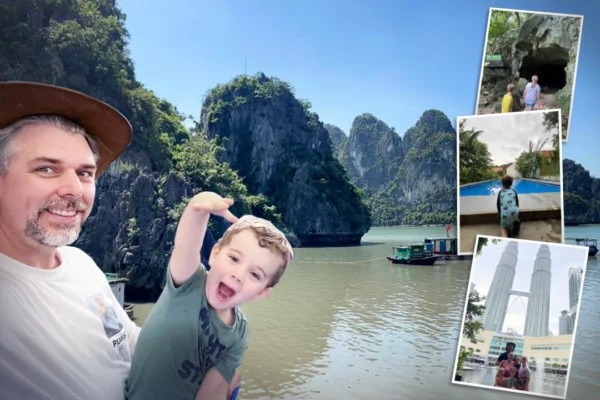
Luxury summer vacations typically involve tropical cruises, leisurely pool days, and white sandy beaches in Bali. But beyond being holiday destinations, these places have become classrooms, serving families like the Mumfords from Australia who are embracing a new educational movement: worldschooling.
Nicky and Brad Mumford embarked on a Southeast Asia tour last fall, visiting Vietnam, Malaysia, and Bali, with future plans including Japan. This trend started around 2000, initially seen as a “counter-culture” movement but has rapidly become mainstream post-pandemic. Worldschooling is an extension of unschooling, which in turn is an extension of homeschooling, focusing on experiential learning through global travel.
Every morning at 7 a.m., the Mumford family and their four children – 12-year-old Hannah, 8-year-old Madelyn, 6-year-old Ari, and 4-year-old Micah – start a new day in a foreign land rich with history. After breakfast in their hotel room, the children have math and English lessons with their mother – two of each daily being the standard – while their father heads downstairs to a café with his laptop to handle business. He runs a worldschooling center to meet the growing needs of global homeschooling parents.
Brad Mumford, a 40-year-old from Adelaide, South Australia, previously a bricklayer turned travel agent, has been organizing what he calls “worldschooling camps,” curating luxurious trips for homeschooling families like theirs.
“We’re going on a cruise from Brisbane in February,” he told The Epoch Times regarding their 2026 trip to the Great Barrier Reef. “We have a group going to Egypt, another to Japan, Borneo, Australia, New Zealand.”
Once or twice a week, this family concludes their classroom learning with an adventure. It could be a visit to an ancient Buddhist temple near Kuala Lumpur, a national museum, or Halong Bay in Vietnam. Their Southeast Asia adventures also involve trying new foods; they discovered pepper seasoning everywhere, minimal dairy, and Nicky fell in love with a Vietnamese dish, pho.
All these adventures stemmed from the pandemic. Post-2020, the couple became increasingly concerned about their children’s well-being.
“More and more children are being diagnosed with mental health issues in schools – anxiety, depression, and suicide,” Mumford said. He added that during the COVID crisis, while teachers were pushed to their limits, parents who volunteered in classrooms, including the Mumfords, were “demonized.”
He also noted that pulling their children out of public school wasn’t a difficult decision, especially as Madelyn had life-threatening developmental problems from birth. They also aimed to create a “safe bubble” to shield their Christian values from the influence of a “woke agenda.”
“We’re returning to the foundations of family values and unity because we felt like we were living segregated lives,” Mumford said. “It wasn’t a decision on whether to homeschool, it was a decision to flip the switch on our lives.”
The initial plan was to take the children on a two-year tour of Australia. “I quit my job, gave up a steady income, and we sold everything and moved into a camper van,” he said. Homeschooling became their only sensible choice for their nomadic departure.
After a year of travel in Victoria, they pondered a new possibility: “If we can do this in a camper van, what’s stopping us from doing this globally?” Mumford said.
While leasing their house in Adelaide, they realized they could live comfortably and cost-effectively in hotels and apartments across Southeast Asia. With a growing number of homeschooling centers worldwide, they saw another opportunity. Could this turn into a business? Could they become a center themselves and also double as travel agents?
“We started by seeing if homeschooling families would be interested,” Mumford said, adding that they “wanted to share the passion for travel with other families.” With the rise of remote work and homeschooling post-pandemic, the response was overwhelmingly positive. Whether digital nomads like them or families traveling the world, the Mumfords tailor trips to suit all.
“Homeschoolers from all over the world want to join us,” he said.
Mumford admitted he once thought homeschoolers were “weird outliers,” but now he says, “It’s almost become weird if you go to school.” Despite occasional feelings of isolation, he mentioned that the increasing popularity of homeschooling is creating social opportunities – chances to forge friendships with other homeschooling families, to have barbecues, ice skating, and park picnics.
So far, this educational approach has been greatly beneficial. However, the curriculum isn’t always smooth; the real world can be harsh at times. While visiting the Batu Caves temple in Malaysia, the family confronted sculptures depicting torture in Buddhist hell scenes. Ari was frightened and cried. In Ho Chi Minh City, they learned that Vietnam refers to the Vietnam War as the “Anti-American War.”
But they also witnessed how this war-torn country had successfully recovered. Mumford said they are learning about human resilience.
He acknowledges that this family journey isn’t always comfortable, but he wouldn’t change it for anything.
“If we’re going to grow, as a community, as a family, we have to step outside our comfort zones,” he said. “I would say, my only regret is that we didn’t do something like this as a family sooner because it’s truly worth it.”
Once an overworked father who could only watch from the sidelines, Mumford is now a full-time teacher, playing a leading role in his children’s lives without any regrets.
“As a father, I was inadequate,” he said, referring to life before worldschooling. “It’s not about whether your children get a higher education or attend traditional schools, it’s about: Are mom and dad always there for them?”
The original article, titled “Circuit Breaker for Our Lives,” was published on the English Epoch Times website.