
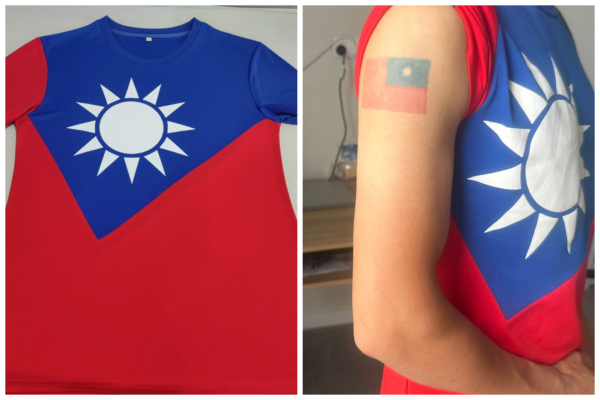
Items containing elements of the Republic of China (ROC) are becoming increasingly sensitive in mainland China. While the ROC style has a long history in mainland China, recent cases indicate that items featuring ROC elements may be classified as contraband.
Recently, 470 T-shirts with the Sun Yat-sen flag ready for printing were seized in mainland China. Ou Ronggui, one of the early initiators of the Southern Street Movement, told a reporter from The Epoch Times that he started mass-producing ROC flag T-shirts over a decade ago, which were very popular among the public and well-received in mainland China. He personally didn’t encounter any issues with this, but some individuals wearing the T-shirts were occasionally arrested, with authorities handling the situation discreetly.
Each time someone wears a Sun Yat-sen flag T-shirt, it’s equivalent to staging a movement on the streets, he said.
Ou Ronggui was active in the early days of the Guangzhou street movement and was arrested multiple times. In 2016, he was sentenced to one year in prison for participating in a demolition and rights protection case in Zhongshan County, Guangxi. Every June 4th, he faced harassment from national security agents, and in May 2020, traffic police even tried to confiscate his truck to force him out of Guangzhou. He arrived in New Zealand in March 2023.
He stated that inside China, he was very cautious, and the distribution of ROC flag T-shirts was carried out through mailing methods. “The clothes were stored at a friend’s place, and when the friend went to mail them, I acted as the sender, so he was not held responsible. People who wanted the clothes only needed to provide a courier station, with me as the recipient, and the two parties never contacted each other directly. The national security agents knew it was me behind it, but taking action against me for this issue would cause more negative consequences. I have observed that no one has been sentenced for wearing these clothes,” he explained.
In September-October of last year, after purchasing fabric online, he arranged for production with a manufacturer in China. However, after making a sample, the factory suddenly deemed the clothing too sensitive and decided not to proceed. Ou Ronggui had someone transport the fabric to a friend’s place. A few days later, he contacted another clothing factory, and the clothes were swiftly produced. On October 24, the clothes were sent for printing, but unfortunately, his friend encountered trouble, leading to the batch being confiscated.
According to Ou Ronggui’s introduction and WeChat conversation records, on October 24th, when he contacted his friend, the friend suddenly said: “You’ve been betrayed. Someone has been watching what you’re doing. My friend went to the police station in Luxi early in the morning, and they plan to ‘have a chat’ in the afternoon.”
Realizing that there was a problem, Ou Ronggui immediately contacted the printing factory, claiming a mistake and requesting to retrieve the goods. The factory mentioned that the goods were locked in the warehouse and inaccessible, as the colleague with the keys was coming from his hometown in a few days. It wasn’t until October 26th that they clearly informed him: “There is an issue with this batch of goods, you know what it is, and it has been confiscated by the relevant department.”
After repeatedly probing for details on the department responsible, Ou Ronggui was provided with the phone number of Luo, the person in charge of the industrial park. Records of conversations between Ou Ronggui and Mr. Luo show that the management office demanded Ou Ronggui provide an overseas consignee and address. Otherwise, the goods owner must personally come to handle the matter within a month, or the goods would be destroyed after New Year’s Day, citing concerns over storing prohibited items for extended periods.
On December 4th, Mr. Luo brought the goods to a logistics company but then took them away citing the absence of an order.
“Yesterday (December 31, 2025), I had three delivery personnel bring the goods to the management office, but they were all sent away by Luo. He wants an agent to handle the operation, creating an international logistics order for him. In my understanding, the goods belong to me, you just give them to me, don’t mix up the goods owner, that would be fine,” Ou Ronggui mentioned.
He believes that Luo is the third party, with someone instructing him from the shadows, likely being directed by national security agents, aiming to suppress the matter at minimal cost. Ou Ronggui pointed out that despite government authorities confiscating the goods, they had not issued any seizure orders. Their approach was cunning, aiming for a discreet resolution, but it actually escalated the situation.
The nationalism in mainland China has deep historical roots. Since the 2008 implementation of the “Three Links” policy between the two sides of the Taiwan Strait, facilitating trade, mail, and transportation, the mainland-to-Taiwan logistics remained smooth. However, it’s understood that inspections for imports from Taiwan to the mainland are very strict, involving customs duties. For instance, printed materials are viewed as potentially cultural invasions, and religious texts are controlled.
In August 2019, mainland China suspended independent travel to Taiwan. It was not until 2024 that authorities partially announced the resumption of Fuzhou residents traveling to Matsu and Kinmen islands. Pilot cities for traveling to Taiwan like Shanghai have not yet seen the implementation.
Since then-House Speaker Nancy Pelosi’s visit to Taiwan in 2022, the Chinese Communist Party (CCP) has increased military intimidation towards Taiwan. At the end of last year (December 29-30, 2025), the CCP conducted live-fire exercises around Taiwan, drawing international attention and condemnation.
“The tension between the two sides is escalating,” Ou Ronggui remarked, expressing concerns about Taiwan facing the looming presence of the CCP. “I always believed that the mainland emerged from the ROC. The CCP is essentially a proxy for the Soviet Union, which carved out the mainland and relocated the ROC to Taiwan. I recognize the ROC, while the Communist Party erases the history of World War II, including distorting the history of the Anti-Japanese War.”
Ou Ronggui even has an ROC flag tattooed on his right arm.
The ROC flag consists of blue, white, and red colors, symbolizing the spirits of freedom, equality, and benevolence, as well as the Three Principles of the People: nationalism, democracy, and livelihood. Along with the colors’ shapes, the blue sky represents the noble character and ambition of the Chinese nation, while the white sun symbolizes integrity, selflessness, and pure thoughts; and the twelve rays of light signify the virtues inherited from Chinese culture.
He explained that the design of his clothes was based on the styles commonly found in Taiwan, with various versions available, and this was the most classic one. The batch of clothes was of high quality, costing approximately 20,000 RMB with additional expenses.
After going abroad, he could continue producing them online by promoting them throughout mainland China via methods like “Meituan Run Errands”, effectively propagating the ROC symbols and patterns. By integrating ROC elements into society through clothing as a form of movement, he could create a widespread movement among the public, where the CCP would be powerless to intervene.
In June 2013, two students wearing school uniforms in Zhuhai displayed the ROC flag under the school flagpole. Images circulated online showed the removal of the five-star red flag from the pole, preparing to raise the Sun Yat-sen flag. At that time, the two students were taken away by government officials.
In May 2015, mainland youth Fan Zhenyi raised the ROC Sun Yat-sen flag on Mount Baota in Yan’an, Shaanxi, taking a picture and sharing it on Weibo, attracting onlookers. Subsequently, Fan Zhenyi was detained.
“We were very close friends. He was arrested that night, detained for over twenty days. He said he was not only detained but also physically abused for over twenty days. We didn’t have much contact after that,” Ou Ronggui observed, noting the significance of the incident. Fan Zhenyi was initially charged with subverting state power and inciting trouble, then the charges were changed to public order detention. He was released in less than a month without facing criminal prosecution.
Ou Ronggui believes that the administrative resources of the CCP are limited, so when many people wear ROC flag T-shirts, the authorities have difficulty handling it or bringing charges, as doing so would not be advantageous for them publicly.
“I want to turn this clothing into a grassroots movement in mainland China by distributing millions of them to ordinary people in a short period,” he expressed.