
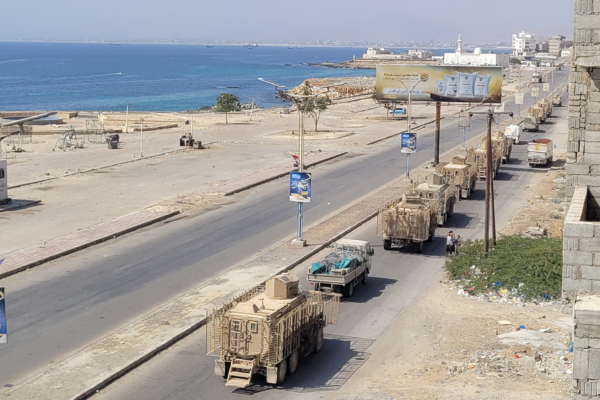
On Friday, January 2, the United Arab Emirates-backed separatist group in Yemen, the Southern Transitional Council (STC), announced a constitution claiming to establish the “State of South Arabia” and calling it the “declaration of independence” for the south.
This move has escalated tensions between Saudi Arabia and the UAE, and puts the coalition formed to combat the Houthi rebels at risk of collapsing.
In response, Saudi warplanes bombed STC military camps and positions in the Hadramout province, as Saudi-backed forces attempted to seize these facilities.
STC spokesperson Mohamed al-Nakib stated that the airstrikes caused casualties, and mentioned that intense clashes broke out between STC and the Saudi-backed National Shield Forces in various areas of Hadramout.
It is currently unclear whether the Saudi-backed forces have successfully regained control of these camps.
As the military conflict intensifies, the regional situation is rapidly evolving. The UAE announced early Saturday morning that all their troops had been completely withdrawn from Yemen. The statement did not provide details on the number of troops and equipment withdrawn, but several UAE military cargo planes were observed flying to and from Yemen in recent days.
“The UAE forces are carrying out the previously announced decision to conclude their remaining mission as part of the anti-terrorism forces,” the UAE Ministry of Defense stated. “The process is being conducted in a manner that ensures the safety of all personnel and is coordinated with all relevant partners.”
In a separate statement, the Saudi Ministry of Foreign Affairs called on all southern Yemeni factions to convene in Riyadh to discuss a “fair solution to the southern question”.
STC chairman Aidarous al-Zubaid announced the 30-article constitution in a video statement, declaring the establishment of the “State of South Arabia”, with territory identical to the independent southern country, the People’s Democratic Republic of Yemen, which existed from 1967 to 1990.
Zubaid stated that the constitution would be implemented for two years, followed by a referendum to “exercise the self-determination of the southern people”. He also warned that if other factions did not agree with his call or took military action against STC, then “all options are possible.”
The Yemeni civil war erupted in 2014, plunging the already impoverished country into years of deadly violence and severe famine crisis.
Initially, the Houthi organization, backed by Iran, seized most of northern Yemen (including the capital Sanaa), leading to the government losing control. In 2015, the conflict escalated, with a coalition of Arab countries including Saudi Arabia and the UAE launching military operations to restore government control.
In recent years, ceasefire agreements have reduced the intensity of the conflict with the Houthis, and the frontlines have somewhat stabilized.
However, the Saudi-backed ruling coalition, the Presidential Leadership Council (PLC), has shown signs of division. The committee, established in 2022, aimed to unite various anti-Houthi factions.
At the same time, the vast majority of southern Yemen has been under the control of the UAE-supported separatist organization STC. Currently, STC remains nominally part of this coalition.
In December last year, STC forces launched a large-scale offensive, swiftly seizing eastern territories including the oil-rich Hadramout province. The Saudi-led coalition demanded STC troops withdraw from their occupied provinces of Hadramout and Mahra, but STC refused to hand over their weapons and camps.
Despite the UAE’s withdrawal of troops, experts believe this does not signify an end to their support for STC. Chatham House researcher Farea al-Muslimi told the BBC that the UAE has had minimal troops in Yemen since 2019, relying mainly on special forces and local “proxy networks” to operate.
Muslimi also remarked, “(STC leader) Zubaidi has been the most consistent and staunch advocate for southern independence within Yemen. So, no, I don’t think he will give up.”
STC spokesperson Anwar al-Tamimi confirmed their intentions in an interview with the BBC.
“Our intention has been clear for years, which is to establish an independent state. We have not attempted to deceive anyone,” he said. “The southern people have the right to choose their own destiny. Unfortunately, many in the region are trying to obstruct us.”
Tamimi denied that independence would threaten Saudi national security, stating, “We will bring stability and not become a source of terrorism threatening them.”
This conflict is viewed as a proxy war between Saudi Arabia and the UAE. Muslimi believes that “the UAE and Saudi Arabia cannot and will not agree in Yemen” due to their “very different logics” in the region.
He pointed out the fundamental geographical differences between the two countries; Saudi Arabia shares a 1,500 km border with Yemen while the UAE does not border it. He added, “Both countries are wealthy and powerful, possessing a large amount of weapons, which is very concerning for the entire region.”