
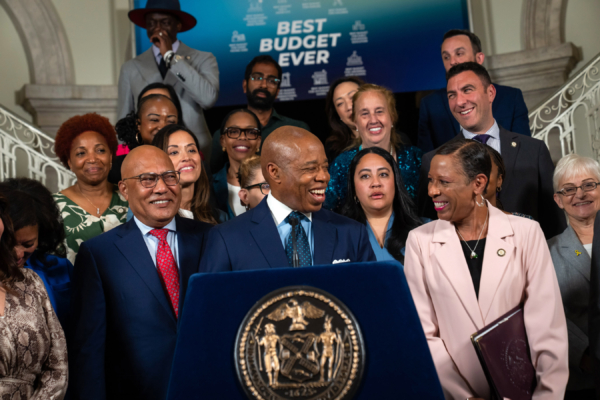
Former New York City Mayor Eric Adams utilized his mayoral powers on his last day in office on December 31 to veto a total of 19 proposals recently passed by the city council. Among them were the 276th bill concerning the rights of Uber and other ride-hail drivers, known as the “Just Cause Termination Law,” and the “Community Opportunity to Purchase Act” (COPA), which had been a source of discontent among Chinese homeowners.
Former City Council Speaker Adrienne Adams also condemned Adams on her final day in office. “The mayor once again showed, as his term ends, that protecting and supporting the working class of New York City is not his top priority, which is not surprising,” Adams, who had a strained relationship with the mayor, stated in a press release. “His veto places special interests above the housing affordability and development opportunities as well as public safety of hardworking New York City residents.”
Mr. Lin, a Chinese homeowner, commented, “As expected, Adams would not sign the COPA bill.”
According to city council news, the vetoed bills included: 902-B, the COPA bill initiated by Councilwoman Sandy Nurse, which prioritizes eligible non-profit organizations or joint ventures involving eligible non-profit organizations in submitting bids to purchase certain residential properties before the owners plan to sell them. On December 18, Republican State Senator Chen Xueli and Assemblyman Zheng Yongjia protested against this bill in front of the city council.
Other vetoed bills included Proposal 276-A introduced by Councilman Shekar Krishnan, which prohibits companies like Uber and Lyft from deactivating drivers’ apps unless there are justifiable reasons, genuine economic considerations, or legal requirements.
Proposal 431-B by Councilwoman Pierina Sanchez aimed to expand the scope of operating licenses for food and general vendors. It would provide an additional 2,200 regulatory permit application spots annually for potential mobile food vendors from 2026 to 2031 and release 10,500 new regulatory permit application spots in 2027.
Proposal 1412-A, also known as the “Safer Sanctuary Act,” initiated by Councilwoman Tiffany Cabán, prohibits federal immigration authorities from establishing offices on lands under the jurisdiction of the New York City Department of Corrections (DOC). The proposal also revises New York City’s sanctuary laws to align with current federal immigration enforcement practices.
Proposal 958-A initiated by Council Speaker Adams would nearly double the purchasing opportunities for government-sponsored affordable housing, requiring at least 4% of all newly constructed affordable housing to be for resident ownership.
Proposal 1433-A by Councilman Eric Dinowitz mandates that starting from July 1, 2027, at least 25% of government-sponsored leased affordable housing be two-bedroom units, and 15% be three-bedroom units.
Proposal 1443-A by Councilwoman Nurse stipulates that starting from July 1, 2027, 50% of newly constructed government-sponsored rental housing must be affordable for low-income families, with at least 30% being affordable for very low-income families.
Adams stated in a release that he vetoed these bills because they “directly contradict his goal of elevating the status of the New York City working class.”
“These bills exacerbate our affordable housing crisis with new, unfunded mandates and red tape; an untested street vendor permit process will harm our small businesses; existing institutions perfectly capable of the job will have to establish new bureaucratic processes, and these bills also violate state government laws regarding labor and enforcement systems,” Adams expressed in a media statement. “My team has worked diligently and sincerely with the city council to seek consensus on shared priorities, but the council has once again shown they are unwilling to make any concessions on their reckless legislation.”
Whether the city council can overturn the former mayor’s vetoes will depend on the determination of the new council speaker, Julie Menin. Menin criticized these veto actions to the media on December 31.
“The Adams administration not only failed to collaborate with the city council but often sidelined the legislative process,” she stated in a release. “The council will consider how to address these vetoes.”