
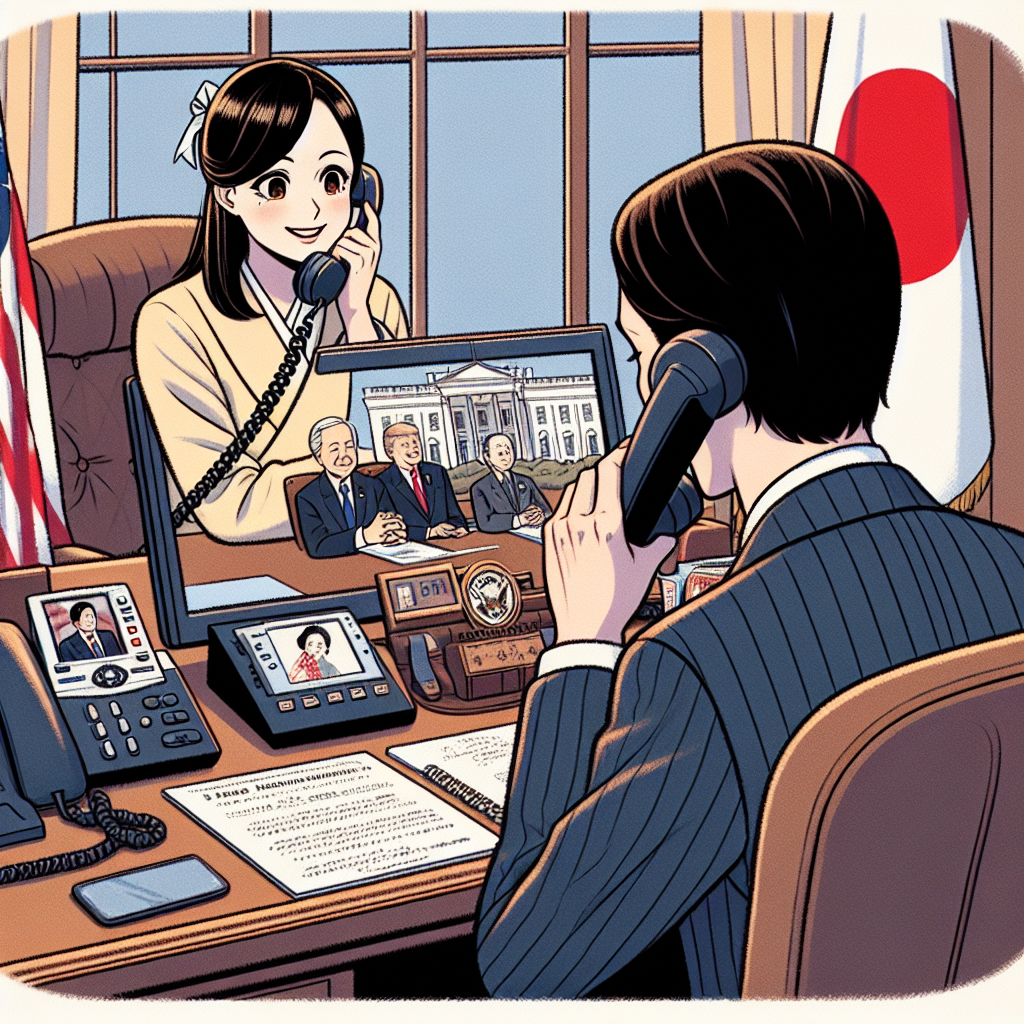
Japan’s Prime Minister, Sanae Takai, had a phone call with US President Trump on Friday, January 2nd, and revealed that she will visit the United States this spring. During the call, Takai congratulated President Trump on the 250th anniversary of the founding of the United States and discussed issues concerning the Japan-US alliance.
Takai stated, “On this significant anniversary, President Trump and I both agreed that this year should mark the beginning of a new chapter in the Japan-US alliance, further deepening friendly relations, and expanding cooperation in various fields such as economy and security.”
She added, “President Trump extended an invitation for me to visit the United States again, and we agreed to make concrete arrangements for my visit this spring.”
This marks the first call of the year 2026 between President Trump and Takai, with their previous conversation in late November 2025. President Trump shared details of his conversation with Chinese leader Xi Jinping and the latest developments in US-China relations during that call.
When asked whether they discussed the large-scale military exercises conducted by Beijing near Taiwan earlier in the week, Takai did not give a clear response, only stating that she and Trump “exchanged views on the Indo-Pacific region and confirmed close coordination in the current international situation.”
The Prime Minister of Japan expressed that both sides “reiterated their commitment to cooperation with like-minded countries, including trilateral relations between Japan, the US, and South Korea, while actively promoting cooperation to build a free and open Indo-Pacific region.”
China recently concluded a two-day military exercise in 2025, which saw the firing of 27 rockets towards Taiwan, with 10 landing within 24 nautical miles (44 kilometers) of Taiwan’s contiguous zone. This was the closest Beijing has conducted live-fire exercises to Taiwan to date.
China considers Taiwan as part of its territory and has vowed to unify the island, even if it means using force. However, China has never ruled Taiwan before.
This also marked the first military exercise targeting Taiwan since Takai took office and tensions escalated in Sino-Japanese relations. In November 2025, Takai publicly stated that if Beijing were to attack Taiwan and U.S. forces defending the island, it would pose a “survival threat to Japan,” and Japan would invoke its right to collective self-defense to order Self-Defense Forces to protect the U.S. troops stationed in Taiwan.
Following this statement, the Chinese Foreign Ministry demanded the Japanese Prime Minister retract her remarks and took a series of actions escalating tensions. The Takai government refused to back down, stating that these remarks did not signify a shift in Tokyo’s policies. The Prime Minister mentioned that the door for dialogue remains open, but experts pointed out that a dangerous new balance was forming between the two countries.
On Thursday, January 1st, the United States urged Beijing to cease its military pressure on Taiwan. State Department spokesperson Thomas Pigott stated in a release: “Beijing’s military activities and rhetoric directed at Taiwan and other countries in the region unnecessarily escalate tensions. We urge Beijing to exercise restraint, halt military pressure on Taiwan, and engage in meaningful dialogue.”
This marks the first public response by the Trump administration regarding these military exercises.
Bloomberg noted that from a broader perspective, China’s recent military exercises serve as a test of Trump’s support for Taiwan. In December 2025, the U.S. approved a $11 billion arms sale to Taiwan, angering Beijing. Analysts pointed out that China is trying to stabilize relations with the U.S. while also signaling to the U.S. that the Taiwan issue is a red line that cannot be crossed.
The call between Trump and Takai comes as Japan accelerates its investment plan in the United States. Japan plans to invest $55 billion in the U.S. as part of a broader trade agreement to lower tariffs. The final approval of this investment will be decided by President Trump based on recommendations from relevant committees.